L
O
A
D
I
N
G


Zoho, Odoo, ERPNext, Dynamics 365 and custom ERP, delivered by one accountable team.

Training institutes live on enquiries, batches and repeat corporate business. We set up ERP that turns a WhatsApp enquiry into an enrolled learner, a scheduled trainer and a paid invoice.
A UAE training institute should use an ERP that captures enquiries from web forms, social ads and WhatsApp, manages a course catalogue with batches, venues and seat limits, handles individual instalment plans and corporate LPO billing, and calculates trainer hours and payouts. Zoho, Odoo and ERPNext can all cover this cycle from first enquiry to certificate release.
ERP for training institutes in the UAE needs to start at the front door. A training center in Al Barsha, Abu Dhabi's Electra Street or Sharjah's Al Majaz area might run IELTS preparation, accounting certifications, project management exam prep, safety courses, Arabic lessons and corporate workshops, all at once. Revenue depends on how quickly counselors respond to enquiries from Instagram, Google and WhatsApp, how full each batch gets, and how many corporate clients come back with the next purchase order.
Behind the sales effort sits a scheduling and finance puzzle: classrooms and online sessions, in-house and freelance trainers paid per hour or per batch, exam vouchers bought from awarding bodies, installment plans for individuals, LPOs and credit terms for companies, and certificates that must only be issued once attendance and payment conditions are met. When these live in separate spreadsheets, batches start half full and trainers get paid late.
We implement training institute operations on Zoho, Odoo, ERPNext and Dynamics 365. Zoho CRM and Odoo CRM work well for the enquiry side, while the ERP handles batches, billing, trainer costs and accounting. Licensed schools have different needs, covered on our ERP for schools page.

Owners and operations managers usually describe some version of these issues.
Enquiries arrive through ads, calls, walk-ins and WhatsApp and are logged in different places. Follow-ups slip and counselors cannot see who already spoke to a prospect.
A batch is confirmed with too few learners to cover trainer fees, venue and materials. Without a cost view per batch, unprofitable sessions keep running.
Individual learners pay in parts, sometimes by card, sometimes by bank transfer. Tracking who is up to date before releasing materials or exam bookings becomes a manual chore.
Companies send LPOs, require attendance sheets with invoices and pay on credit terms. Missing paperwork pushes payment back by weeks.
Many trainers are freelancers paid per hour or per course. Calculating their fees from timetables and approving invoices takes time every month.
Each step creates the data the next team needs, from counselor to trainer to accountant.
One shared database: every step updates stock, finance and reports in real time.
A focused set that covers sales, delivery and finance without unnecessary complexity.
Leads from forms, ads and WhatsApp assigned to counselors with follow-up tasks and conversion tracking by course.
Courses with durations, prerequisites and prices; batches with dates, venue or online link, seat limits and trainers.
Enrollment records linked to payment plans, with reminders before each installment is due.
Company contracts, LPO references, nominated employees and invoices with attendance attached.
Trainer profiles, availability, rates and automatic calculation of fees per batch or hour.
Learners see schedules, materials, payments and download certificates once conditions are met.
Vouchers and materials purchased from awarding bodies tracked as stock and issued to learners.
Revenue by course and batch, deferred revenue for courses that span months, and VAT-ready invoices.
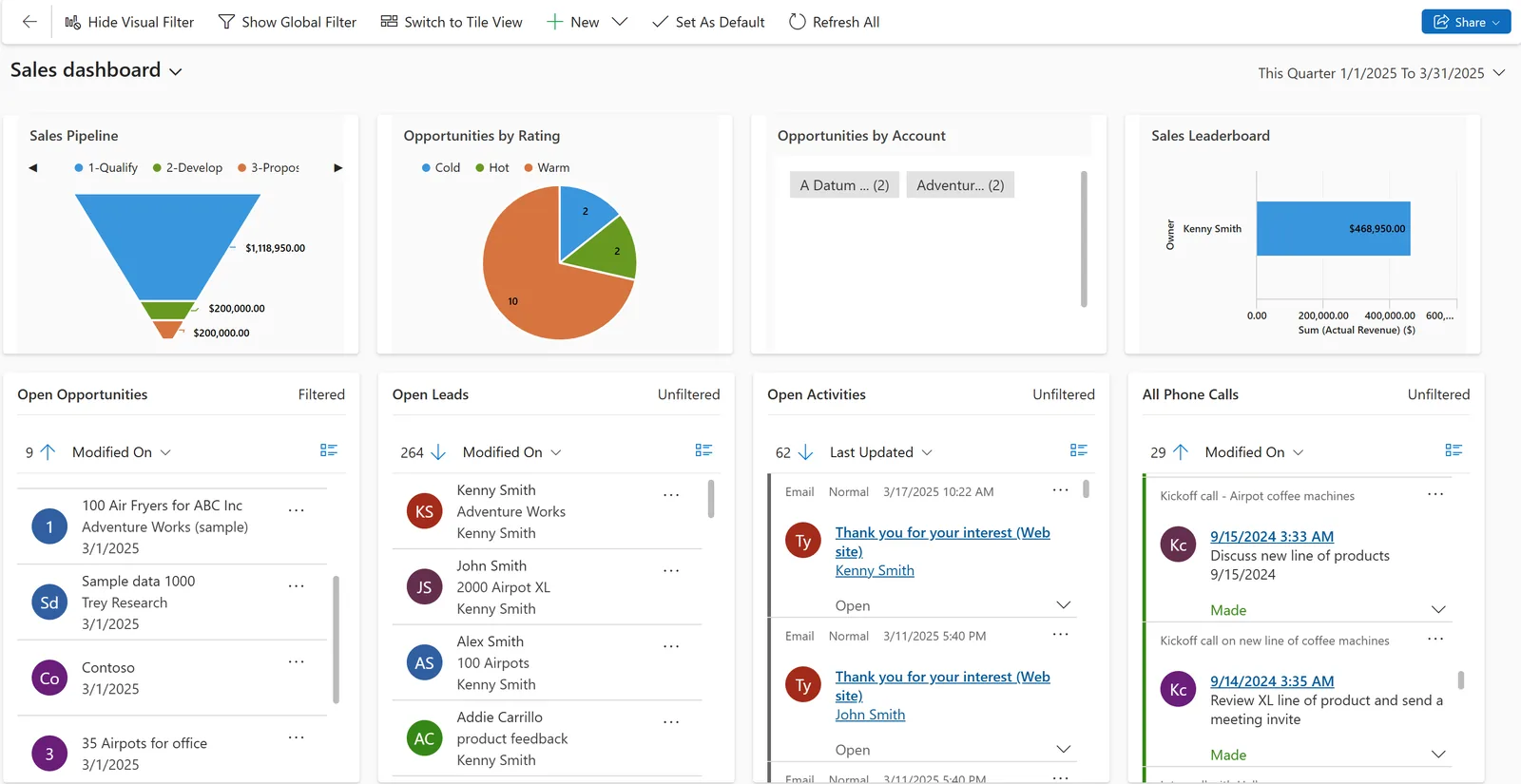
Sales and delivery numbers side by side, because a training institute needs both to be healthy.
The balance between sales tooling and operational depth usually decides the platform.
| Institute profile | Platform that usually fits | Why it fits | Watch-out |
|---|---|---|---|
| Sales-driven center with many short courses | Zoho CRM with Zoho Books | Strong lead management, WhatsApp and campaigns with VAT-ready invoicing | Batch scheduling often needs Zoho Creator |
| Center with in-house trainers and eLearning | Odoo | CRM, eLearning, events, invoicing and HR in one database | Keep the course and batch model simple at first |
| Institute wanting education features and no licence fees | ERPNext | Education app with programs, courses, student groups and fees | Sales automation is lighter than dedicated CRM tools |
| Corporate training arm of a larger company | Dynamics 365 Sales with Business Central | Fits enterprise clients, contracts and group finance | Higher effort; best when Microsoft is already the standard |
We implement Zoho, Odoo, ERPNext, Dynamics 365 and custom ERP, and can extend any of them for institute-specific workflows.
We configure the ERP to support these areas. Licensing and tax questions should be confirmed with the relevant authority and your tax advisor.
Commercial training courses and workshops are generally standard-rated at 5%, unlike recognized school education. Exam vouchers, materials and venue charges may need separate items with their own tax codes. Confirm treatment with your tax advisor.
Training institutes in Dubai typically operate under a KHDA permit alongside their trade license, with equivalent authorities in other emirates. The ERP can hold approved course lists and trainer approvals for reference.
Invoices to companies are B2B and will need to follow the PINT AE e-invoicing model through an Accredited Service Provider once your phase applies. Check the latest Ministry of Finance and FTA guidance.
Employed trainers are paid through WPS with gratuity accrued; freelance trainers are handled as suppliers with their own invoices and, where relevant, their VAT registration details.
General information, not tax or legal advice. Rules change; confirm current FTA, MOHRE and Ministry of Finance guidance with your advisor.
These are the outcomes we design for; results depend on adoption by counselors and trainers.
Every lead has an owner and a next step, so fewer prospects go cold.
Break-even seat counts are visible before a batch is confirmed.
Invoices go out with LPO references and attendance records on the first attempt.
Fees are calculated from the timetable, so monthly payouts take far less effort.
Indicative ranges for a single-location institute; multi-branch groups take longer.
Durations are typical ranges; your plan is agreed after discovery.
Map lead sources, course catalogue, pricing, payment plans and trainer arrangements.
Configure lead capture, assignment rules, WhatsApp and counselor pipelines.
Build course and batch structures, installments, corporate billing and accounting.
Import active learners, open balances and trainers, then train counselors and coordinators.
Start with new enquiries and upcoming batches, then move running batches across.
CRM, education and platform pages relevant to training centers.
We configure the system for the rules UAE businesses report against, and test it before go-live.
General information, not tax or legal advice. Confirm current requirements with the FTA, MOHRE or your advisor. See all UAE compliance guides.
On-site workshops in Dubai, Abu Dhabi and Sharjah, and remote or on-site delivery across the Northern Emirates and free zones.
Official sources and references
Facts on this page were checked against these sources in October 2026. Rules change, so confirm current requirements before acting.
Still have a question? Our consultants are happy to help.
Ask an ExpertYes. Zoho, Odoo and ERPNext can connect to WhatsApp Business through official APIs or connectors, so messages create or update leads and counselors reply from the CRM.
Each enrollment carries a payment schedule. The system sends reminders, records payments against the right installment and can block certificate release until the balance is clear.
Yes. Corporate enrollments are grouped under the client account, and one invoice can cover several learners with the LPO number and attendance summary attached.
Yes. Batches can be classroom, online or blended, with meeting links and learning materials attached. Odoo includes an eLearning app, and other platforms can link to your existing learning management system.
Trainer rates are stored on their profile, and sessions delivered are calculated from the batch schedule. The result becomes a supplier bill for approval rather than a manual calculation.
Related Solutions
Related Industries
Related ERP Platforms
Call +971 55 145 3265 or email contact@uaeerpexperts.com to talk through your courses, channels and corporate clients.
Dubai, United Arab Emirates