
L
O
A
D
I
N
G


Zoho, Odoo, ERPNext, Dynamics 365 and custom ERP, delivered by one accountable team.

Revenue on one report, costs on another and write-offs nowhere. Project profitability software brings them together so you know which projects and clients actually make money.
Project profitability software combines revenue, costs and write-offs per project so firms see real margin. It requires every cost posted to a project, revenue recognized on progress rather than invoicing, unbilled work in progress tracked, and forecast margin at completion. UAE consultancies, agencies, IT firms and contractors can then compare margin by client, service line, project manager and contract type.
Project profitability software answers a simple question: after all revenue, costs and write-offs, how much did this project earn? In many UAE consultancies, agencies, IT service firms and contractors the honest answer is "we find out at year end". Revenue is visible in the accounting system, but costs are spread across payroll, purchases and expense claims, and discounts or written-off hours are never recorded against the project that caused them.
Good profitability reporting needs three things in place. First, every cost must be posted to a project, which is the job of project costing software. Second, revenue must be recognized in the period the work is done, not only when an invoice goes out, so that work in progress (WIP) and unbilled time are visible. Third, the margin must be sliced the way management thinks: by client, service line, project manager, emirate or contract type.
This page focuses on that third layer: measuring, explaining and forecasting margin. It shows the reports we build, how the four platforms we implement handle them, and the UAE tax points to watch. For setting and approving the budget each project is measured against, see project budget management, and for the multi-project view at board level see project portfolio management.

These issues make projects look better or worse than they are, and they are common in growing UAE project businesses.
A project that billed a large advance looks highly profitable this quarter and loss-making the next. Without revenue recognized on progress, margin swings with the billing calendar instead of the work.
Hours the client refused to pay for, or a discount agreed by the partner at invoicing, simply vanish. Nobody can see that a client consistently pays for only part of the work.
Each project is analyzed alone, so a client with ten small profitable jobs and one large loss-making one is never reviewed as a whole relationship.
Reports show margin to date, but not the expected margin at completion. A project at 40% margin today can end at 5% once the remaining work is costed.
The project manager tracks hours in a planning tool, finance tracks money in accounting, and the two never agree. Meetings turn into arguments about whose number is right.
The workflow below turns transactions into a margin figure management can act on every month.
One shared database: every step updates stock, finance and reports in real time.
Profitability is a reporting outcome, so it depends on clean data from these modules.
Revenue, cost and WIP accounts per project, with project as a dimension on every ledger posting.
Contract value, billing type and agreed rates per project, which set the revenue side of the margin.
Hours valued at both cost rate and bill rate, so the gap between the two shows the margin on each hour.
Invoices linked to projects and to the time or milestones they bill, including any write-down taken at billing.
Percentage-of-completion or milestone-based recognition so earned revenue matches work performed in each period.
Account, industry and account manager on each project, so margin can be grouped by relationship as well as by job.
Estimate-to-complete entries from project managers that turn margin to date into margin at completion.
Margin rankings, trend charts and drill-downs from a client to a project to a single invoice line.
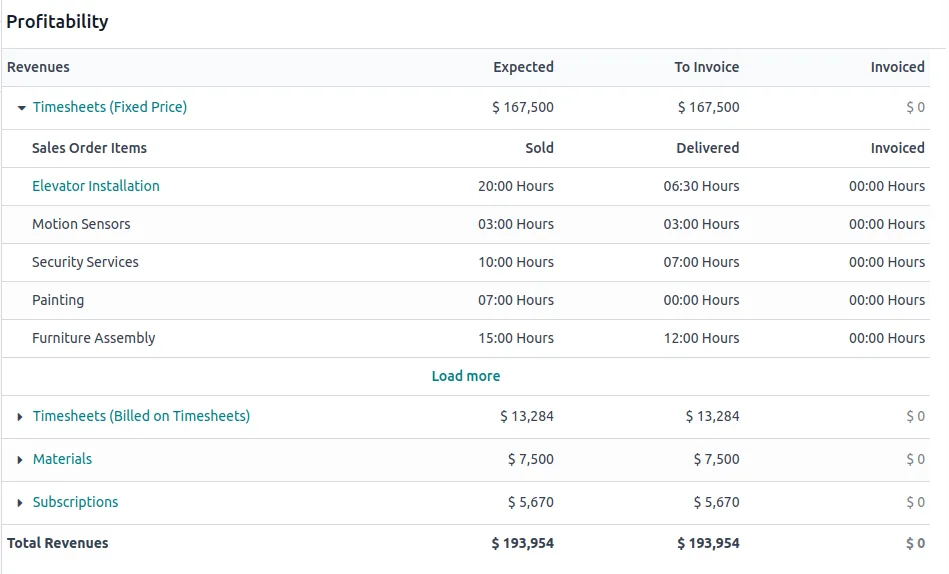
We start with a small set of reports and add more only when they are used in the monthly review.
Each platform can produce project margin reports. They differ in how much is built in versus configured. Check current edition features before deciding.
| Zoho | Odoo | ERPNext | Dynamics 365 | |
|---|---|---|---|---|
| Project P&L | Project profitability views in Zoho Books and Zoho Projects; deeper analysis in Zoho Analytics | Project profitability panel on project updates, based on analytic accounting | Project shows costing, billing and gross margin fields; Profitability Analysis report by project dimension | Project statistics and WIP in Business Central; profitability analysis in Project Operations |
| Revenue recognition | Invoice-based by default; progress-based recognition usually via journals | Invoice-based; deferred and progress recognition through accounting configuration | Invoice-based by default; deferred revenue features available; progress via journals | WIP and recognition methods built in (for example cost value or sales value methods in Business Central) |
| Write-offs on time | Unbilled time can be adjusted at invoicing | Timesheet lines can be marked non-billable or adjusted on the sales order | Billing hours can differ from actual hours on timesheets | Adjustments on project journals and invoice proposals |
| Client and service line margin | Grouped in Zoho Analytics | Analytic plans for client, department or service line | Accounting dimensions for service line or business unit | Dimensions in Business Central; richer models in Finance and Project Operations |
| Forecast at completion | Usually custom report or Analytics model | Custom fields or reports on top of project data | Custom fields and script reports | Estimate-to-complete built into Project Operations |
Capabilities change between releases; confirm against your edition.
Profitability is only as good as the data behind it. These connections close the usual gaps.
Margin reports are management tools, but they draw on the same records as your tax filings. Confirm treatments with your tax advisor.
Taxable income starts from accounting profit, so how revenue and WIP are recognized affects which period profit falls in. Consistent, documented recognition methods matter under Federal Decree-Law 47 of 2022.
Where group entities share project work, intercompany charges should be at arm's length. Master and local file documentation applies above the revenue thresholds of AED 200 million (entity) or AED 3.15 billion (group).
Margin reports use net revenue, but VAT is due on supplies when the tax point occurs. Keep VAT out of project margin and make sure invoices and advances are taxed at the right time.
Revenue recognition workings, WIP schedules and write-off approvals should be kept with the accounting records for the statutory retention period.
General information, not tax or legal advice. Rules change; confirm current FTA, MOHRE and Ministry of Finance guidance with your advisor.
These are qualitative outcomes; the scale depends on your starting point.
Directors can see which relationships earn money and renegotiate or exit the ones that consistently lose it.
Actual margins by service line feed rate cards and fixed-fee quotes, so pricing reflects real delivery cost.
Forecast margin at completion flags weak projects while scope or change orders can still be discussed.
Finance and delivery work from the same project P&L, which shortens monthly review meetings.
Durations are indicative for a mid-size project business; they depend on how clean costing and billing data already is.
Durations are typical ranges; your plan is agreed after discovery.
Agree what counts as revenue, direct cost and overhead, and how WIP and write-offs are treated.
Set project, client and service line dimensions; fix cost and bill rates; link invoices to projects.
Configure the revenue recognition method and WIP accounts with your auditor's input.
Build the project P&L, client margin and forecast reports and test them against last quarter.
Project managers update estimates to complete before each review; finance publishes the margin pack.
We configure the system for the rules UAE businesses report against, and test it before go-live.
General information, not tax or legal advice. Confirm current requirements with the FTA, MOHRE or your advisor. See all UAE compliance guides.
On-site workshops in Dubai, Abu Dhabi and Sharjah, and remote or on-site delivery across the Northern Emirates and free zones.
Official sources and references
Facts on this page were checked against these sources in October 2026. Rules change, so confirm current requirements before acting.
Still have a question? Our consultants are happy to help.
Ask an ExpertUse contribution margin first (earned revenue minus direct cost), then a fully loaded margin after overhead allocation. Show both, plus forecast margin at completion, so decisions are not made on one partial figure.
Make client a mandatory field on every project and report margin grouped by client over a rolling twelve months. That view often shows that a few relationships carry most of the profit.
Usually because revenue follows invoices, not work done. Recognizing revenue on progress and tracking unbilled WIP smooths the picture and matches revenue to the costs of the same period.
For any labour-based business, yes. Hours are usually the largest cost. Our project timesheet software page covers how to capture them reliably.
Most firms give PMs their own projects' margin and keep salary-level detail hidden by using role-based cost rates. A project dashboard is the usual way to share it.
Smaller service firms often do well with Zoho, mid-size firms with Odoo or ERPNext, and larger groups with Dynamics 365. We implement all four; see ERP for project managers for how each looks from the delivery side.
Related Solutions
Related Industries
Related ERP Platforms
We review your current margin reporting and show what it takes to get a reliable project P&L from your ERP.
Dubai, United Arab Emirates