L
O
A
D
I
N
G


Zoho, Odoo, ERPNext, Dynamics 365 and custom ERP, delivered by one accountable team.

Once a company has several departments, branches and managers, it needs controls as well as records. We design SME ERP around approvals, visibility and growth.
ERP software for SMEs in the UAE, typically companies with roughly 20 to 250 staff, should replace a patchwork of accounting, CRM, payroll spreadsheets and department tools with one connected system. The priority is control: approval rules, role-based access and branch-level reporting, so department heads see what they need while finance keeps oversight and the business has room to grow.
ERP software for SMEs in the UAE has a different job from small-business software. With 20 to 250 people, the owner no longer sees every transaction. Sales, procurement, warehouse, finance and HR each run their own routines, and the risk shifts from missing data to missing control: purchases nobody approved, discounts outside policy, stock moved between branches without a record.
Mid-sized companies often run a basic accounting package alongside a separate CRM, a payroll spreadsheet and a few department tools. Each works on its own, but month-end means exporting and matching data across all of them. Managers wait for reports that are already out of date by the time they arrive.
We help SMEs replace that patchwork with one connected system, set up with approval rules, role-based access and branch-level reporting. The aim is to give department heads what they need while keeping finance in control, and to leave headroom for the next stage of growth. Our multi-branch ERP work is often part of this.

These issues tend to appear as a company adds managers, locations and product lines.
Purchase requests, discounts and expense claims are approved in chat threads. There is no audit trail, and finance cannot see commitments until the invoice arrives.
Each showroom or warehouse keeps its own stock and sales figures. Transfers between branches are recorded late or not at all.
CRM, accounting, HR and e-commerce do not share data, so the same customer or item is entered several times with small differences.
Accruals, intercompany charges and reconciliations take days because data comes from several systems.
Systems chosen for a team of 15 struggle at 80. Adding a new entity or a free zone company becomes a project in itself.
These features address the control and coordination problems that come with scale.
Purchase requests, orders above set values, credit limit overrides and expense claims routed to the right manager with a full audit trail.
Separate warehouses, price lists and sales teams per branch, with inter-branch transfers and consolidated reporting.
Staff see the menus, documents and reports their role needs. Sensitive data such as salaries and margins stays restricted.
Connect e-commerce stores, payment gateways, bank feeds, biometric attendance and shipping tools so data is entered once.
Sales pipeline, purchase commitments, stock aging and payroll cost shown to the people who manage them.
Recurring journals, bank reconciliation rules and checklists that shorten the close and reduce adjustments.
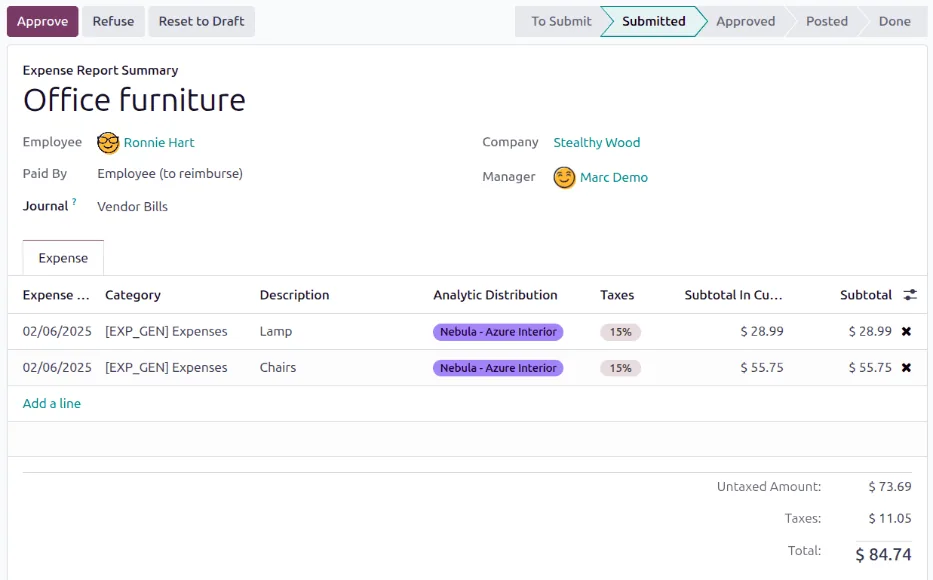
Managers and finance see what is waiting for a decision and what has already been committed.
Each platform serves SMEs well in a particular profile. We recommend after mapping your processes.
| Zoho One | Odoo Enterprise | ERPNext | Dynamics 365 Business Central | |
|---|---|---|---|---|
| Strongest SME profile | Service, distribution and sales-led companies | Trading, retail and light manufacturing with several branches | Manufacturers and traders wanting full control of cost | Finance-led companies and groups on Microsoft 365 |
| Approvals | Built into apps and Zoho Creator for custom flows | Approval rules per app plus Studio for custom steps | Workflow engine on any document type | Approval workflows across purchasing and sales |
| Multi-branch and multi-company | Separate organizations per entity; reporting through Zoho Analytics | Multi-company in one database | Multi-company and cost centers built in | Multiple companies with consolidation features |
| Integration approach | Native Zoho links plus APIs and Zoho Flow | Connectors and REST/XML-RPC APIs | REST API and webhooks | APIs, Power Automate and Microsoft ecosystem |
| Watch-out | Many apps to govern | Customization depth versus upgrade effort | Requires solid technical support | License cost grows with headcount |
Ranges are typical for SMEs and depend on the number of branches, integrations and data quality.
Durations are typical ranges; your plan is agreed after discovery.
Workshops with sales, procurement, warehouse, finance and HR to map processes, approval limits and reports.
Chart of accounts, branches, roles, approval rules and document templates configured and reviewed.
Bank, e-commerce and attendance integrations built; masters and open balances migrated and reconciled.
Department heads test real scenarios; key users trained to support their teams.
Branch-by-branch or big-bang go-live, with daily support during the first close.
More entities and staff mean more filings. Confirm treatments with your tax advisor.
Branches under one TRN share a VAT return, while separate legal entities may file separately or as a tax group. The ERP structure should mirror your registration.
Track revenue and costs by entity, especially where a free zone company sits alongside a mainland one. Clean segmentation helps your advisor assess qualifying income.
SMEs near or above AED 50 million revenue fall into the first wave, with ASP appointment by 30 October 2026 and mandatory e-invoicing from 1 January 2027. Others follow from 1 July 2027. Check the latest Ministry of Finance and FTA guidance.
With larger payrolls, SIF generation, leave accruals and gratuity provisions should run from the HR module, not a spreadsheet.
General information, not tax or legal advice. Rules change; confirm current FTA, MOHRE and Ministry of Finance guidance with your advisor.
These are the outcomes we design for and review after go-live.
Every significant spend and discount has a recorded approver and date.
Fewer manual reconciliations and adjustments between systems.
Management compares branch sales, margins and stock without asking for spreadsheets.
New branches, warehouses or companies can be added within the same structure.
Explore platform-specific SME pages and the features growing companies need most.
We configure the system for the rules UAE businesses report against, and test it before go-live.
General information, not tax or legal advice. Confirm current requirements with the FTA, MOHRE or your advisor. See all UAE compliance guides.
On-site workshops in Dubai, Abu Dhabi and Sharjah, and remote or on-site delivery across the Northern Emirates and free zones.
Official sources and references
Facts on this page were checked against these sources in October 2026. Rules change, so confirm current requirements before acting.
Still have a question? Our consultants are happy to help.
Ask an ExpertWe use roughly 20 to 250 staff as a working range. The real marker is structure: several departments, managers who approve spending, and often more than one branch or entity.
Yes. Many SMEs go live at head office first, then add branches once processes are proven. The design must allow for all branches from the start so data stays consistent.
You set rules such as purchase orders above a value needing a manager and finance sign-off. The system routes the document, records each decision and blocks the next step until approval is given.
Bank feeds, e-commerce platforms, payment gateways, biometric attendance and courier tools are the most common. We check each one during discovery and plan it in the timeline.
It depends on your industry, finance complexity and existing tools. We compare them for SMEs on our best ERP for SMEs page and recommend after a discovery workshop.
Related Solutions
Related Industries
Related ERP Platforms
Talk to us about your departments, branches and approval rules, and we will map a phased rollout.
Dubai, United Arab Emirates