L
O
A
D
I
N
G


Zoho, Odoo, ERPNext, Dynamics 365 and custom ERP, delivered by one accountable team.

Decide which projects to start, pause or stop using one portfolio register, consistent scoring and live financial data from your ERP.
UAE organizations can manage project portfolios in their ERP with one register of proposed, active, on-hold and closed projects, structured intake forms, weighted scoring against strategy, margin, risk and capacity, and stage-gate approvals that release budget phase by phase. Portfolio health is reviewed from ledger data, including committed cost from open purchase orders, rather than self-reported red, amber and green status.
Project portfolio management UAE organizations need is the discipline of deciding which projects get funded, staffed and kept alive, then reviewing that mix as conditions change. It sits one level above individual project control. A project manager asks whether a job is on time and on budget; a portfolio board asks whether it should be running at all, and what it is crowding out.
We see the need most in engineering and design consultancies juggling dozens of client commissions, developers and family groups running several fit-out and capex programmes at once, IT service firms balancing client work against internal products, and semi-government entities in Abu Dhabi and Dubai that report programme status to a board or strategy office. In each case the portfolio is usually governed through a slide deck rebuilt every month from emails and spreadsheets.
Running the portfolio inside the ERP links governance decisions to real numbers: committed purchase orders, approved budgets, actual hours and recognized revenue. This page covers intake, prioritization, stage gates and portfolio reviews. For the day-to-day execution layer, see project management ERP.

These problems appear long before anyone calls it a portfolio problem.
Client jobs sit in the ERP, internal initiatives in a PMO tracker and capex projects in finance's fixed-asset workbook. Leadership cannot see the full commitment in one place.
Sales or a director approves a new commission and the same senior engineers are already booked on three others. Delays show up weeks later as overtime and missed milestones.
Green, amber and red are chosen by the PM, so a job that has spent 90% of its budget at 50% progress can still be shown green on the board pack.
Purchase orders, subcontracts and hired staff costs commit money before invoices arrive. A portfolio view built only on actuals underestimates what is already spent.
Internal initiatives and stalled client jobs stay open, keep cost codes alive and absorb timesheet hours with no decision to stop them.
The PMO assembles the monthly pack by hand, so by the time the board meets the numbers are two to three weeks old.
Each step creates a record, an approval or a data point, so the portfolio view builds itself from the process.
One shared database: every step updates stock, finance and reports in real time.
Portfolio management reuses project, finance and HR data. The additions are mainly intake, scoring and governance records.
A structured request captures sponsor, objective, estimated cost, revenue or benefit, required skills and target dates before anything is created as a project.
Weighted criteria such as strategic fit, margin, client importance, risk and urgency produce a comparable score for every request.
Multi-level approval workflows release budget phase by phase, with the approver, date and conditions logged.
Projects roll up into programmes, business units and portfolios so reports can be cut at each level.
Approved budgets compared with actuals and open POs per project. Budget setup itself is covered in project budget management.
Demand from proposed and active projects compared with available hours by role, linked to project resource planning.
Project-level risks with owner, likelihood and impact roll up so the board sees the top exposures across the portfolio.
Dashboards that plot value against risk, show spend by programme and flag projects breaching tolerance.
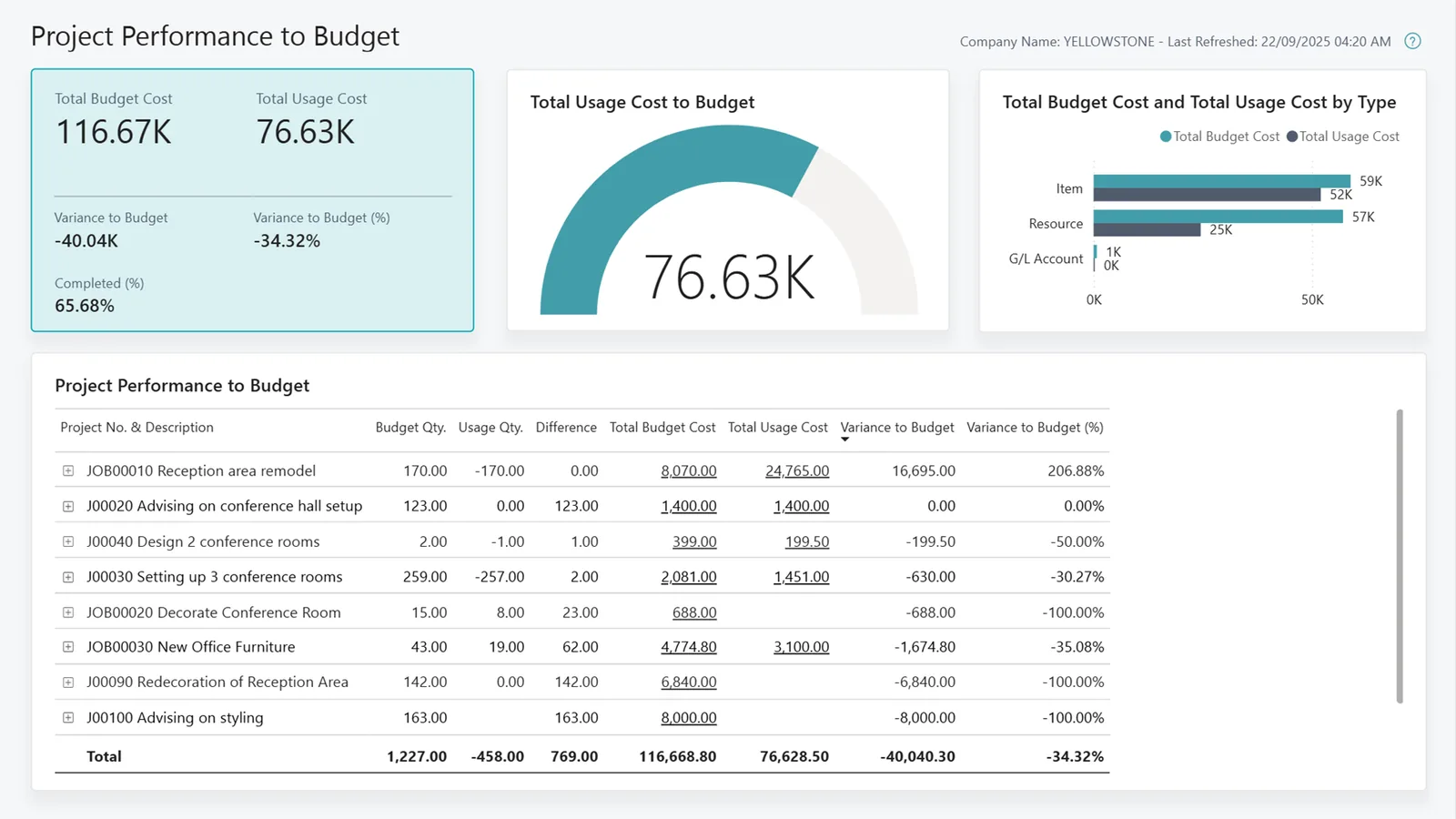
The portfolio dashboard is the agenda for the monthly review: what is new, what is in trouble and what needs a decision.
None of the four platforms is a dedicated PPM suite out of the box at every edition, but each can support the process with standard features and some configuration. Confirm current features for your edition.
| Zoho | Odoo | ERPNext | Dynamics 365 | |
|---|---|---|---|---|
| Project register and grouping | Zoho Projects with project groups and portfolio-level views in recent plans | Project app with tags, stages and analytic plans; see Odoo project management | Project, Project Type and Project Template doctypes; see ERPNext projects | Project Operations or Business Central Projects; Microsoft Planner for lighter portfolios |
| Intake and scoring | Zoho Creator or Projects forms with custom fields | Odoo Studio or CRM-style pipeline for requests | Custom doctype with weighted scoring fields | Power Apps forms and Dataverse tables |
| Stage-gate approvals | Blueprint-style workflows in Creator; approvals in Projects | Approvals app or Studio-built stages | Workflow engine with role-based states | Power Automate approvals linked to project stages |
| Budget vs actual vs committed | Zoho Books project costs plus open POs via Zoho Analytics | Analytic budgets and purchase commitments by analytic account | Budget against cost center or project, with PO commitments | Project budgets with committed cost tracking |
| Capacity view | Resource utilization in Zoho Projects | Planning app (Enterprise) against timesheet capacity | Timesheet and activity reports; capacity usually customized | Resource management in Project Operations |
| Portfolio reporting | Zoho Analytics dashboards | Spreadsheet dashboards and pivot views | Insights app and dashboard charts | Power BI portfolio reports |
Hedged summary from public product information. We implement all four and recommend by fit, not by preference.
Use this as the standard agenda, generated from the ERP rather than assembled by hand.
Portfolio data usually comes from more than one system.
Portfolio decisions are governance decisions, but some UAE rules shape how the data is structured. Confirm specifics with your tax advisor.
Groups that run shared projects across a mainland company and free zone entities should record recharges between entities. Transfer pricing documentation (master and local file) applies at revenue of AED 200 million or group revenue of AED 3.15 billion, and arm's length pricing applies to related-party transactions regardless.
Internal projects that create assets need costs capitalized correctly, which affects accounting profit and therefore corporate tax. Tag capex projects at intake so costs land in the right accounts.
Costs recharged between group entities that are not in the same VAT group may need a tax invoice with 5% VAT. The portfolio structure should make recharges visible.
Gate approvals, business cases and budget releases are part of the audit trail. Keep them for at least 5 years under Cabinet Decision 74 of 2023, alongside the related financial records.
General information, not tax or legal advice. Rules change; confirm current FTA, MOHRE and Ministry of Finance guidance with your advisor.
These are the outcomes boards usually look for; results depend on how consistently gates and reviews are run.
Scoring and capacity checks stop low-value work from starting and diluting key staff.
Objective tolerance flags bring troubled projects to the board while there is still time to act.
Committed cost alongside actuals shows true exposure before invoices arrive.
The review pack comes from the ERP, so the PMO spends time on analysis instead of compilation.
Most organizations start with the register and reviews, then add scoring and capacity. Durations are indicative.
Durations are typical ranges; your plan is agreed after discovery.
Define portfolio levels, gate criteria, scoring weights, tolerance thresholds and who approves what.
Load all active, proposed and on-hold projects with sponsor, budget and programme; close zombie projects.
Build intake forms, gate approvals and the portfolio dashboard; connect commitments and timesheets.
Run monthly reviews from the system, refine scoring weights and tolerance levels based on real decisions.
We configure the system for the rules UAE businesses report against, and test it before go-live.
General information, not tax or legal advice. Confirm current requirements with the FTA, MOHRE or your advisor. See all UAE compliance guides.
On-site workshops in Dubai, Abu Dhabi and Sharjah, and remote or on-site delivery across the Northern Emirates and free zones.
Official sources and references
Facts on this page were checked against these sources in October 2026. Rules change, so confirm current requirements before acting.
Still have a question? Our consultants are happy to help.
Ask an ExpertProject management delivers a single project. Portfolio management decides which projects to run, how to fund them and when to stop them, using comparable data across all of them. The ERP for project managers page covers the execution side.
Not necessarily. If your projects already run through an ERP with project accounting and procurement, adding intake, scoring and gate workflows is often enough. A dedicated PPM tool makes sense for very large or highly regulated programme offices, but then it must be integrated with finance.
Calculate health from data: budget consumed vs progress, forecast margin vs approved margin, and milestone dates vs baseline. The PM can add commentary, but the colour comes from tolerance rules.
Yes. Committed cost shows what you are already obliged to pay. Our project procurement page explains how POs and subcontracts are tagged to projects.
Yes, with a project type that distinguishes them. Client projects are judged on margin and client value; internal and capex projects on cost, benefit and strategic fit. The scoring model can weight criteria differently for each type.
Revenue and backlog by programme show whether the portfolio supports the business plan. See the project revenue dashboard for how that view is built.
Related Solutions
Related Industries
Related ERP Platforms
Tell us how projects are approved and reviewed today, and we will map an ERP-based portfolio process that fits your organization.
Dubai, United Arab Emirates