L
O
A
D
I
N
G


Zoho, Odoo, ERPNext, Dynamics 365 and custom ERP, delivered by one accountable team.

Build one agreed forecast from sales history, customer input and UAE seasonality, then let it drive raw material buying and production instead of guesswork.
Demand planning in an ERP builds one agreed forecast by product and month from cleaned sales history, open orders, CRM pipeline and customer input, then feeds it into MRP to drive purchasing and production. UAE manufacturers must adjust for Ramadan and Eid, which move about eleven days earlier each year, summer slowdowns and irregular re-export orders, and should measure forecast accuracy monthly.
An ERP for demand planning in the UAE turns sales history, open orders, customer commitments and market knowledge into a forecast by product and month, and then makes that forecast the input for purchasing and production. It is the first step of the planning chain: without it, MRP can only react to orders already received, which is too late when raw materials take six to ten weeks to arrive by sea.
UAE demand has patterns that generic forecasting tools miss. Food and beverage volumes shift around Ramadan and Eid, both moving about eleven days earlier each year. Construction-linked products follow project cycles and the summer slowdown. Re-export customers in the GCC, Africa and Central Asia order in large irregular lots. A forecast that simply averages the last twelve months will be wrong in exactly the months that matter.
This page covers building and agreeing the forecast. Checking whether the plant can make it is covered in ERP for capacity planning, and machine learning models that automate forecasting are discussed in AI demand forecasting.

Poor forecasting shows up as both stockouts and excess stock at the same time.
The sales manager, the production planner and the buyer each keep a different forecast. Purchasing buys to one number while the plant produces to another.
Last year's Ramadan peak fell in a different month, so a forecast based on calendar months shifts the peak to the wrong place. Plants run short just before Ramadan and overstock afterward.
A large tender or one-time export order inflates a month of history. Unless it is flagged and removed, it repeats in next year's forecast.
History records what was delivered, not what customers wanted. Months with stockouts look like low demand, so the forecast stays too low.
Nobody compares forecast with actual, so the same optimistic bias repeats. Safety stock is set by feel rather than by measured forecast error.
Raw materials such as resins, steel coil, packaging film and flavors are imported. A forecast horizon shorter than the supply lead time leaves purchasing guessing.
A monthly cycle keeps the forecast current without turning it into a full-time job.
One shared database: every step updates stock, finance and reports in real time.
Demand planning draws on sales data and feeds supply planning, so it must sit inside the ERP rather than beside it.
Invoiced and ordered quantities by item, customer and channel, with flags for one-off orders and stockout periods.
Forecast quantities by item or product family and period, with versions for baseline, sales input and final approved figures.
Quoted and probable opportunities from the sales team, used as tentative demand for large or project-based orders.
Incoming sales orders reduce the forecast for the same period so demand is not counted twice.
The approved forecast drives planned purchase and production orders; see production planning software for the next step.
Long-lead components planned from the forecast horizon, covered in raw material management.
Buffer quantities set from measured forecast error and lead time, not a flat number of days.
Forecast accuracy, bias and value at risk by product family, reviewed monthly.
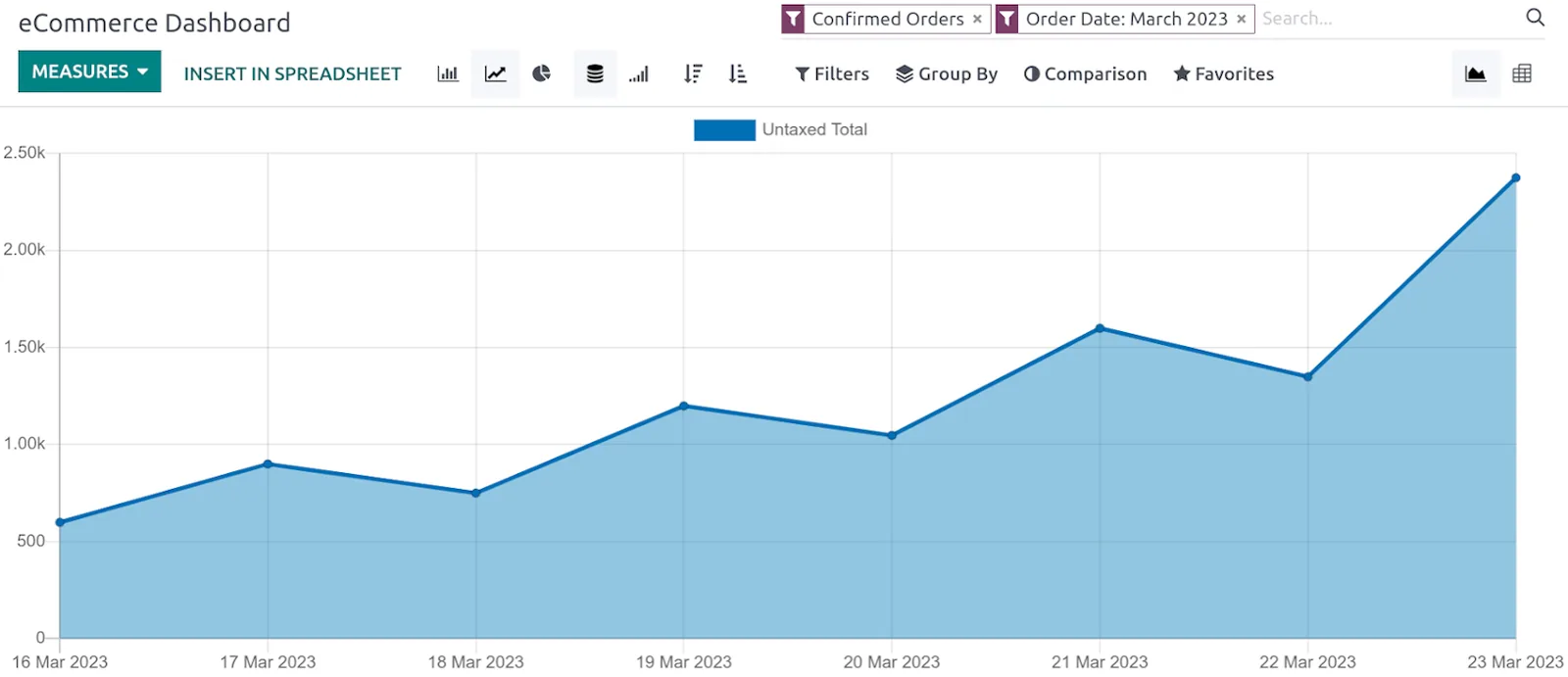
A demand dashboard compares forecast, orders and actual sales so the team can agree the next plan quickly.
None of these platforms replaces judgment, but they differ in built-in forecasting. Confirm features for your edition.
| Zoho | Odoo | ERPNext | Dynamics 365 | |
|---|---|---|---|---|
| Forecast storage | No forecast object in Zoho Inventory; typically held in Zoho Analytics or a Creator app | Forecast quantities entered in the Master Production Schedule (Enterprise) | Sales history reports and Production Plan inputs; forecasting features vary by version | Demand forecasts in Business Central; Demand Planning app and forecasting in SCM |
| Statistical forecasting | Zia-based forecasting in Zoho Analytics, confirm for your plan | Basic; often extended with apps or external tools | External Python or BI models through the API | Forecasting in SCM and the Demand Planning app; Business Central relies more on manual or add-on forecasts |
| Forecast consumption | Custom logic | Handled in MPS with demand forecast and actual demand | Through Production Plan and Material Request logic | Supported in planning worksheets and master planning |
| Driving MRP | Through integration with an MRP or custom reorder logic | MPS feeds replenishment and manufacturing orders | Production Plan creates work orders and material requests | Planning worksheet or master planning creates planned orders |
| S&OP collaboration | Shared Zoho Analytics dashboards | Spreadsheet views and MPS screen | Shared reports and dashboards | Excel add-in and Power BI dashboards |
| Best fit | Trading-led manufacturers with simple bills | SMEs wanting forecasting close to manufacturing | Data-savvy teams adding custom models | Larger manufacturers with many SKUs |
Our forecasting software page compares dedicated tools if your needs go beyond the ERP.
The best forecasts combine your own history with what customers and the market are telling you.
Some regulatory changes shift demand directly. Confirm specifics with your tax advisor.
From 1 January 2026, excise on sweetened drinks is tiered by sugar content under Cabinet Decision 197 of 2025. Beverage makers should model reformulated and existing products separately; see ERP for beverage manufacturing.
Demand from re-export customers may run through designated zones with different VAT treatment. Tagging customers and channels keeps forecasts and tax reporting aligned.
Food and cosmetics products need Arabic labeling and expiry controls. Over-forecasting short shelf-life items leads to write-offs, so accuracy matters more for these lines.
General information, not tax or legal advice. Rules change; confirm current FTA, MOHRE and Ministry of Finance guidance with your advisor.
The gains come from planning ahead with one number everybody trusts.
Sales, production and purchasing work from the same approved forecast instead of three spreadsheets.
Ramadan, Eid and summer shifts are planned on the right dates each year.
Imported materials are bought to a forecast with a known error, so buffers are sized rather than guessed.
Key accounts see that their input changes the plan, which improves the quality of the information they share.
A first demand planning cycle often runs within 6-10 weeks of starting, assuming clean sales history.
Durations are typical ranges; your plan is agreed after discovery.
Extract two to three years of sales, flag one-off orders and stockout periods, and group items into families.
Build the baseline forecast with moving Hijri-based seasonality and test it against last year.
Set up forecast entry, versions, consumption rules and the link to MRP.
Run the monthly meeting, agree the number and release it to purchasing and production.
Measure error and bias every month and adjust safety stock and models.
We configure the system for the rules UAE businesses report against, and test it before go-live.
General information, not tax or legal advice. Confirm current requirements with the FTA, MOHRE or your advisor. See all UAE compliance guides.
On-site workshops in Dubai, Abu Dhabi and Sharjah, and remote or on-site delivery across the Northern Emirates and free zones.
Official sources and references
Facts on this page were checked against these sources in October 2026. Rules change, so confirm current requirements before acting.
Still have a question? Our consultants are happy to help.
Ask an ExpertAt least as far as your longest raw material lead time plus production time, typically three to six months. Longer horizons at product family level help with capacity and capital decisions.
Tag history by Hijri period rather than calendar month, then project the effect onto next year's Gregorian dates. Most ERPs need a simple event calendar or an external model to do this.
Forecast families for planning capacity and long-lead materials, and items for the near-term months that drive finished goods production. Splitting family forecasts by recent item mix is common.
Less for finished goods, but still for long-lead raw materials and capacity. Make-to-order plants often forecast materials and hours rather than products.
For stocked products the forecast directly sets production quantities and reorder points; see ERP for make to stock manufacturing for how that works.
Common measures are absolute percentage error and bias by product family and month. The point is not a perfect number but knowing the size of the error so safety stock can be set properly.
Related Solutions
Related Industries
Related ERP Platforms
Share two years of sales history and we will show how a demand planning cycle would run in your ERP.
Dubai, United Arab Emirates