L
O
A
D
I
N
G


Zoho, Odoo, ERPNext, Dynamics 365 and custom ERP, delivered by one accountable team.

Know what came off the line today, what is released for sale, where each pallet sits and what sales can promise to customers, without calling the warehouse.
An ERP manages finished goods by posting output against the manufacturing order, printing batch or serial labels, holding stock in a QC status until quality releases it, putting it away to a pallet location, reserving it against sales orders and picking it FEFO or FIFO for dispatch. UAE manufacturers then see only released, unreserved stock as available to promise.
An ERP for finished goods in the UAE manages the stage between the end of the production line and the customer's truck. Output is reported against the manufacturing order, labeled by batch or serial number, held until quality releases it, put away to a location, reserved against sales orders and finally picked and dispatched. Each step changes either the quantity, the status or the location of the stock, and the ERP has to know all three.
In many UAE plants this is where visibility breaks. Production reports output on a shift sheet, the warehouse counts pallets at the end of the day, and sales checks availability by WhatsApp. Goods that are made but not yet tested are promised to customers. Pallets for export to Saudi Arabia or Oman sit next to local orders with different labels. At month end, finished goods in the books do not match what is on the floor.
This page covers output posting, release, storage, allocation and dispatch of finished products. The physical receiving dock for purchased goods is covered in goods receipt, and outbound movements in general in goods issue.

These issues hurt customer service and month-end figures at the same time.
Shift supervisors write output on paper and the office enters it the next day, sometimes in bulk at the week end. Stock and order status are always behind reality.
Without a QC hold status, a batch still waiting for lab results can be picked for a delivery. If it later fails, the plant has to recall from the customer.
The same pallets are promised to two customers because reservations are not recorded. One order ships short, and the other customer waits.
The same product exists in Arabic and English labeling, private label versions and export packs. Treating them as one item leads to the wrong pack on the truck.
Pickers take the nearest pallet instead of the oldest batch. Older stock ages in the back of the warehouse until it nears expiry or becomes obsolete.
Without output tied to actual order cost, the value of finished stock is an estimate, and gross margin swings month to month.
The goal is that every pallet has a batch, a status and a location from the moment it leaves the line.
One shared database: every step updates stock, finance and reports in real time.
Finished goods control connects production, quality, warehouse and sales on the same item and batch records.
Report good quantity, rejects and by-products on the order, valued at actual or standard cost.
Assign batch numbers with production and expiry dates, or serials for equipment; see serial number tracking.
Final inspection results change stock from hold to available; details in manufacturing quality control.
Pallet positions, racks and staging lanes for local, export and customer-specific stock.
Reservations and available-to-promise quantities by product, pack variant and warehouse.
FEFO or FIFO pick lists, scanning at loading and delivery notes; see warehouse picking.
Finished goods value and cost of goods sold posted automatically to the ledger.
Customer returns received by batch, inspected and reworked, restocked or scrapped.
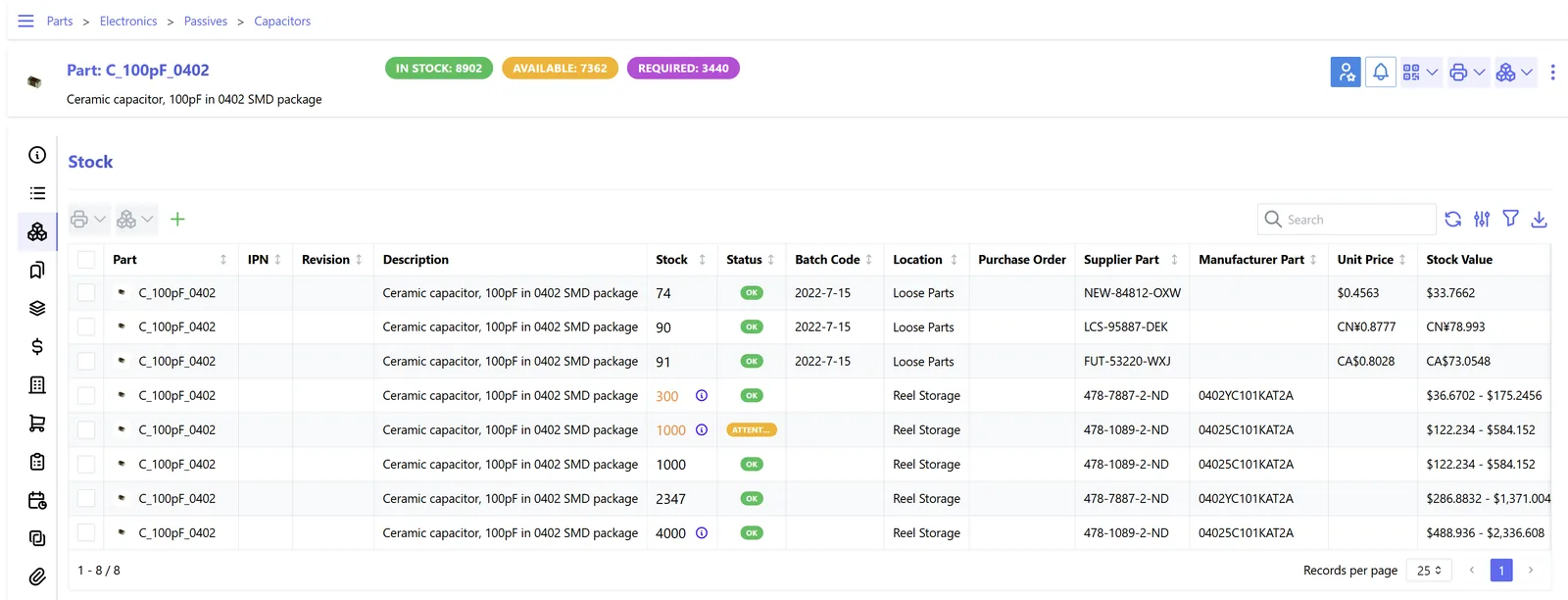
A warehouse view of finished goods tells production, sales and logistics the same story.
Each platform we implement can post output and track finished batches; the release and allocation steps differ. Confirm details for your edition.
| Zoho | Odoo | ERPNext | Dynamics 365 | |
|---|---|---|---|---|
| Output posting | Assembly of composite items in Zoho Inventory adds finished stock | Produce action on the manufacturing order, with partial production | Manufacture stock entry from the Work Order into the finished goods warehouse | Output journal or production order posting |
| Batch on output | Batch numbers on assembled items; confirm for your plan | Lot assigned to the finished product on the order | Batch created automatically on manufacture when configured | Item tracking lines on output |
| QC hold | Separate hold warehouse with manual transfer | Quality checks on the manufacturing order (Enterprise) and multi-step routes | Quality Inspection on the manufacture entry, plus a hold warehouse | Blocked inventory status or quality orders in Finance and SCM |
| Reservation | Committed stock shown against sales orders | Reservation on delivery orders, with reservation method options | Stock reservation on sales orders in recent versions | Reservation on sales lines |
| Picking strategy | Batch selection at shipment | FIFO, LIFO or FEFO removal strategies by category or location | Batch selection with FIFO or expiry-based picking | Pick by bin and lot rules in Warehouse Management |
| Best fit | Light assembly and packing operations | Plants needing integrated MRP, quality and warehouse | SMEs wanting flexible batch control | High-volume plants with advanced warehousing |
The end of line and the loading bay are where most manual re-keying happens today.
Finished goods records feed your sales invoices, export documents and tax filings. Confirm specifics with your advisors.
Local sales carry 5% VAT; qualifying exports may be zero-rated if export evidence is kept. Link the delivery, exit documents and invoice in the ERP; confirm treatment with your tax advisor.
B2B sales invoices will be exchanged in PINT AE format through Accredited Service Providers under the UAE e-invoicing program. Clean item and customer data now makes that step easier; see UAE e-invoicing and check the latest MoF / FTA guidance.
Manufacturers of sweetened drinks, energy drinks or tobacco products must track excise goods and their movement. Rates changed from 1 January 2026 under Cabinet Decision 197 of 2025.
Keep output, delivery and invoice records for at least five years under Cabinet Decision 74 of 2023.
General information, not tax or legal advice. Rules change; confirm current FTA, MOHRE and Ministry of Finance guidance with your advisor.
The benefits show up in customer service, warehouse discipline and month-end accuracy.
Sales sees released, unreserved stock in real time and stops promising goods that are already allocated.
Stock on QC hold cannot be picked, which protects customers and reduces recalls.
Expiry-based picking and an ageing report, as in stock ageing analysis, move older batches first.
Output posted at order cost keeps finished goods and gross margin in line every month.
Finished goods control is usually delivered with production and warehouse modules. Durations are typical ranges.
Durations are typical ranges; your plan is agreed after discovery.
Define finished items, pack variants, label languages and batch numbering rules.
Set pallet locations, hold and staging areas, and removal strategy.
Configure output posting, label printing and QC release on test orders.
Connect reservations, pick lists and delivery notes, and train loading staff.
Review daily output and stock variances until counts match the system.
We configure the system for the rules UAE businesses report against, and test it before go-live.
General information, not tax or legal advice. Confirm current requirements with the FTA, MOHRE or your advisor. See all UAE compliance guides.
On-site workshops in Dubai, Abu Dhabi and Sharjah, and remote or on-site delivery across the Northern Emirates and free zones.
Official sources and references
Facts on this page were checked against these sources in October 2026. Rules change, so confirm current requirements before acting.
Still have a question? Our consultants are happy to help.
Ask an ExpertAs soon as output is reported on the manufacturing order, but in a hold or QC status if a release test is required. Only released stock should count as available to sell.
Treat each sellable pack as its own item or variant, with the bulk product as a component in its BOM. That way sales, labels and stock stay separate even when the product inside is the same.
Not quite. Make-to-stock plants need free stock, reorder rules and FEFO picking. Make-to-order plants reserve output to the sales order from the start.
Receive returns against the original delivery and batch, hold them for inspection, then restock, rework or scrap. Our page on return management covers the commercial side.
Yes. All four platforms can print labels with barcodes from the output or receipt step, usually through report templates or label printer integration. GS1-style barcodes are possible where customers require them.
Related Solutions
Related Industries
Related ERP Platforms
Tell us how output, QC release and dispatch work in your plant today, and we will show the finished goods flow in a live ERP.
Dubai, United Arab Emirates