
L
O
A
D
I
N
G


Zoho, Odoo, ERPNext, Dynamics 365 and custom ERP, delivered by one accountable team.

Turn orders, forecasts and stock targets into a master production schedule that sales, purchasing and the plant manager agree on before work orders are released.
Production planning software turns confirmed orders, forecasts and stock targets into a master production schedule (MPS) by product and week, checked against rough-cut capacity before work orders are released. It differs from scheduling, which sequences batches on lines. UAE manufacturers use it to plan around Ramadan, Eid and summer demand, long import lead times and export orders, then generate MRP and work orders.
Production planning software UAE manufacturers use answers the medium-term question: what should we produce, in what quantity, in each week or month of the coming horizon? It sits between the sales forecast and the shop floor. The output is a master production schedule (MPS) by product and period, checked against the plant's broad capacity and the stock levels the business wants to hold.
Planning is different from scheduling. The plan says we will make 40,000 bottles of product A and 15,000 of product B next week. Production scheduling then decides which line runs which batch on Tuesday morning and in what sequence. Keeping these apart matters: a plan that is changed hourly is not a plan, and a schedule frozen for a month cannot react to a breakdown.
In UAE factories the planning problem has local features: demand peaks before Ramadan, Eid and the summer slowdown, export orders for GCC and African distributors that arrive in large lumps, and long import lead times for raw materials. A good planning process uses the ERP to bring these into one view, so the weekly planning meeting discusses decisions rather than arguing about whose spreadsheet is correct.

These are the patterns plant managers and planners in UAE factories describe most often.
Sales promises dates from a price list and a hope. Production plans from last month's numbers. The gap appears as late deliveries and overtime.
The spreadsheet adds up orders but not hours. Three large export orders land in the same week and the filling line is overloaded while another line sits idle.
Nobody has agreed how many weeks of finished goods to hold for fast movers, so the plant either over-produces and fills the warehouse or runs out during the peak.
Pre-Ramadan and summer demand is predictable, yet build-up starts when orders arrive. By then materials and labor are short.
When capacity is tight, someone calls a subcontractor. The decision is not in the plan, so materials, costs and quality checks are not prepared.
The plan is overwritten every week. Management cannot see how often it changed or why, so planning discipline never improves.
Most SMEs run this cycle weekly with a monthly review of the longer horizon.
One shared database: every step updates stock, finance and reports in real time.
Planning pulls from sales, inventory and manufacturing data and pushes into purchasing and the shop floor.
Forecasts by product family and item, consumed by confirmed orders, from a demand planning process that sales owns.
Planned quantities per item and period, with a frozen zone near term and a flexible zone further out.
Load versus available hours on key work centers and lines by week, linked to capacity planning.
Target stock, safety stock and minimum batch sizes for finished goods and key intermediates.
Explodes the approved plan into material needs and planned purchase orders.
Outsourced operations or products planned with material sent to the subcontractor and receipt expected back.
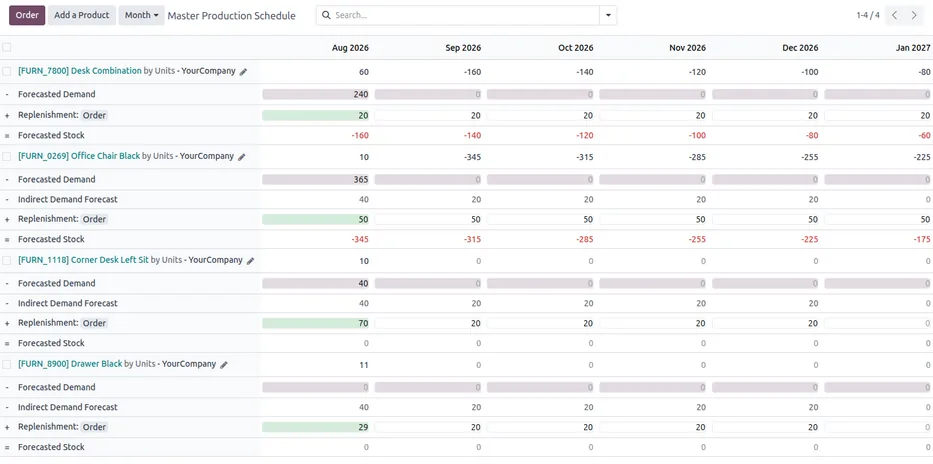
The meeting should start from the same numbers for sales, production and purchasing.
All four platforms we implement can support a planning process, with different depth. Confirm features against your edition.
| Zoho | Odoo | ERPNext | Dynamics 365 | |
|---|---|---|---|---|
| Master production schedule | No native MPS; typically built in Zoho Creator or planned in Zoho Analytics | Master Production Schedule screen in Odoo Enterprise | Production Plan document built from sales orders or material requests | MPS and planning worksheets in Business Central; master planning in Supply Chain Management |
| Forecast input | Imported or calculated in Analytics | Forecast quantities entered in the MPS | Sales forecast feature in recent versions; confirm for yours | Demand forecasts in both products |
| Capacity view | Custom reports | Work center load and planning views | Capacity planning on work orders and workstations | Capacity load and rough-cut views |
| Plan to execution | Custom workflow to create assemblies | MPS replenishment creates manufacturing and purchase orders | Plan creates work orders and material requests | Firm planned orders become production and purchase orders |
| Typical fit | Light assembly or planning done outside the ERP | SME and mid-sized plants wanting an integrated plan | Plants planning from firm orders with modest forecasting | Multi-site or high-volume plants with formal sales and operations planning |
Capabilities change with each release. We implement all four and recommend by fit after reviewing your products and volumes.
A plan is only as good as the demand and capacity signals it receives.
Planning decisions affect labor, stock and cost reporting. This is general information, not tax or legal advice.
Plans that assume overtime must respect UAE Labour Law limits on working hours and overtime pay, and reduced hours during Ramadan. Build realistic shift calendars into the capacity check.
Building stock ahead of a peak increases closing inventory and work in progress, which affects cost of sales and taxable income under corporate tax. Finance should see the stock build in the plan.
Work orders, stock movements and production postings support your financial records, which generally need to be kept for at least five years.
General information, not tax or legal advice. Rules change; confirm current FTA, MOHRE and Ministry of Finance guidance with your advisor.
The benefits are visible in delivery performance and in calmer weeks on the floor.
Sales commits dates based on a plan that has been checked against capacity and material.
Peaks are built up in advance, so the plant runs steadily rather than swinging between idle time and overtime.
Agreed targets for finished goods reduce both shortages and excess.
Plan attainment and change reasons are measured, so the planning process improves over time.
Durations are typical ranges and assume BOMs and routings are already in the ERP.
Durations are typical ranges; your plan is agreed after discovery.
Agree planning horizon, frozen zone, product families and who approves the plan.
Load forecasts, stock targets, work center capacities and shift calendars.
Run several weekly cycles on one product family or line before extending.
Extend to all lines, connect the plan to MRP and start measuring attainment.
We configure the system for the rules UAE businesses report against, and test it before go-live.
General information, not tax or legal advice. Confirm current requirements with the FTA, MOHRE or your advisor. See all UAE compliance guides.
On-site workshops in Dubai, Abu Dhabi and Sharjah, and remote or on-site delivery across the Northern Emirates and free zones.
Official sources and references
Facts on this page were checked against these sources in October 2026. Rules change, so confirm current requirements before acting.
Still have a question? Our consultants are happy to help.
Ask an ExpertA rolling 8-12 week horizon suits most SMEs, with the first one or two weeks frozen. Plants with long import lead times for materials often look further ahead at product family level.
A planner or the plant manager owns it, but sales, purchasing and finance agree it in a short weekly meeting. Ownership by one role avoids constant changes from several directions.
Batch sizes and the number of changeovers in the plan drive setup cost per unit. Our page on production costing explains how planned and actual costs are compared.
Yes. Plan attainment, load and stock projection fit well on a production dashboard that management reviews weekly.
The idea is similar, matching demand to limited resources, but project firms plan people across projects, while factories plan products across lines. See project resource planning for the project version.
Planning works best when it reads live orders, stock and BOMs, which is what an enterprise resource planning system provides. A standalone planning sheet quickly falls out of date.
Related Solutions
Related Industries
Related ERP Platforms
We map your current planning cycle and show how an ERP-based master production schedule would work for your lines and products.
Dubai, United Arab Emirates