
L
O
A
D
I
N
G


Zoho, Odoo, ERPNext, Dynamics 365 and custom ERP, delivered by one accountable team.

On a fixed fee contract the price is settled on day one. Everything after that is about cost: how much effort the job really takes, and whether extra scope gets paid for.
Fixed fee project billing in an ERP splits the agreed fee into phases with effort and cost budgets, bills by milestones or retainer, costs every timesheet hour at a loaded rate, and recognizes revenue on progress rather than invoice timing. UAE consultancies and fit-out contractors also price and approve change requests before extra work begins, protecting margin when scope grows.
Fixed fee project billing means the client pays an agreed price for a defined scope, regardless of how many hours or how much material the work consumes. UAE consultancies, design studios, software houses, audit and advisory firms and many fit-out contractors prefer fixed fees because clients like price certainty. The risk moves to the supplier: if the work takes longer than estimated, the overrun comes straight out of margin.
The invoices themselves are the easy part. A fixed fee is usually billed in instalments, by milestone or as a monthly retainer. The hard part is knowing, mid-project, how much of the fee has been earned, how much of the effort budget has been burned, and whether the remaining budget is enough to finish. That needs timesheets, cost rates and a forecast, all held against the same project.
This page covers the control side of fixed fee work: effort budgets, revenue recognition based on progress, and change control. For setting and approving the budget itself, see project budget management; for the overall picture across clients and services, see project profitability software.

These are the patterns we find when we look at fixed price projects that finished below their planned margin.
Teams know 70% of the hours are used but not whether 70% of the work is done. A project can look on budget right up to the point it runs out.
Extra reports, design rounds or integrations are agreed in meetings and delivered without a change order. The fee stays the same while effort grows.
A large advance makes the first month look very profitable and later months look like losses. Management decisions are made on misleading numbers.
Hours are tracked but not costed, so the project shows hours used, not money spent. Senior staff time is treated the same as junior time.
A monthly fixed retainer covers a set of services, but usage is never compared with the retainer value. Some clients consume twice what they pay for.
Estimates for the next proposal reuse the same assumptions, because actual effort by phase is never compared with the original estimate.
The cycle runs monthly, with progress and forecast updated before the books close.
One shared database: every step updates stock, finance and reports in real time.
The modules below give both the billing view and the margin view of the same contract.
Phase-by-phase effort estimates by role, stored as the baseline for the project.
Hours and cost budget per phase, with revisions recorded when a change request is approved.
Every hour costed at the employee's loaded rate, so burn is measured in money, not only time.
Percent complete per phase entered by the project manager or derived from tasks or deliverables.
Instalments or monthly retainer invoices generated from the agreed fee schedule.
Monthly entries that recognize revenue on progress and move the difference to contract assets or liabilities.
Requests with description, effort estimate, price and client approval, linked to the budget revision.
Fee, cost to date, forecast cost and forecast margin per project and phase.
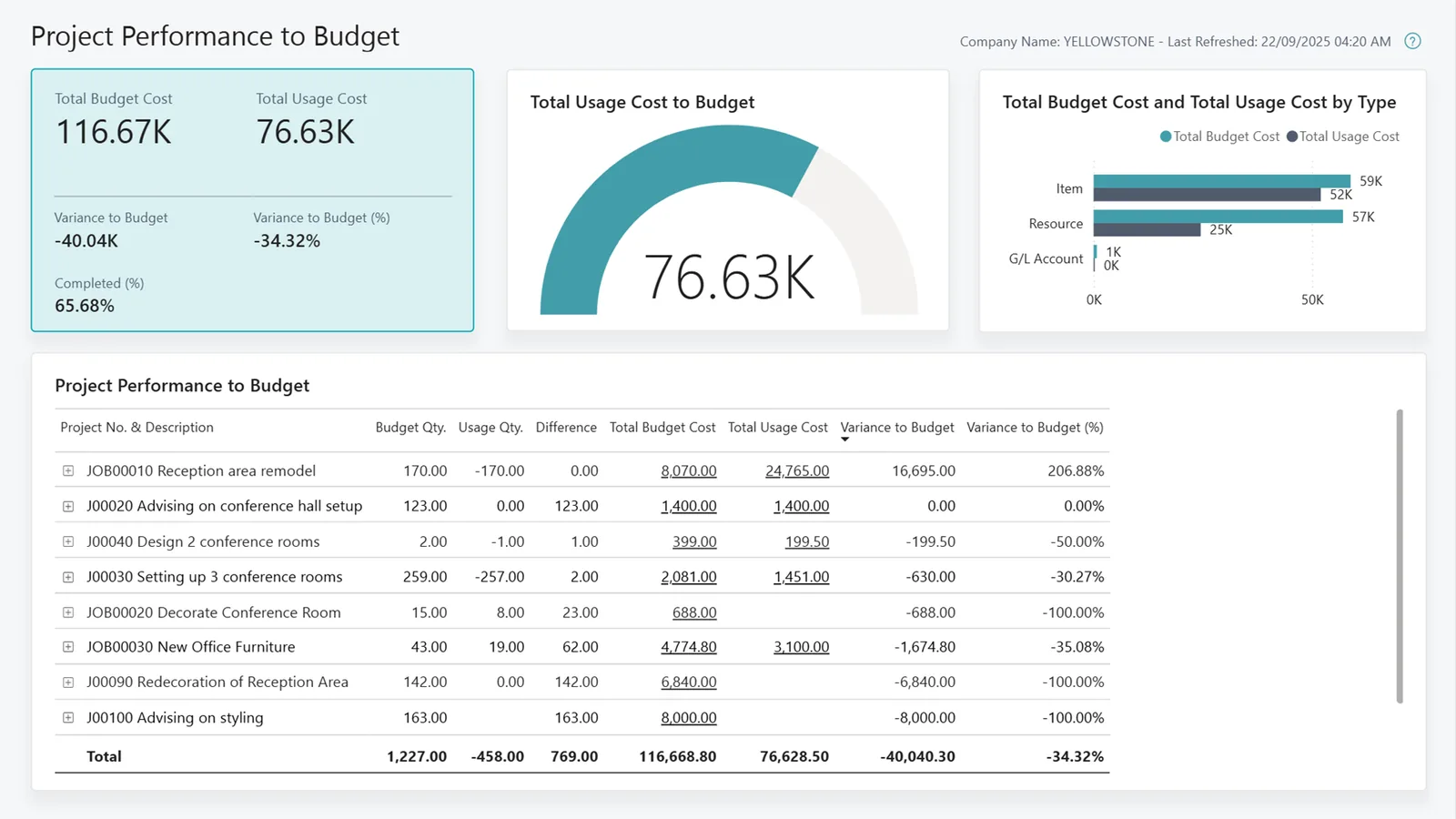
These reports work best in a short monthly review between the project manager and finance.
All four handle fixed price invoicing. Effort-based revenue recognition and forecasting differ more. Confirm features for your edition.
| Zoho | Odoo | ERPNext | Dynamics 365 | |
|---|---|---|---|---|
| Fixed fee billing | Fixed cost projects in Zoho Projects billed through Zoho Books | Sales order with fixed price lines, invoiced by milestone or manually | Sales order or payment schedule for fixed price | Fixed price jobs in Business Central; fixed price contract lines in Project Operations |
| Effort budget | Budget hours and cost in Zoho Projects | Planned hours on project and tasks; analytic budgets | Project budget via cost center or project, plus planned hours | Job planning lines with budget cost |
| Cost rates | User cost rates in Zoho Projects | Employee hourly cost feeds timesheet cost | Activity cost per employee | Resource unit cost; cost price lists |
| Revenue on progress | Usually by journal with Zoho Analytics support | Manual or custom entries in most setups | Journal entries or custom script | WIP and recognition methods on jobs in Business Central; confirm method support |
| Change control | Tasks or a Zoho Creator change request app | Additional sales order lines or project tasks | Custom change request doctype | Change orders through contract lines; approvals via Power Automate |
These connections keep costs, progress and approvals flowing into the project record.
These shape how fixed fee revenue and invoices are configured. Confirm the treatment with your auditor and tax advisor.
Corporate tax starts from accounting profit under the accounting standards you apply, so recognizing fixed fee revenue on progress rather than on invoicing affects taxable income per period.
VAT follows the invoice or payment date of each instalment, not the revenue recognized in the books. The ERP must keep the two separate.
Approved scope changes create new invoice lines; agreed fee reductions need tax credit notes referencing the original invoice.
Proposals, change approvals and progress assessments support the revenue figures and should be kept with the project for at least five years.
General information, not tax or legal advice. Rules change; confirm current FTA, MOHRE and Ministry of Finance guidance with your advisor.
The value is earlier warning and better pricing, not more invoices.
Burn compared with progress shows a problem while there is still budget left to react.
Extra work goes through a priced change request instead of being absorbed.
Revenue on progress gives a steadier P&L than revenue on invoicing.
Actual effort by phase feeds back into estimates for the next fixed price bid.
Typical ranges when adding fixed fee control to an existing project setup.
Durations are typical ranges; your plan is agreed after discovery.
Agree phases, cost rates, progress method and the revenue recognition approach with finance and the auditor.
Set up budgets, cost rates, billing plans, change request records and reports.
Load live fixed fee projects with fee billed, cost to date and current percent complete.
Run the progress and forecast review for two cycles, then adjust thresholds and reports.
We configure the system for the rules UAE businesses report against, and test it before go-live.
General information, not tax or legal advice. Confirm current requirements with the FTA, MOHRE or your advisor. See all UAE compliance guides.
On-site workshops in Dubai, Abu Dhabi and Sharjah, and remote or on-site delivery across the Northern Emirates and free zones.
Official sources and references
Facts on this page were checked against these sources in October 2026. Rules change, so confirm current requirements before acting.
Still have a question? Our consultants are happy to help.
Ask an ExpertBecause hours are your cost. Without them you cannot see burn, forecast margin or learn how accurate your estimates were.
Common methods are cost-to-cost (cost to date divided by forecast total cost), deliverables completed, or a project manager's assessment. Choose one per contract type with your auditor and apply it consistently.
Record every out-of-scope request, estimate it and get client approval before work starts. A project approval workflow helps by routing change requests to the right people automatically.
It is a fixed fee per period. Track usage against what the retainer covers so you can renegotiate or bill overage at the agreed rate.
Under most accounting standards an expected loss on an onerous contract should be recognized when it becomes known. The forecast in the ERP is what tells you early.
It depends on size and existing tools. Smaller service firms often fit Zoho Projects with Zoho Books, while firms wanting one database for sales, projects and accounting often choose Odoo Project.
Related Solutions
Related Industries
Related ERP Platforms
Related Guides
Talk to a consultant about setting up burn, progress and change control for your fixed price work.
Dubai, United Arab Emirates