
L
O
A
D
I
N
G


Zoho, Odoo, ERPNext, Dynamics 365 and custom ERP, delivered by one accountable team.

Time-based, fixed fee, milestone, progress and retainer contracts all need different invoices. Project billing software handles them in one process, so nothing billable is missed and every invoice is VAT-ready.
Project billing software lets UAE project businesses bill time-based, fixed fee, milestone, progress and retainer contracts from one process. The billing method is set on each contract, billable events such as approved hours or completed milestones generate draft invoices, project managers approve them, advances and retention are deducted, and a VAT tax invoice is issued and tracked to collection.
Project billing software turns delivered work into accurate client invoices. In a UAE project business the hard part is not printing the invoice; it is knowing what to bill, when, and under which rules. One client pays monthly for approved hours, another pays 30% on signing and the rest on milestones, a third is billed on certified progress with 10% retention held back, and a fourth pays a fixed monthly retainer. If each is managed in a separate spreadsheet, billing depends on one accountant remembering everything.
A proper setup stores the billing method on the contract and builds a billing schedule for every project. Each billing period, the system proposes draft invoices from the right source: approved hours and expenses for time-based work, completed milestones for staged payments, certified progress for construction-style contracts. The project manager confirms, finance issues a VAT tax invoice, and advances, retention and credit notes are tracked against the contract balance.
This page covers the billing engine as a whole. Each contract type has its own deep dive: milestone billing, time and material billing, fixed fee project billing and, for contractors, progress billing. Here we focus on what all of them share.

Billing problems show up as cash flow problems. These are the root causes we usually find.
A milestone was completed in the second week but nobody told finance, so the invoice goes out a month late. On a long project, these delays add up to a large unbilled balance.
Rates, payment stages, retention percentages and expense rules live in signed PDFs. Each invoice is prepared by reading the contract again, and mistakes slip through.
An advance paid at signing should be recovered proportionally from later invoices. Without tracking, it is deducted twice, or not at all, and the client disputes the account.
Missing PO numbers, wrong entity names, no supporting timesheet or the wrong VAT treatment cause large clients to reject invoices, which restarts their payment cycle.
Management sees receivables but not the value of work done and not yet invoiced. That unbilled WIP is often where cash is stuck.
The same cycle runs for every contract type; only the source of the billable amount changes.
One shared database: every step updates stock, finance and reports in real time.
Billing connects delivery, contracts and finance. These modules carry the data.
Contract value, billing method, rates, payment terms and client PO reference, set once per project.
Planned invoice dates or triggers per project, with alerts when a billing event is due.
Approved billable hours and expenses that feed time-based invoices.
Completed milestones or certified progress percentages that trigger staged invoices.
Tax invoices with the client's TRN, PO number and supporting detail, plus credit notes linked to the original invoice.
Advance invoices, proportional recovery and retention receivable tracked as separate balances.
Aging, reminders and dispute tracking per project and client.
Clients view and download invoices and supporting timesheets, which shortens query cycles.
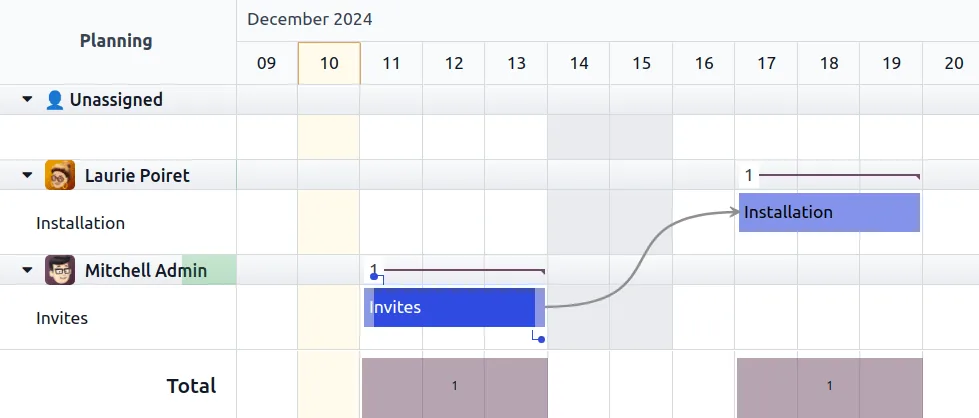
These reports show what should be billed, what has been billed and what is stuck.
Each platform handles the common billing methods. Advance recovery and retention are the areas that most often need configuration. Confirm for your edition.
| Zoho | Odoo | ERPNext | Dynamics 365 | |
|---|---|---|---|---|
| Billing methods | Zoho Books projects: fixed cost, project hours, task hours or staff hours | Invoicing policy per service: ordered quantity, timesheets, milestones or delivered quantity | Billing from timesheets, sales orders or payment schedules | Fixed price and time-and-material contract lines in Project Operations; project billing via planning lines in Business Central |
| Milestones | Milestones in Zoho Projects; invoicing typically per stage in Books | Milestone-based invoicing on sales order lines | Payment schedule on sales order or terms template | Milestone billing on fixed price contract lines |
| Advances | Retainer invoices applied to later invoices | Down payment invoices deducted from final invoices | Advance payments allocated against invoices | Advance invoicing in Project Operations; prepayments in Business Central |
| Retention | Usually via custom fields or separate lines | Often via custom setup or apps | Commonly via custom fields or retention accounts | Retention handling depends on configuration or add-ons |
| Client-facing detail | Timesheet details on invoices; client portal | Timesheet lines on invoice; customer portal | Timesheet detail on invoice print formats; customer portal | Invoice detail from approved transactions; customer portal options |
Retention and advance recovery rules vary widely; we confirm them during discovery.
These connections reduce invoice rejections and get money in sooner.
Every project invoice is a tax document. These points apply to most project billing setups; confirm specifics with your tax advisor.
Invoices must show your TRN, the client's TRN where applicable, the 5% VAT amount and the other prescribed fields. Templates should be set once and locked.
For advances, milestones and periodic billing, VAT is generally due at the earlier of invoice date or payment received. Advance invoices therefore carry VAT, and the ERP must not charge it again when the advance is recovered.
Under Ministerial Decisions 243 and 244 of 2025, invoices will be exchanged through Accredited Service Providers using PINT AE: from 1 January 2027 for businesses with revenue of AED 50 million or more, and 1 July 2027 for others. Check the latest MoF and FTA guidance.
Corrections and write-downs after issue need a tax credit note referencing the original invoice, not an edited invoice.
Invoices, contracts and billing approvals are tax records to be kept for at least five years, or seven for real estate.
General information, not tax or legal advice. Rules change; confirm current FTA, MOHRE and Ministry of Finance guidance with your advisor.
Qualitative outcomes; results depend on contract mix and starting point.
Billing events trigger draft invoices, so the gap between work done and invoice sent shrinks.
Invoices carry PO numbers, supporting detail and correct advance deductions, so clients have less to query.
Management sees unbilled WIP alongside receivables and can chase both.
Structured invoice data is in place before the UAE e-invoicing mandate applies to your business.
Indicative ranges for a mid-size project firm; the number of contract types and live projects matters most.
Durations are typical ranges; your plan is agreed after discovery.
Catalogue billing methods, advance and retention terms, and client invoice requirements.
Set up billing methods, schedules, invoice templates, advance and retention handling.
Enter open contracts with invoiced-to-date, advance balances and retention held.
Produce invoices in the ERP and compare with the old process before switching.
Connect to your chosen Accredited Service Provider in line with your mandatory date.
We configure the system for the rules UAE businesses report against, and test it before go-live.
General information, not tax or legal advice. Confirm current requirements with the FTA, MOHRE or your advisor. See all UAE compliance guides.
On-site workshops in Dubai, Abu Dhabi and Sharjah, and remote or on-site delivery across the Northern Emirates and free zones.
Official sources and references
Facts on this page were checked against these sources in October 2026. Rules change, so confirm current requirements before acting.
Still have a question? Our consultants are happy to help.
Ask an ExpertYes. Most ERPs allow different lines on one contract, for example a fixed design fee plus time-based site support plus re-billed expenses, each billed by its own rule.
Usually as a percentage deduction on each invoice until the advance is fully recovered, or in full against the final invoice. The ERP should track the remaining advance balance per contract.
Retention is deducted on each invoice and held as a separate receivable, released on handover or after the defects period. Contractors should also see construction retention management.
In-scope businesses will issue invoices through an Accredited Service Provider under the UAE e-invoicing rules from 2027, depending on revenue. See UAE e-invoicing for service companies and check the latest official guidance.
Some firms share a pro forma or billing statement through the client portal for approval, then issue the tax invoice. This cuts rejections from large clients with strict procurement rules.
Zoho Books suits simpler service billing, Odoo and ERPNext cover mixed contract types well, and Dynamics 365 suits complex multi-entity contracts. We implement all four; see project financial management for the wider process.
Related Solutions
Related Industries
Related ERP Platforms
We map your contract types and set up a billing process that produces correct, VAT-ready invoices every cycle.
Dubai, United Arab Emirates










