L
O
A
D
I
N
G


Zoho, Odoo, ERPNext, Dynamics 365 and custom ERP, delivered by one accountable team.

On a project, a purchase order is a commitment against a budget that is already set. Project procurement software makes that commitment visible the moment it is raised, not when the supplier invoice arrives.
Project procurement software handles buying that belongs to a specific project, so every requisition and purchase order carries a project and cost code and is checked against the remaining project budget before approval. It records committed cost from open POs, compares supplier quotes, receives goods at site, runs three-way matching and posts cost, including items rebilled to clients, so overspends show before invoices arrive.
Project procurement software handles buying that belongs to a specific project: equipment for an IT rollout, materials for a fit-out, specialist subcontract services for an engineering package, or hardware bought for a client and rebilled. Unlike general procurement software, every requisition and purchase order carries a project and cost code, and the system checks it against what is left in the project budget before it is approved.
In many UAE project firms the buyer works from emails and WhatsApp messages from the site or project team. Purchase orders are raised correctly, but they are coded to a general expense account or to the wrong project, and the project manager only sees the cost when the supplier invoice is posted weeks later. By then the budget is already overspent. Tracking committed cost (open POs not yet invoiced) is what closes this gap, and it is the input that project costing and budget control depend on.
Contractors with BOQ-driven buying, material requests from site and subcontract packages will find more detail on construction procurement software. This page covers project procurement for service, technology, engineering and mixed project businesses.

These are the issues project managers and finance raise most often about buying for projects.
POs are raised without a project code and finance allocates the cost later from the invoice description. Some costs land on the wrong project and some on overheads.
The project report shows only invoiced cost. Large open orders are invisible, so the budget looks healthier than it is.
Approval limits are based on PO value alone. A small PO on a project with no budget left goes through without question.
Switchgear, servers or imported furniture with long delivery times are ordered when they are needed, not when the plan says. The project schedule absorbs the delay.
Items bought on behalf of the client are paid for and installed, but never added to the client invoice.
Goods are delivered directly to site and the delivery note stays with the site engineer. Finance cannot match the supplier invoice, and payment is delayed or made without proof of receipt.
The flow keeps the project code and budget check on every document from request to payment.
One shared database: every step updates stock, finance and reports in real time.
These modules need to share the project and cost code structure so commitments and actuals line up.
Requests from project teams with item, quantity, required date, delivery location and project code.
Checks each request against the project budget less committed and actual cost, and warns or blocks when exceeded.
Requests for quotation to several suppliers with a comparison sheet on price, delivery time and terms.
POs that inherit the project and cost code, with delivery address on site or at the client.
Goods received at a warehouse or directly at site, with partial deliveries and returns.
Supplier invoices matched to PO and GRN before payment, with VAT recorded correctly.
Approval routes by PO value, project and budget status, with the project manager always in the loop.
Approved supplier lists, trade licence and TRN details, and supplier performance on delivery and quality.
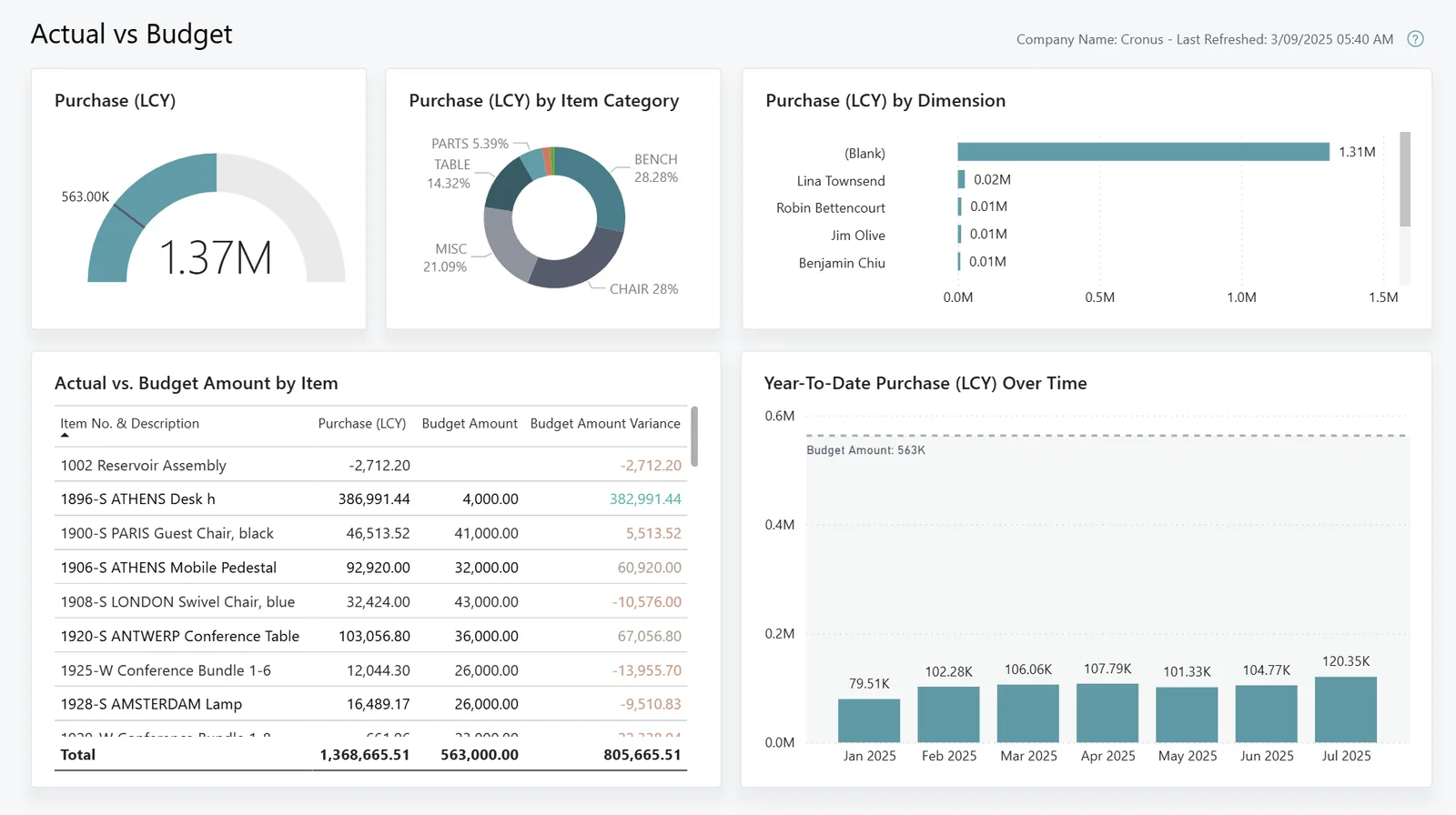
These reports serve both the procurement team and the project managers.
All four platforms let you code purchases to projects. Commitment tracking and budget checks differ. Confirm for your edition.
| Zoho | Odoo | ERPNext | Dynamics 365 | |
|---|---|---|---|---|
| Project-coded POs | POs in Zoho Books or Inventory linked to projects | Analytic distribution on purchase lines | Project field on material request, PO and invoice | Job number and task on purchase lines in Business Central |
| Requisitions | Usually via Zoho Creator or approval workflows | Purchase requisition / agreements apps (Enterprise) | Material Request doctype | Requisition worksheets; purchase requisitions in Finance and Supply Chain |
| Budget check | Budget reports; hard checks need custom logic | Analytic budgets with committed amounts in recent versions | Budget against project or cost center with warn or stop actions | Budget control in Finance; job budget comparison in Business Central |
| RFQ comparison | Manual or Zoho Creator app | RFQs and purchase agreements (calls for tender) | Request for Quotation and Supplier Quotation comparison | Requests for quotation in Finance and Supply Chain |
| Three-way match | Bill against PO with received quantities | Bill control on received quantities | Purchase receipt and invoice matching | Matching policies in Finance and Supply Chain |
These connections reduce retyping between site, buyer and finance.
These points affect how purchase documents and supplier invoices are recorded. Confirm specifics with your tax advisor.
Input VAT on project purchases is recoverable only with a valid tax invoice and where the cost relates to taxable supplies. Matching supplier invoices to POs and GRNs supports the claim.
Imported equipment and services from abroad usually fall under the reverse charge mechanism for VAT, and goods may attract customs duty. Record these on the project cost.
When e-invoicing applies, supplier invoices will arrive in PINT AE format through your Accredited Service Provider. Your AP matching process should be ready to receive them. Check the latest Ministry of Finance and FTA guidance.
POs, delivery notes, GRNs and supplier invoices should be kept for at least five years and linked so an auditor can trace a project cost to its source.
General information, not tax or legal advice. Rules change; confirm current FTA, MOHRE and Ministry of Finance guidance with your advisor.
The main gain is knowing project cost before the invoice arrives.
Committed cost shows overruns at requisition stage, when the purchase can still be changed.
Every purchase carries its project code from the start, so reports need fewer corrections.
Long-lead items are tracked against the date the project needs them.
Purchases made for the client are flagged and added to the next invoice.
Typical ranges when introducing project-coded procurement.
Durations are typical ranges; your plan is agreed after discovery.
Agree the cost code structure, approval matrix and budget check rules with project and finance leads.
Set up requisitions, RFQs, PO templates, site receiving and approval routes.
Load open POs with project codes so committed cost is correct from day one.
Train project teams on requisitions and site GRNs, then buyers and AP on matching.
We configure the system for the rules UAE businesses report against, and test it before go-live.
General information, not tax or legal advice. Confirm current requirements with the FTA, MOHRE or your advisor. See all UAE compliance guides.
On-site workshops in Dubai, Abu Dhabi and Sharjah, and remote or on-site delivery across the Northern Emirates and free zones.
Official sources and references
Facts on this page were checked against these sources in October 2026. Rules change, so confirm current requirements before acting.
Still have a question? Our consultants are happy to help.
Ask an ExpertCommitted cost is the value of approved purchase orders and subcontracts that have not yet been invoiced. Adding it to actual cost shows the real budget consumed.
Many firms start with a warning and an extra approval step rather than a hard block, so urgent site needs are not stopped. Hard blocks suit firms with mature budgeting.
Yes. All four platforms offer mobile access in some form, and site requisitions and GRNs are among the most useful mobile uses.
Flag the PO line as rebillable. When the supplier invoice is posted, the line appears in the billing queue for the client, at cost or with the agreed markup.
Project procurement adds the project dimension. Company-wide spend, supplier and cycle time analysis sits on a procurement dashboard.
It depends on your project volume and existing systems. We implement Zoho, Odoo, ERPNext and Dynamics 365, and recommend based on your budget control and approval needs.
Related Solutions
Related Industries
Related ERP Platforms
We will map how your project teams request and buy today, and design a budget-checked purchasing flow.
Dubai, United Arab Emirates