
L
O
A
D
I
N
G


Zoho, Odoo, ERPNext, Dynamics 365 and custom ERP, delivered by one accountable team.

Projects are won on a sales forecast and delivered by people. Project resource planning is how you know, weeks ahead, whether those people will be available.
Project resource planning matches people, skills and sometimes equipment to project work over coming weeks. UAE consultancies, engineering offices, IT firms and MEP contractors use ERP resource planners that read employee records, leave and public holiday calendars, tentative bookings for pipeline deals and firm bookings for won work, then compare planned hours with timesheets to show utilization and bench time.
Project resource planning is the process of matching people, skills and sometimes equipment to project work over the coming weeks and months. For UAE consultancies, engineering offices, IT service firms and MEP contractors, the main resource is staff time, and the main question is simple: do we have the right people free to start the projects we are about to win, and are the people we already pay working on billable work?
In most firms the answer lives in a spreadsheet that the operations manager updates on Sundays. It shows names down the side and weeks across the top, and it is out of date by Tuesday. A resource plan inside the ERP or project management ERP uses the same employee records, leave calendar, project tasks and timesheets as the rest of the business, so planned and actual time can be compared and the plan stays current.
This is different from production planning in manufacturing, which schedules machines and work orders. Project resource planning deals with people who have skills, leave, visas, site access cards and different cost rates. It also feeds the money side: every allocation has a cost, and the plan is the basis for cost forecasts in project budgets.

These issues come up in almost every resource planning review we run.
The same senior engineer or solution architect is promised to three projects starting in the same month. Delivery dates slip and the client hears about it first.
Staff between projects are not visible, so the firm hires freelancers while its own people wait. Salary, housing and visa costs continue regardless.
Annual leave, public holidays and reduced Ramadan working hours are not reflected in capacity, so plans assume hours that do not exist.
Sales commits start dates without checking capacity. Delivery learns about the project after it is signed.
Nobody knows quickly who holds a specific certification, Arabic language skills or a site access permit. Staffing depends on who the manager remembers.
Allocations are tracked in hours only, so the effect on project cost and margin is not known until timesheets arrive.
Planning runs weekly, with demand from sales and projects and supply from HR.
One shared database: every step updates stock, finance and reports in real time.
Resource planning combines HR data with project demand, so it touches more than the projects module.
Role, department, skills, certifications, languages and site permits recorded on each employee.
Approved leave, public holidays and working-hour calendars that reduce available capacity.
A grid or Gantt view of allocations by person and week, with tentative and confirmed bookings.
Expected start dates and roles for deals likely to close, used for tentative demand.
Planned hours by task and role, which become the demand the planner must cover.
Actual hours compared with planned allocations to show drift and update forecasts.
Loaded cost per hour including salary, allowances, visa and housing, so each allocation has a cost.
Freelancers and partner firms with rates and availability, for gaps the internal team cannot cover.
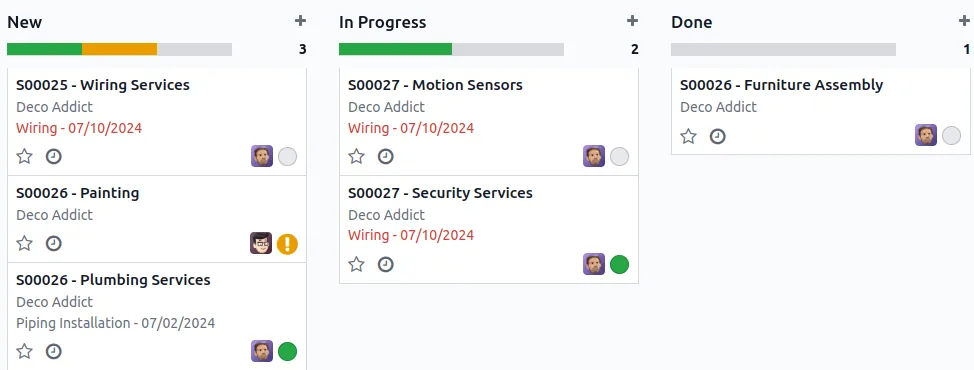
These views help the operations manager, project managers and HR agree on staffing.
All four can show allocations. Skills matching and pipeline-driven planning vary. Confirm for your edition.
| Zoho | Odoo | ERPNext | Dynamics 365 | |
|---|---|---|---|---|
| Allocation view | Resource utilization chart in Zoho Projects | Planning app with shifts and project roles (Enterprise) | Project and task assignments; planner views usually configured | Resource scheduling in Business Central; schedule board in Project Operations |
| Leave in capacity | Zoho People leave can inform availability | Time off reduces availability in Planning | Leave applications and holiday lists from HR module | Calendars and absence in Project Operations / HR |
| Skills matching | Usually custom fields or Zoho Creator | Roles and skills on employees; matching depends on version | Custom fields and reports | Characteristics and resource matching in Project Operations |
| Tentative bookings | Usually tracked as separate tasks | Planning slots can be unpublished drafts | Custom status on assignments | Soft and hard bookings in Project Operations |
| Planned vs actual | Timesheets versus planned hours | Planning versus timesheet reports | Timesheet versus task expected time | Planned versus actual on jobs and projects |
A plan is only as current as the HR and pipeline data that feeds it.
These rules change how many hours your people actually have. Check current MOHRE announcements and your HR policies.
Private sector working hours are set by UAE Labour Law, and reduced hours during Ramadan are announced each year. Capacity calendars should reflect both.
Statutory annual leave and announced public holidays reduce available hours. Load them into the calendar before planning the quarter.
Loaded cost rates should match payroll actually paid through WPS, including allowances, so project cost forecasts are realistic.
Skills, certifications and availability are personal data. Limit access by role and keep processing in line with the UAE data protection law.
General information, not tax or legal advice. Rules change; confirm current FTA, MOHRE and Ministry of Finance guidance with your advisor.
These benefits show in both delivery and cost.
Conflicts appear in the plan before they appear on site or in front of the client.
Free capacity is visible and offered to sales and project managers early.
Sales commits dates that delivery can meet because tentative demand is in the plan.
Allocations carry cost rates, so project budgets reflect who is really assigned.
Typical ranges for a firm moving resource planning out of spreadsheets.
Durations are typical ranges; your plan is agreed after discovery.
Confirm employee roles, skills, cost rates and leave balances in the HR records.
Configure the planner, calendars, booking statuses and links to projects and CRM.
Move the existing spreadsheet allocations into the system for the next quarter.
Run the weekly resource meeting from the system and adjust reports until it replaces the spreadsheet.
We configure the system for the rules UAE businesses report against, and test it before go-live.
General information, not tax or legal advice. Confirm current requirements with the FTA, MOHRE or your advisor. See all UAE compliance guides.
On-site workshops in Dubai, Abu Dhabi and Sharjah, and remote or on-site delivery across the Northern Emirates and free zones.
Official sources and references
Facts on this page were checked against these sources in October 2026. Rules change, so confirm current requirements before acting.
Still have a question? Our consultants are happy to help.
Ask an ExpertNo. Resource planning is one function within enterprise resource planning. It focuses on people and their time on projects.
Both. Plan by role early, when a project is still in the pipeline, and assign named people once the project is confirmed and the start date is close.
Most UAE project firms plan firmly four to eight weeks ahead and tentatively for the quarter. Longer horizons are useful only for hiring decisions.
Yes. Record them as external resources with rates and availability so gaps can be filled from the same plan. Their purchase orders then go through project procurement.
It depends on the role and business model. Set targets per role with your management team, then use the ERP to measure against them rather than adopting a generic figure.
Dynamics 365 Project Operations has the deepest scheduling for larger firms, Odoo Planning suits mid-sized teams, and Zoho Projects covers simpler needs. We implement all four and recommend by fit.
Related Solutions
Related Industries
Related ERP Platforms
We will look at how you plan people today and show how the same plan would run inside your ERP.
Dubai, United Arab Emirates