
L
O
A
D
I
N
G


Zoho, Odoo, ERPNext, Dynamics 365 and custom ERP, delivered by one accountable team.

Slow movers still sell, just not fast enough to justify the cash and shelf space they hold. An ERP measures velocity per item and per warehouse so buyers and sales teams can act while the stock is still sellable.
An ERP manages slow-moving inventory in the UAE by measuring sales velocity per item and per warehouse, then flagging lines that fall below agreed thresholds. Buyers can pause auto-reorder, sales teams can plan clearance, and finance sees slow and non-moving stock value monthly. Zoho, Odoo, ERPNext and Dynamics 365 all support this through aging and movement reports, with some needing customized reports.
An ERP for slow moving inventory in the UAE answers a question most trading and distribution companies cannot answer from their current system: which items are still selling, but at a rate far below what you bought for? A spare-parts distributor in Al Quoz may hold 9,000 SKUs where the top 15 percent of lines drive most of the revenue and several thousand lines sell a few units a quarter. Those slow lines tie up cash, rent in Jebel Ali or Sharjah warehouses, and buyer attention.
Slow moving stock is different from dead stock. Dead stock has stopped moving entirely and needs write-off or liquidation decisions, which we cover on the dead stock management page. Slow movers are the stage before that: items where sales velocity has dropped, where reorder rules still fire out of habit, and where a timely price change, transfer or supplier return can still recover full value.
The usual root causes are familiar: minimum order quantities from overseas suppliers that exceed real demand, a buyer who orders for a project that was cancelled, a product line replaced by a newer model, or reorder levels set two years ago and never reviewed. Without item-level movement data, nobody sees the problem until the annual stock count or the auditor's provision discussion. It is one of the most common inventory problems we are asked to fix, and it is usually tied to weak inventory accuracy, because velocity data is only as good as the stock balances behind it.

Most UAE SMEs we meet already know they have too much stock. What they lack is a reliable way to say which items, where, and since when.
Finance sees one inventory balance on the trial balance. Nobody can break it into fast, normal and slow lines without a day of spreadsheet work.
Min-max levels set at go-live keep generating purchase suggestions for items that now sell twice a year. Buyers approve them because the system said so.
Importing a full container from China or India lowers unit cost but can leave 18 months of supply for low-demand variants. The landed cost saving disappears in holding cost. A FIFO view of cost layers, as on our FIFO inventory page, shows how long those layers sit.
An item may be slow in the Abu Dhabi branch while Dubai keeps running short of it. Without warehouse-level velocity, inter-branch transfers do not happen.
Purchasing blames sales forecasts, sales blames pricing, and finance only raises it at year-end. Slow movers need a named owner and a monthly action list.
The aim is a repeatable monthly cycle, not a one-time clean-up. Each step uses data the ERP already captures from GRNs, delivery notes and invoices.
One shared database: every step updates stock, finance and reports in real time.
These are the settings and routines we configure when slow moving stock is the main complaint.
Agree definitions with management, for example fast (sold in each of the last 3 months), slow (sold in fewer than 3 of the last 6 months or below a set turnover ratio) and non-moving (no issue in 180 days). Thresholds differ for FMCG, spare parts and project materials.
The ERP compares average monthly consumption with on-hand quantity to show days of cover per item and warehouse. An item with 400 days of cover in a business that turns stock four times a year is a clear candidate.
Flagged items get their reorder rule paused or their maximum reduced, so the replenishment process stops suggesting new POs. Buyers can still order manually against a confirmed customer order.
Sales receives a list with cost, current price floor and quantity, then chooses a promotion, bundle, inter-branch transfer or a return-to-supplier request. Each action is recorded so the next review shows what moved.
Slow movers are a cross-functional problem, so the fix touches more than the stock module.
Item master, warehouse balances and FIFO or weighted-average cost layers give the quantity and value behind every slow line.
Reorder rules, supplier lead times and MOQ data decide whether a new PO is justified or should be blocked.
Price lists, promotional pricing and bundle items help sales clear slow lines without manual price overrides on each invoice.
Transfer orders move slow stock to the branch or showroom where it still sells, with in-transit tracking.
Purchase returns and debit notes record stock sent back under supplier agreements, with the VAT adjustment handled on the document.
Movement analysis, ABC classification and days-of-cover reports, scheduled to arrive before the monthly review.
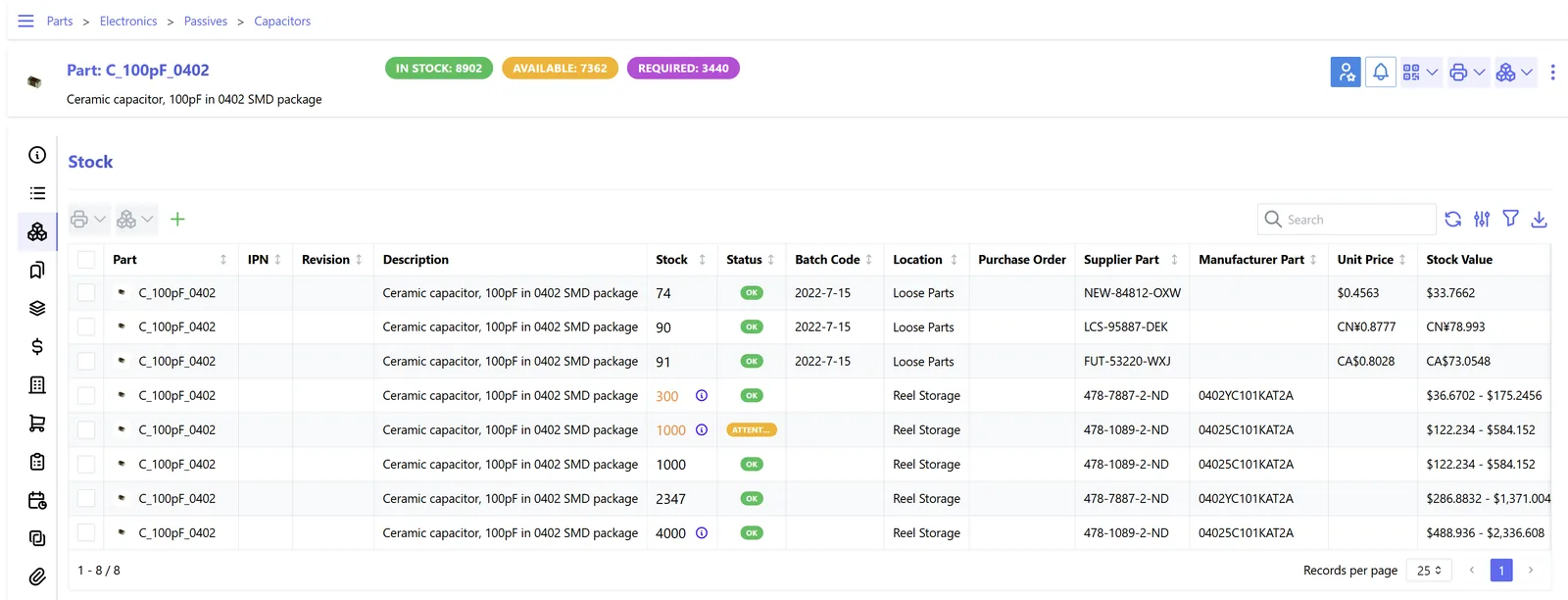
One screen replaces the year-end spreadsheet exercise. It is filtered by warehouse, category and buyer.
All four platforms we implement can support this process. The difference is how much is standard and how much needs a report or small customization. Capabilities vary by edition, so confirm for yours.
| Zoho | Odoo | ERPNext | Dynamics 365 | |
|---|---|---|---|---|
| Movement and aging reports | Inventory aging and sales-by-item reports in Zoho Inventory; deeper analysis in Zoho Analytics | Stock moves and valuation reports with pivot views; slow-mover logic usually a filtered report | Stock Ageing and Stock Analytics reports are standard | Business Central item age and inventory reports; Power BI for velocity analysis |
| Reorder control | Reorder points per item with notifications | Reordering rules (min/max) per warehouse in the Replenishment view | Item reorder levels per warehouse with auto material request option | Reordering policies and planning or requisition worksheets |
| Valuation method | FIFO-based costing; confirm options for your plan | FIFO, AVCO or standard per product category | FIFO or moving average per item or company | FIFO, average, standard and others per item |
| Clearance pricing | Price lists and discounts in Zoho Inventory and Books | Pricelists and promotions in Sales and POS | Pricing rules and promotional schemes | Price lists and line discounts |
| Velocity classification | Usually built in Zoho Analytics | Custom field or report; ABC often via a module or customization | Custom report or script on stock ledger | ABC classification available in Supply Chain Management; BC via report |
| Best fit | Trading SMEs on Zoho Books and Inventory | Distributors wanting stock, sales and POS in one system | Cost-conscious traders comfortable with open source | Larger multi-entity groups with Power BI |
Hedged summary as of October 2026; product features change between versions.
Velocity is only accurate if every sale and issue reaches the ERP.
Clearance decisions have tax and audit consequences. These are the points we configure for; confirm treatment with your tax advisor.
Discounted clearance sales still need compliant tax invoices with TRN and the correct taxable value. Bundles need clear line pricing so 5% VAT is calculated on the right amount.
Goods returned to a UAE supplier should be supported by a debit note or the supplier's tax credit note so input VAT is adjusted correctly in the VAT return.
Inventory values feed the financial statements used for corporate tax. Write-downs of slow stock should follow your accounting policy and be documented; ask your advisor how they are treated.
Stock ledgers, transfer records and clearance approvals should be retained for at least five years in line with UAE tax record-keeping rules.
General information, not tax or legal advice. Rules change; confirm current FTA, MOHRE and Ministry of Finance guidance with your advisor.
Benefits depend on how disciplined the monthly review becomes, not just on the software.
Stopping repeat purchases of slow lines and clearing excess frees working capital for items that actually sell.
Finance sees slow and non-moving value monthly instead of discovering it during the audit provision review.
Buyers see days of cover and recent velocity on the PO screen before committing to a supplier MOQ.
Clearing slow stock frees racking and bin locations in rented warehouse space for higher-velocity products.
If you already run an ERP, this is often a configuration and reporting project. Durations are typical ranges, not commitments.
Durations are typical ranges; your plan is agreed after discovery.
Check item master quality, units of measure and the last 12 months of stock movements.
Agree movement classes, days-of-cover limits and who approves clearance pricing.
Set reorder controls, classification fields, dashboards and scheduled reports.
Run the first monthly review with purchasing, sales and finance, then adjust thresholds.
We configure the system for the rules UAE businesses report against, and test it before go-live.
General information, not tax or legal advice. Confirm current requirements with the FTA, MOHRE or your advisor. See all UAE compliance guides.
On-site workshops in Dubai, Abu Dhabi and Sharjah, and remote or on-site delivery across the Northern Emirates and free zones.
Official sources and references
Facts on this page were checked against these sources in October 2026. Rules change, so confirm current requirements before acting.
Still have a question? Our consultants are happy to help.
Ask an ExpertIt compares sales or issue quantities over a period with the quantity on hand and the date of last movement. You define the thresholds, for example turnover below a set ratio or days of cover above a limit, and the ERP applies them to every item and warehouse.
Slow moving analysis looks at how fast an item sells. Aging looks at how long specific quantities have been sitting since receipt. Both matter; our stock aging page covers age buckets and provisions.
Yes. Reorder rules can be paused or reduced for flagged items, and an approval step can be added when a PO includes a slow-moving line. Purchases backed by a confirmed customer order can still go through.
Only if marketplace orders flow into the ERP, either through a connector or a regular import. Otherwise an item that sells well online can look slow in the ERP. Tools such as Zoho Inventory and Odoo Inventory can pull marketplace orders in through connectors; confirm the connector for your channel.
ERPNext has a standard Stock Ageing report, Zoho and Dynamics 365 rely more on analytics tools, and Odoo handles it well with filtered reports. The right choice depends on the rest of your process, which we assess against your inventory management requirements.
Not automatically. Slow stock is often still sellable at a lower margin. Write-downs are an accounting decision for finance and auditors; the ERP gives them the evidence by item, quantity and age.
Related Solutions
Related Industries
Related ERP Platforms
We review your item movements and reorder rules and show where cash is tied up in slow lines.
Dubai, United Arab Emirates










