L
O
A
D
I
N
G


Zoho, Odoo, ERPNext, Dynamics 365 and custom ERP, delivered by one accountable team.

Garages and service centers in Al Quoz, Ras Al Khor, Mussafah and Sharjah Industrial Area use ERP to control job cards, parts, technician time and insurance approvals.
ERP for auto workshops in the UAE replaces paper job cards, parts registers and separate invoicing with one flow: vehicle check-in, inspection and estimate, customer or insurer approval, parts issue, logged labour and an invoice from work actually done. It handles walk-in card payments, monthly fleet statements by plate number, and insurance jobs split between insurer and customer excess.
ERP for auto workshops in the UAE replaces the paper job card, the parts register and the separate invoicing tool with one connected flow. A car arrives, an advisor records the complaint, a technician inspects and estimates, the customer or insurer approves, parts are issued, labor is logged and the invoice is generated from what was actually done. Every step leaves a record, which is what the paper process lacks.
UAE workshops have a particular mix of customers. Walk-in retail drivers pay by card on collection. Corporate fleets want monthly statements with every job listed by plate number. Insurance companies approve accident repairs, sometimes in stages, and pay after delivery minus the customer's excess. Each needs different paperwork and different credit terms, and the ERP must handle all three in the same workshop.
This page is for independent garages, specialist workshops (body and paint, AC, transmission, tyres) and multi-branch service networks. For the parts trading side, see ERP for auto parts trading; for equipment maintenance concepts that overlap, see maintenance management software.
These issues cost workshops money every week, often without anyone noticing.
Technicians take parts from the store for a job, but the job card is closed without them. Stock disappears and margin goes with it.
Without clock-on and clock-off per job, nobody knows whether a 2-hour job took 2 hours or 5. Flat-rate pricing then hides real losses.
Accident repairs wait for surveyor visits and approvals, and supplementary estimates need fresh sign-off. Cars occupy bays while paperwork sits in someone's inbox.
Corporate clients want each invoice tied to a plate, an odometer reading and an authorizing manager. Missing details delay payment for months.
When a returning car arrives, the advisor cannot see what was done last time. Repeat repairs and warranty claims become arguments instead of facts.
We build the ERP around this sequence, with variations for insurance and fleet jobs.
One shared database: every step updates stock, finance and reports in real time.
Most garages need these eight, configured for their service mix.
Complaint, inspection findings, photos, estimate lines and approvals on one digital card per visit.
Appointments, bay allocation and technician assignment with a daily workshop board.
Technicians clock on and off each job from a tablet, comparing actual time with estimated hours.
Part numbers, cross-references, bin locations, reorder levels and reservations against open jobs.
Claim numbers, surveyor approvals, supplementary estimates, excess amounts and insurer receivables.
Corporate customers with vehicles by plate, approved drivers, credit limits and monthly statements.
WhatsApp or SMS updates for approvals, ready-for-collection notices and service reminders.
Card and cash collection at the counter, VAT invoices and daily cash-up per branch.
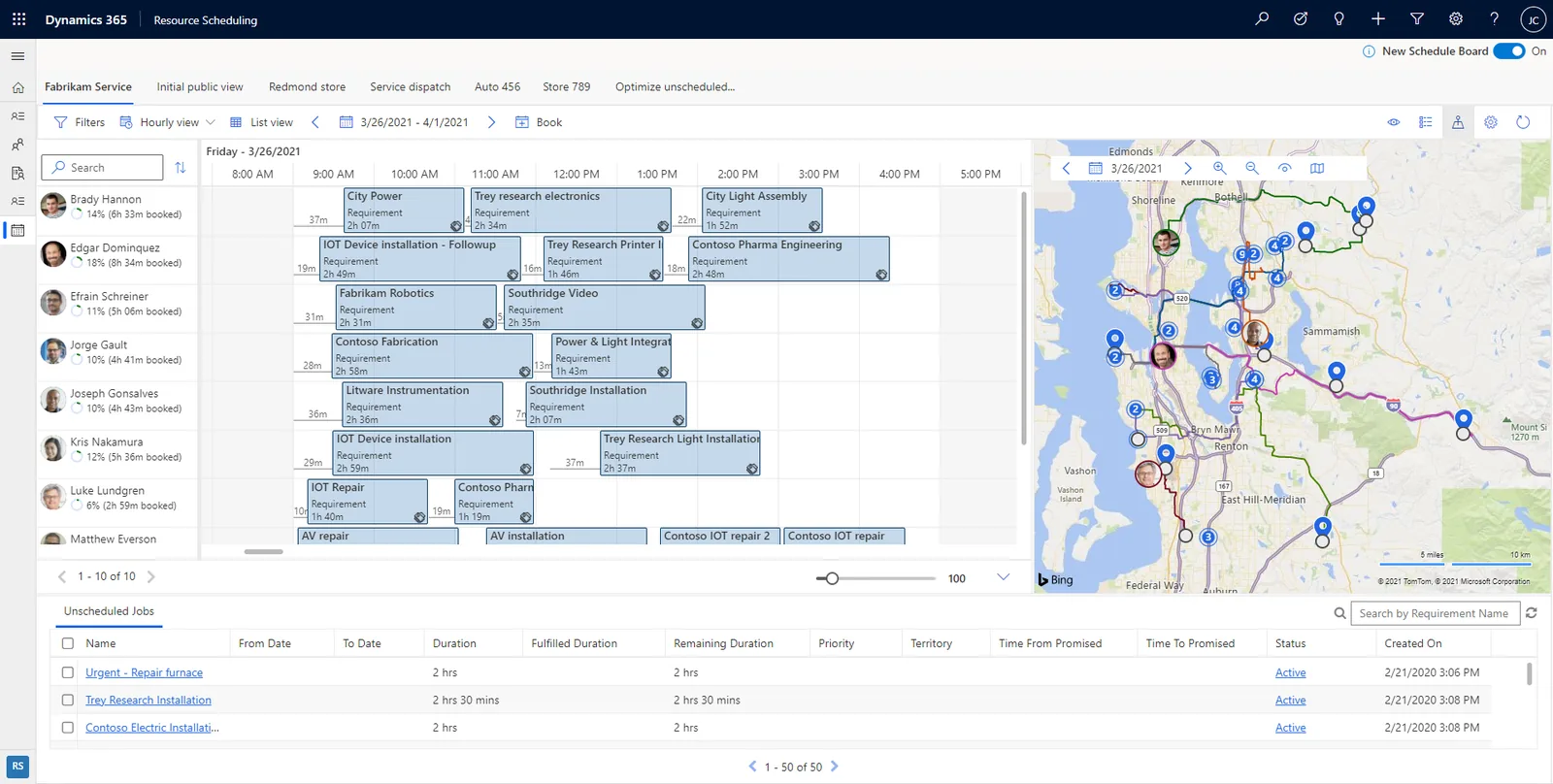
Service managers run the day from this screen instead of a whiteboard.
The right choice depends on volume, branch count and how much insurance work you do.
| Workshop profile | Often a good fit | Why |
|---|---|---|
| Single-bay or small specialist garage | Zoho One or a Zoho Creator app | Simple job cards, invoicing and stock at a low cost, adjustable without heavy development. |
| Mid-size multi-service workshop | Odoo (Repairs, Inventory, Accounting, POS) | Repair orders consume parts from stock and invoice directly, with POS at the counter. |
| Body and paint shop with heavy insurance work | Odoo or ERPNext with claim customization | Custom fields and workflows for surveyor approvals, supplements and excess. |
| Multi-branch service network | Dynamics 365 Business Central or Odoo | Branch-level stock and profit with central purchasing and consolidated reporting. |
| Workshop attached to a dealer group | Same platform as the group | Shared customers, vehicles and parts across sales and service. |
We configure the ERP to support these. Confirm tax treatment of insurance jobs with your tax advisor.
Repairs are standard-rated at 5%. Insurance jobs often split the invoice between the insurer and the customer's excess, so the ERP must produce correct tax invoices to each party.
Invoices carry your TRN, the customer's TRN for business clients, and the prescribed fields. Fleet invoices also benefit from plate and job references.
Workshop staff are paid through the Wage Protection System using a Salary Information File, with overtime and incentives calculated in payroll.
Invoices to insurers and corporate fleets will move to structured PINT AE e-invoices through an Accredited Service Provider from 2027. Check the latest Ministry of Finance and FTA guidance.
General information, not tax or legal advice. Rules change; confirm current FTA, MOHRE and Ministry of Finance guidance with your advisor.
These benefits are typical goals; actual gains depend on discipline at the counter and in the store.
Parts can only leave the store against a job, so they appear on the invoice.
Clocked time per job shows where training, tools or pricing need attention.
Approval status is visible to everyone, and overdue claims are chased on time.
Service history and automatic reminders bring customers back for their next service.
Indicative ranges for one to three branches.
Durations are typical ranges; your plan is agreed after discovery.
Shadow the service desk, store and workshop floor for a few days.
Set up job card templates, labor rates, parts catalog, insurance workflow and invoice formats.
Clean and import part numbers, cross-references, stock quantities and bin locations.
Run live jobs in one branch or service line with close support.
Roll out to all advisors and technicians, then review the first month's results.
Neighboring automotive pages and the modules behind a workshop system.
We configure the system for the rules UAE businesses report against, and test it before go-live.
General information, not tax or legal advice. Confirm current requirements with the FTA, MOHRE or your advisor. See all UAE compliance guides.
On-site workshops in Dubai, Abu Dhabi and Sharjah, and remote or on-site delivery across the Northern Emirates and free zones.
Official sources and references
Facts on this page were checked against these sources in October 2026. Rules change, so confirm current requirements before acting.
Still have a question? Our consultants are happy to help.
Ask an ExpertYes. Technicians use a tablet or phone to view assigned jobs, clock on and off, add photos and request parts. The interface can be kept simple with only the fields they need.
The job is split so the insurer is invoiced for the approved amount and the customer pays the excess. Both invoices link back to the same job card and claim number.
Yes, through WhatsApp Business integration. The customer receives the estimate and can approve it, and the approval is recorded on the job card.
It can require a job reference for every parts issue. Combined with regular cycle counts, this closes most of the gaps that cause stock losses.
Many platforms offer a customer portal where fleet managers view invoices, job history and upcoming services by plate number.
Each branch has its own warehouse, with transfers between them. Central purchasing can replenish all branches while each keeps its own profit report.
Related Solutions
Related Industries
Related ERP Platforms
Book a walkthrough and we will show a full job, from check-in to paid invoice, in the platform that fits your garage.
Dubai, United Arab Emirates