
L
O
A
D
I
N
G


Zoho, Odoo, ERPNext, Dynamics 365 and custom ERP, delivered by one accountable team.

Count small, scheduled parts of the warehouse every day, approve variances against tolerances and fix the causes while they are still fresh.
Cycle counting in an ERP counts a small, planned set of items or bin locations every day or week while operations continue, instead of closing the warehouse for a yearly count. The ERP selects what to count by ABC class, last count date and triggers like negative balances, sends blind count tasks to handhelds, checks variances against tolerance, requires recounts and approvals, and records root-cause codes.
ERP for cycle counting UAE replaces the idea that stock accuracy is a year-end event. Instead of closing the warehouse for a weekend to count everything, a cycle count program counts a small, planned set of items or bin locations every day or week, while normal operations continue. Over a quarter or a year, every location is counted at least once, and the items that matter most are counted much more often.
The program only works if the ERP drives it. The system decides what to count today, based on ABC class, last count date and triggers such as a negative balance or a failed pick. It sends a count task to a handheld without showing the expected quantity, compares the result against the book balance at that moment, and routes variances above tolerance for a recount and approval. The aim is not just a correct number: it is to find out why the number was wrong. That is what moves inventory accuracy in a lasting way.
Cycle counting complements, but does not always replace, the full physical stock count. Whether your auditors accept a strong cycle count program instead of a wall-to-wall count is a conversation to have with them early.

These are typical of trading, retail and spare parts warehouses in Dubai, Sharjah and Abu Dhabi.
Errors build up for twelve months. By the time the annual count finds them, nobody remembers the receipt, transfer or pick that caused them.
When the count sheet shows the system balance, counters tend to confirm it rather than count. Real errors stay hidden.
Goods are picked or put away in the bin while it is being counted. The variance is caused by timing, not by a real error, and good stock gets written off.
Storekeepers adjust balances themselves to make orders work. Shrinkage and theft can hide inside these adjustments for months.
Variances are posted and forgotten. The same unit-of-measure mix-up or wrong bin location causes the same error next month.
The flow below runs daily alongside normal picking and receiving.
One shared database: every step updates stock, finance and reports in real time.
A cycle count program needs scheduling, mobile counting, approvals and accounting working together.
Items ranked by value or movement, with a count frequency set per class or item.
Count lists generated by due date, location or trigger, so counters do not pick the easy bins.
Handheld or phone scanning by bin, with blind entry and support for cartons and pieces.
Counts done by location, which makes misplaced stock visible, not just quantity errors.
Variances above a quantity or value tolerance go to the inventory controller before posting.
Approved adjustments posted to a stock variance account, with reason codes for reporting.
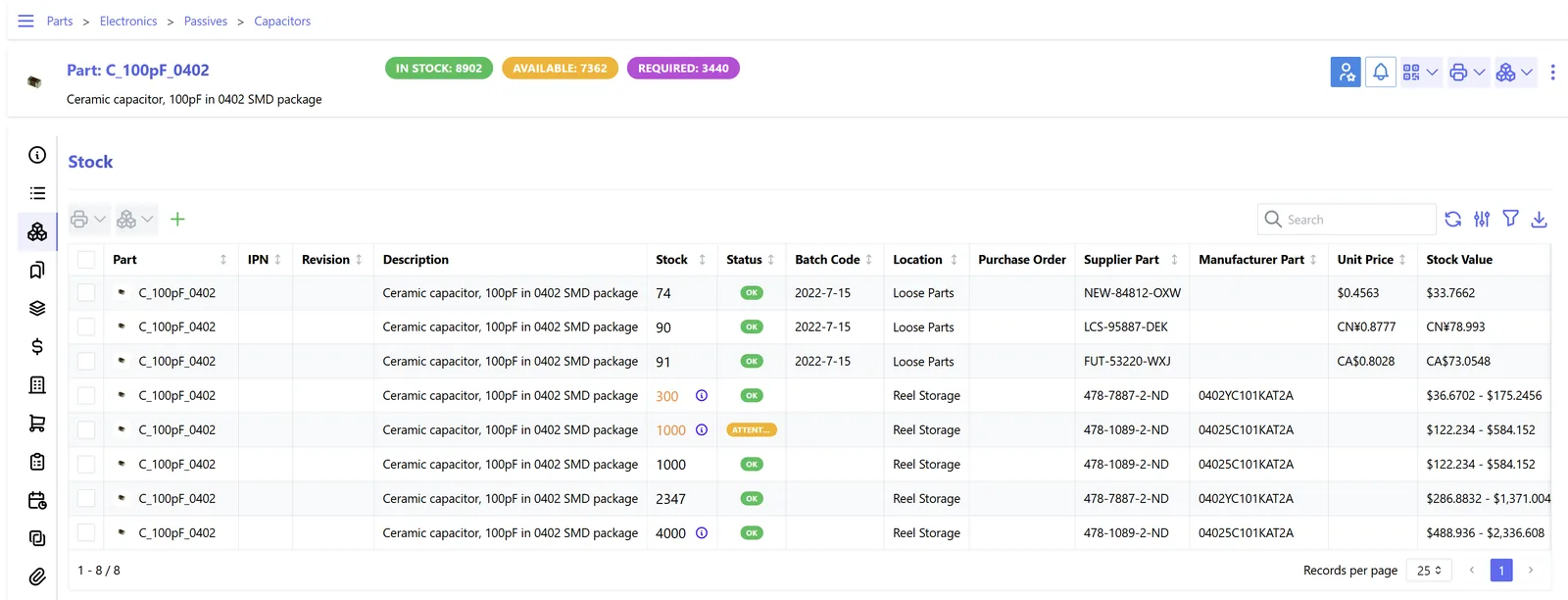
The dashboard should show both how well the program is running and what it is finding.
Support for structured cycle counting differs more between platforms than most inventory features. Capabilities vary by edition and version, so confirm for yours.
| Zoho | Odoo | ERPNext | Dynamics 365 | |
|---|---|---|---|---|
| Count scheduling | Limited native scheduling; often managed with custom fields, reports or a Zoho Creator app. Check the current edition | Counting frequency per location plus an annual inventory day in recent versions | No native cycle scheduler; schedules usually built with reports or a small customization | Physical inventory counting periods on items or SKUs (Business Central); cycle counting plans in Supply Chain Management |
| Count document | Inventory adjustments | Inventory adjustments (count and apply quantities) | Stock Reconciliation | Physical inventory journal, or physical inventory orders and recordings |
| Blind counting | Depends on how the process is set up | Counted quantity entered separately from on-hand | Achievable by setting up count sheets without current quantities | Recordings can be printed without expected quantities |
| Mobile counting | Mobile app with barcode scanning | Barcode app counting (Enterprise) | Barcode scanning on forms in a browser or mobile app | Warehouse mobile app or partner apps, depending on product |
| Variance approval | Typically through approval rules or a custom flow | Approval through access rights or a configured step before applying | Approval workflow on the reconciliation document | Journal approval workflows; cycle count thresholds in Supply Chain Management |
| ABC support | Usually handled in reports or custom fields | Configurable through product categories or customization | Item groups or custom fields | ABC codes on items and SKUs |
Counting is mostly a mobile activity. These connections keep data flowing without paper.
Count results affect inventory value, which feeds your financial statements and tax computations. This is general information, not tax advice; confirm the treatment with your tax advisor and auditor.
Where audited financial statements are required, auditors look at how inventory is counted. A documented cycle count program with approvals and history can reduce reliance on a single year-end count, subject to the auditor's judgment.
Stock losses found in counts are generally deductible when they are business-related and supported by evidence. Keep the count record, recount and approval with each adjustment.
The person who counts should not be the person who approves or posts the variance. Configure roles so the ERP enforces it.
Count tasks, results and approvals are part of your accounting records and should be kept for at least five years.
General information, not tax or legal advice. Rules change; confirm current FTA, MOHRE and Ministry of Finance guidance with your advisor.
The benefits build up month by month as the causes of errors are removed.
Errors are found within weeks of happening, while the cause can still be traced.
Counting happens alongside operations, so customers are not told the warehouse is closed for stock-taking.
Reliable balances mean reorder points work as designed and negative stock becomes rare.
Approved variances with reason codes show where losses come from, by item, zone and shift.
Durations are typical ranges and depend on the number of SKUs and locations.
Durations are typical ranges; your plan is agreed after discovery.
Set ABC rules, count frequencies, tolerances by class, recount rules and approval roles.
Fix bin locations, units of measure and barcodes so counts compare like with like.
Set up count schedules, mobile counting, approval steps, variance accounts and reason codes.
Run daily counts in one zone, review variances and tune tolerances.
Extend to all zones and review accuracy and root causes monthly.
We configure the system for the rules UAE businesses report against, and test it before go-live.
General information, not tax or legal advice. Confirm current requirements with the FTA, MOHRE or your advisor. See all UAE compliance guides.
On-site workshops in Dubai, Abu Dhabi and Sharjah, and remote or on-site delivery across the Northern Emirates and free zones.
Official sources and references
Facts on this page were checked against these sources in October 2026. Rules change, so confirm current requirements before acting.
A common starting point is to count A items monthly, B items quarterly and C items once or twice a year. Adjust based on what the counts find: items with repeated variances should be counted more often.
No. Only the bin being counted needs to be blocked for a few minutes, or the count needs to be compared with the balance at the exact time of counting. Good ERP setups handle this automatically.
Set tolerances by value and by ABC class. A high-value item might need a recount for any difference, while a low-value consumable might allow a small quantity variance before anyone reviews it.
Sometimes. It depends on the strength of the program and your auditor's view. Many UAE companies keep a year-end count in the first year of cycle counting, then discuss reducing it once accuracy is proven.
Any scanner that runs the ERP's mobile app or a browser reliably. Our page on barcode inventory software covers hardware and labeling choices.
The inventory controller daily, and the warehouse manager and finance monthly. Accuracy trends belong on the inventory dashboard next to stock value.
Related Solutions
Related Industries
Related ERP Platforms
We design ABC rules, tolerances and mobile count tasks that fit your warehouse and set them up in your ERP.
Dubai, United Arab Emirates










