
L
O
A
D
I
N
G


Zoho, Odoo, ERPNext, Dynamics 365 and custom ERP, delivered by one accountable team.

See what your distributors hold and sell to retailers, settle promotion claims against evidence, and manage targets across the UAE and GCC from one system.
A distributor management system (DMS) helps brands, FMCG manufacturers and master distributors in the UAE see what their distributors hold and sell to retailers. Distributors place orders and upload secondary sales and stock through a portal, promotion claims are checked against scheme rules before credit notes are issued, and targets are tracked by territory across the UAE and GCC.
A distributor management system (DMS) serves a different user from ordinary distribution software. It is built for the company that sits above the distributors: a brand's regional office in Dubai, an FMCG manufacturer, or a master distributor based in Jebel Ali that appoints sub-distributors across the northern emirates, Oman and the wider GCC. Your own ERP shows primary sales, the stock you ship to distributors. What you cannot see is secondary sales, what each distributor sells on to retailers, pharmacies and HoReCa outlets, or what is sitting in their warehouses.
Without that visibility, the regional team runs on monthly Excel files that distributors send late and in different formats. Promotions are funded on trust, scheme claims arrive months after the campaign with weak evidence, and targets are set without knowing whether stock is moving or just piling up at the distributor. Expiry write-offs, price undercutting between territories and disputed claims follow.
This page covers the principal's side of the network. If you are the distributor and want to run your own warehouse, routes and invoicing, see wholesale management software. Brands selling through authorized resellers with warranty and spare parts should read dealer management software.

These issues are common to FMCG, pharma, building products and electronics networks in the region.
The brand sees only what it invoices to distributors. A strong primary month can hide stock building up at the distributor, which returns as an expiry claim or a price war later.
Each distributor sends sales and stock in its own spreadsheet layout, with its own item codes. Someone at head office spends days mapping codes before any analysis starts.
Promotional, price-support and display claims are submitted after the campaign with limited proof. Without linking claims to secondary sales, overpayment and disputes are routine.
A distributor sells outside its territory or below agreed prices, undercutting a neighbor. Without outlet-level data the brand only hears about it from the complaint.
Annual targets are set on primary sales and split evenly by month. Incentives then reward loading stock into distributors rather than selling through to the market.
The DMS sits between the brand's ERP and each distributor's own system, with approvals at the points where money changes hands.
One shared database: every step updates stock, finance and reports in real time.
We usually build these on top of the brand's existing ERP rather than as a separate island.
Territories, channels, credit terms, price lists, agreed margins and contract periods for each distributor.
Distributors place orders, see their account statement, and upload sales and stock in a standard template.
Uploads, API feeds or integration with the distributor's own ERP, with item and outlet code mapping.
Stock on hand, days of cover and near-expiry batches by distributor to guide replenishment and rotation.
Define promotions with rules and budgets, receive claims with evidence and validate them against secondary data.
Targets by distributor, territory and brand, with achievement tracked on sell-through. Payout rules link to distributor commission software.
Brand merchandisers and sales reps log outlet visits, stock checks and photos from a mobile app.
Sell-in versus sell-through, numeric distribution, and outlet coverage by territory.
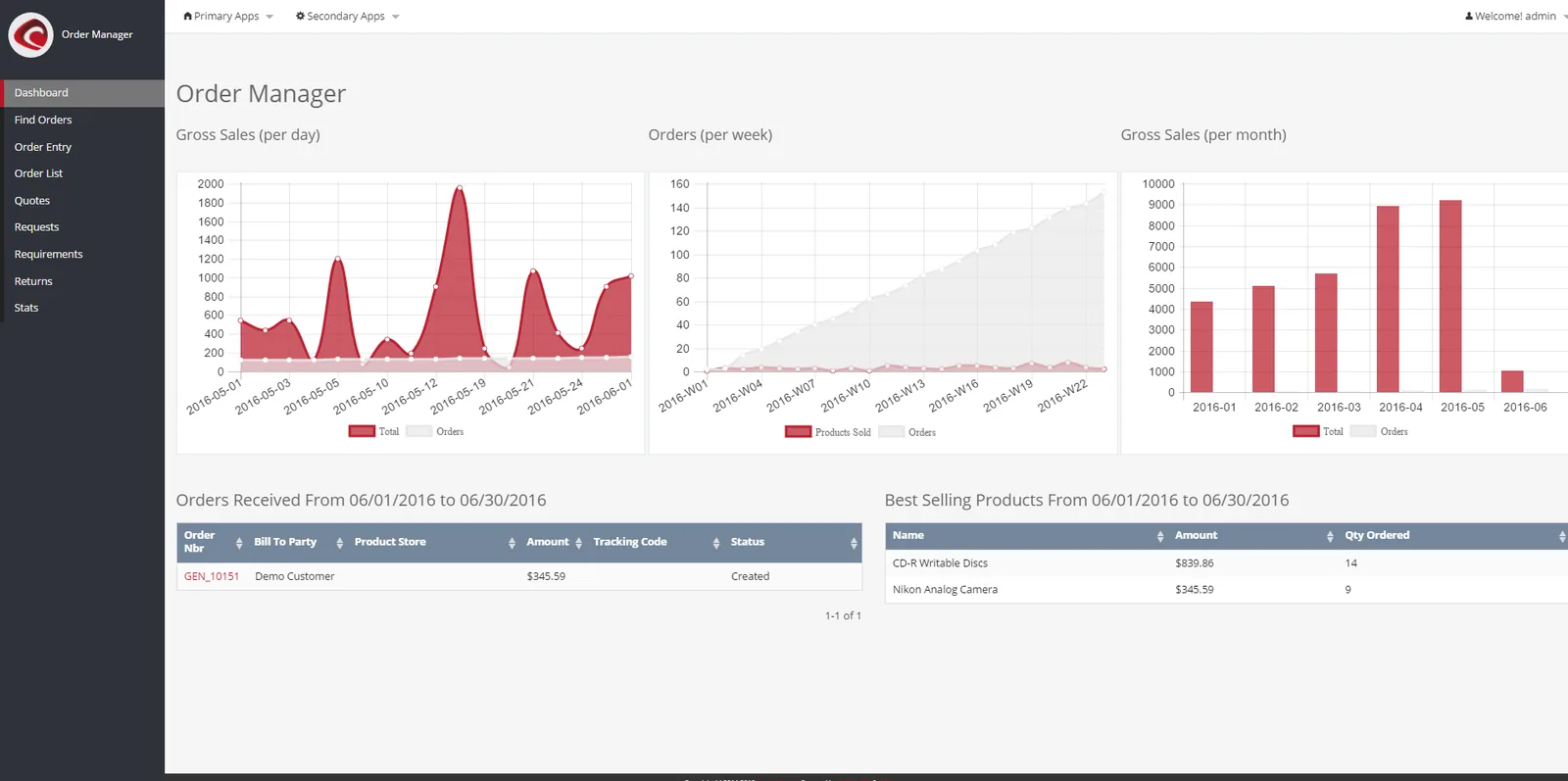
One view of sell-in, sell-through and distributor stock across the network.
None of the four is a dedicated FMCG DMS product out of the box; each is extended with portals, imports and rules. These are typical approaches; confirm the details for your edition.
| Zoho | Odoo | ERPNext | Dynamics 365 | |
|---|---|---|---|---|
| Distributor portal | Zoho Creator portal or CRM portals | Customer portal extended for distributors | Web portal with custom forms for uploads | Power Pages portal over Dataverse |
| Secondary sales capture | Creator forms, imports and Zoho Flow | Custom model with imports or API | Custom DocType with data import and REST API | Dataverse tables with Power Automate or Data Factory |
| Scheme and claim workflow | Creator or CRM blueprint with approvals | Studio or custom module with approvals | Workflow and approvals on custom DocTypes | Power Apps with approval flows |
| Targets and achievement | CRM forecasts and Zoho Analytics | Sales targets and spreadsheet dashboards | Sales person and territory targets | Sales targets with Power BI |
| Analytics | Zoho Analytics | Odoo dashboards or Power BI | Report builder, Insights or Power BI | Power BI |
| Typical fit | Brands already on Zoho CRM and Books | Brands wanting ERP and DMS in one database | Brands needing deep customization at lower license cost | Regional offices standardized on Microsoft |
Most of the data comes from systems you do not own, so the connection methods matter.
Claims and incentives move money, so the tax and data treatment must be right. Not tax or legal advice; confirm with your advisors.
Depending on the arrangement, promotional support may be settled by a tax credit note or invoiced by the distributor as a service, each with different VAT treatment. Set the document type per scheme with your tax advisor.
Supplies to distributors outside the UAE are generally zero-rated exports when export evidence is held. Separate tax codes and document storage per country keep the return clean.
Outlet contact details shared by distributors fall under the UAE Personal Data Protection Law (Federal Decree-Law 45 of 2021). Limit what is collected and control who can see it.
Invoices and credit notes to UAE distributors will move to PINT AE through an ASP from 2027. Check the latest Ministry of Finance and FTA guidance for dates.
General information, not tax or legal advice. Rules change; confirm current FTA, MOHRE and Ministry of Finance guidance with your advisor.
Outcomes regional teams typically aim for.
Decisions are based on what reaches the market, not on what was loaded into distributors.
Claims are checked against agreed scheme rules and secondary data before approval.
Near-expiry stock at distributors is visible early enough to move it.
Targets based on sell-through reward distributors that actually grow the market.
Often 10-18 weeks, mainly driven by how many distributors are onboarded and how their data is received.
Durations are typical ranges; your plan is agreed after discovery.
Agree territories, channels, item and outlet coding, scheme types and approval rules.
Build the portal, upload templates, code mapping and claim workflow.
Onboard two or three distributors and run one full monthly cycle.
Onboard the remaining distributors in waves with training and data checks.
We configure the system for the rules UAE businesses report against, and test it before go-live.
General information, not tax or legal advice. Confirm current requirements with the FTA, MOHRE or your advisor. See all UAE compliance guides.
On-site workshops in Dubai, Abu Dhabi and Sharjah, and remote or on-site delivery across the Northern Emirates and free zones.
Official sources and references
Facts on this page were checked against these sources in October 2026. Rules change, so confirm current requirements before acting.
Still have a question? Our consultants are happy to help.
Ask an ExpertNo. Most keep their own system and either upload a standard file through the portal or connect through an API. Smaller sub-distributors sometimes use the portal for ordering and stock reporting.
Uploads are checked for unknown item and outlet codes, missing periods and figures that conflict with primary shipments and reported stock. Exceptions go back to the distributor before the data reaches reports.
Yes. Targets are set per distributor, territory and brand and tracked on secondary sales. The design of the territories themselves is covered in sales territory management.
Yes, through a mobile sales app that logs visits, shelf checks, photos and orders passed to the distributor.
Very much, because batch traceability and expiry at distributor level matter for recalls. See ERP for pharmaceutical distribution for sector requirements.
Usually yes, so key accounts, distributor contacts and joint business plans live in one place. Our page on CRM for trading companies covers the CRM side.
Related Solutions
Related Industries
Related ERP Platforms
Tell us how your network is structured and how data reaches you today, and we will outline a distributor management setup that fits.
Dubai, United Arab Emirates