
L
O
A
D
I
N
G


Zoho, Odoo, ERPNext, Dynamics 365 and custom ERP, delivered by one accountable team.

A purchase order commits company money. Purchase order management makes sure each commitment is approved, delivered as ordered and invoiced at the agreed price before a single dirham leaves the bank.
Purchase order management in a UAE ERP makes sure every commitment is approved before it is sent, delivered as ordered, and invoiced at the agreed price before payment. The cycle runs from requisition and RFQ to a PO with budget check, approval by limit matrix, goods receipt, three-way match with the supplier invoice, payment and PO closure. All four major platforms support it.
Purchase order management in the UAE covers the life of a PO: from the need (a purchase requisition or reorder suggestion), through supplier selection and approval, to issue, amendment, goods or service receipt, matching with the supplier invoice, and closure. It applies to trading stock, raw materials, spare parts, services and capital items, in any company that buys from suppliers.
The weak points in UAE companies are familiar. POs are raised after the goods have arrived to regularize a phone order. Approvals happen by email or WhatsApp, so there is no record of who approved what amount. The storekeeper receives goods without seeing the PO and signs the supplier's delivery note. The AP clerk pays the invoice because it looks right. Price increases, short deliveries and duplicate invoices go unnoticed.
This page is about controlling the PO itself. How requests are raised is covered in purchase requisition, rule-based PO creation in purchase order automation, and overseas buying with shipments and customs in import management software.

These gaps rarely cause one big loss; they cause many small ones every month.
Goods are ordered by phone and the PO is created when the invoice arrives. The approval becomes a formality and the budget check never happens.
Managers approve by email or voice note. Auditors cannot see who approved a PO, at what amount, or whether the approver had authority for that value.
Storekeepers sign delivery notes for whatever arrives. Over-deliveries, substitutions and wrong specifications become stock nobody ordered.
Suppliers invoice at a higher price or for undelivered quantities. Without a match against the PO and GRN, AP pays what is billed.
Old POs with small balances stay open for years, inflating commitments and allowing late deliveries against outdated prices.
PO prices or quantities are edited after approval without re-approval, so the approved document is not the one that was paid.
The approval happens before the commitment, and the match happens before the payment.
One shared database: every step updates stock, finance and reports in real time.
Purchase order management relies on these modules working from the same supplier, item and budget data.
Internal requests with cost center, project and required date, converted to RFQs or POs.
Requests to several suppliers with side-by-side comparison of price, lead time and terms.
POs with supplier price lists, delivery schedule, payment terms and VAT treatment per line.
Multi-level approval by amount, category, department and project, with re-approval on amendment.
GRNs with accepted, rejected and short quantities, and service receipts for non-stock items.
Two- or three-way match with price and quantity tolerances before the bill is approved for payment.
Open PO value shown against budget by cost center or project.
Approved supplier lists, ratings, documents and price agreements, linked to supplier price lists.
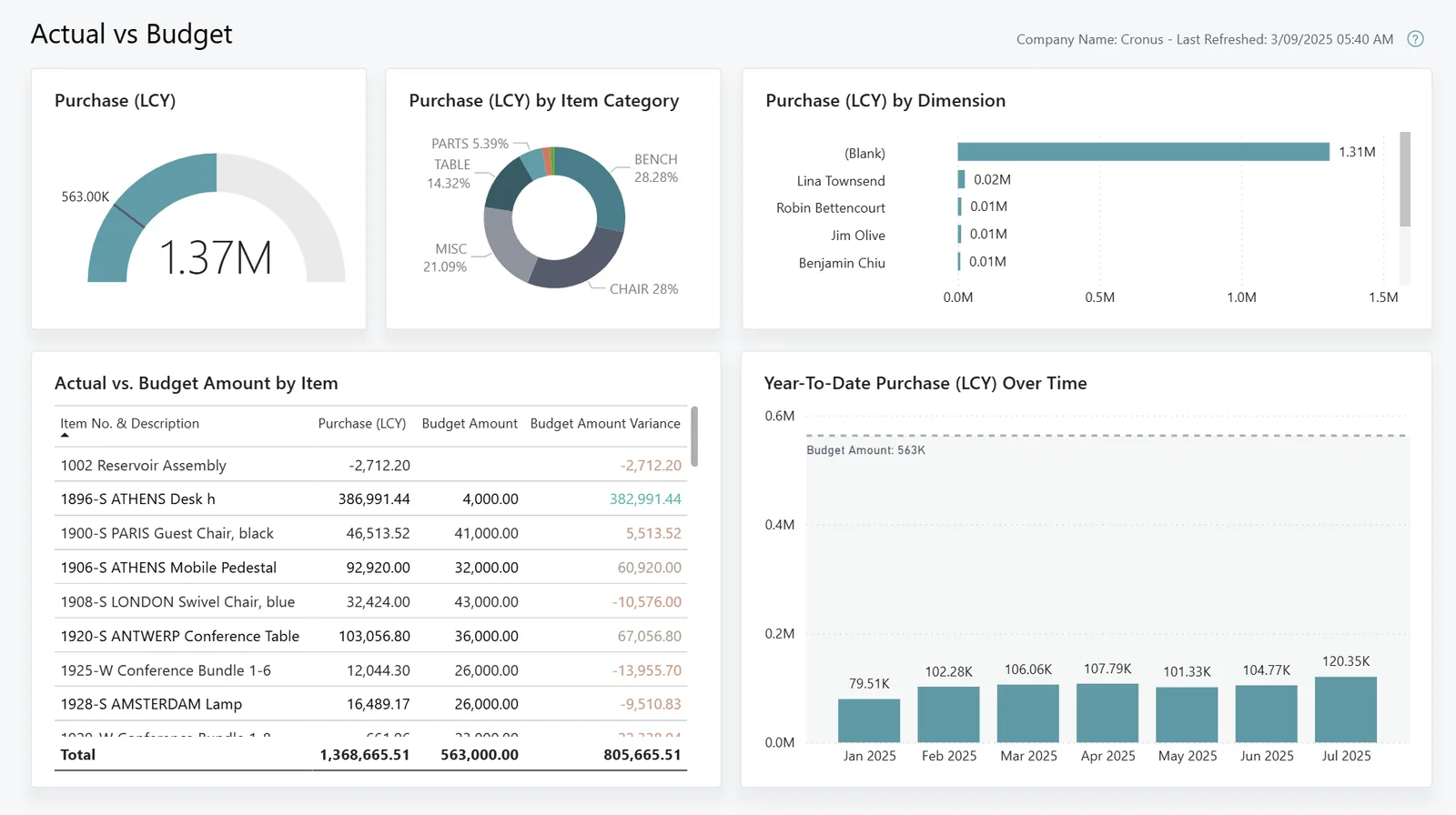
Procurement managers, finance controllers and auditors use these views.
All four support the full procure-to-pay cycle. Configuration of approvals and matching is where the work lies. Confirm for your edition.
| Zoho | Odoo | ERPNext | Dynamics 365 | |
|---|---|---|---|---|
| Requisition to PO | Purchase requests via Zoho Creator or approvals; POs in Books or Inventory | Purchase requests via apps or Studio; RFQs to POs in Purchase | Material Request to RFQ, Supplier Quotation and Purchase Order | Requisitions in Finance and Operations; Business Central via worksheets or apps |
| Approval levels | Multi-level approvals in Zoho Books | Order approval above an amount; more levels via Studio or apps | Workflow with roles and conditions | Approval workflows in Business Central; workflow editor in Finance and Operations |
| Blanket or framework orders | Typically handled as standing POs | Purchase agreements (blanket orders) | Blanket Order doctype | Blanket purchase orders and purchase agreements |
| Three-way match | Bills from POs and receives; matching is mostly manual review | Bill control on received quantities | Purchase Invoice from Purchase Receipt with tolerance settings | Invoice matching policies in Finance and Operations; receipt-based invoicing in Business Central |
| Budget check | Budgets in Zoho Books; hard checks usually custom | Budgets in Accounting with analytic accounts | Budget against cost center with stop or warn actions | Budget control in Finance and Operations |
| Best fit | Smaller teams with simple approvals | SMEs wanting purchase and stock in one app | Teams needing detailed workflows at low licence cost | Larger companies with strict policies and many entities |
See Odoo Purchase for Odoo-specific setup details.
Connections remove retyping between buyers, suppliers and finance.
Configure purchasing to support these and confirm treatment with your tax advisor.
Input VAT can generally be recovered only with a valid tax invoice showing the supplier's TRN. Matching the invoice to the PO and GRN is a good point to check that the invoice is valid before it is booked.
Purchases from overseas suppliers often fall under reverse charge. Set the right tax on the PO so the bill posts correctly to the VAT return.
Once UAE e-invoicing is live, supplier invoices will arrive as structured PINT AE files through Accredited Service Providers, making automatic matching to POs easier. Check the latest Ministry of Finance and FTA timelines.
Keep who raised, approved, received and paid each PO, and separate those roles. This supports internal audit and the five-year record keeping requirement.
General information, not tax or legal advice. Rules change; confirm current FTA, MOHRE and Ministry of Finance guidance with your advisor.
The benefit is spending that is approved, visible and paid correctly.
No PO goes to a supplier without the right approval for its amount and category.
Three-way matching stops payments for undelivered goods or prices above the PO.
Open PO value is visible against budgets and cash flow forecasts.
Every PO has a full history of approvals, amendments, receipts and payments.
A focused procure-to-pay rollout often takes 6-10 weeks; multi-entity or project-based purchasing can take longer.
Durations are typical ranges; your plan is agreed after discovery.
Map purchase categories, approval authority, receiving points and how invoices are checked today.
Define the approval matrix, matching tolerances, PO statuses and amendment rules.
Set up requisitions, RFQs, POs, approvals, receipts and matching, plus reports.
Load suppliers, price agreements and open POs; test approvals and mismatches.
Switch buyers and stores to the new flow with support and close old open POs.
We configure the system for the rules UAE businesses report against, and test it before go-live.
General information, not tax or legal advice. Confirm current requirements with the FTA, MOHRE or your advisor. See all UAE compliance guides.
On-site workshops in Dubai, Abu Dhabi and Sharjah, and remote or on-site delivery across the Northern Emirates and free zones.
Official sources and references
Facts on this page were checked against these sources in October 2026. Rules change, so confirm current requirements before acting.
Still have a question? Our consultants are happy to help.
Ask an ExpertMost UAE companies use an approval matrix by amount, with extra levels for capital items, new suppliers or over-budget spend. Keep it simple enough that approvals happen within a day. See purchase approval in ERP for examples.
It compares the purchase order, the goods receipt and the supplier invoice. Quantities and prices must agree within agreed tolerances before the invoice is approved for payment, which stops paying for goods not received or at unapproved prices.
It can be amended, but changes to price, quantity or supplier should send it back for approval and keep a version history. Small changes such as delivery dates can be allowed without re-approval.
Yes, in a controlled setup. Service POs are received with a service entry or receipt note confirming the work was done, which then supports the invoice match.
AI can read supplier quotes and invoices, suggest suppliers and flag unusual prices, with a person still approving. We cover this in AI purchase automation.
Back-to-back POs can be created from customer orders, and shortages on confirmed orders can trigger requisitions. The customer side is covered in sales order management.
Related Solutions
Related Industries
Related ERP Platforms
Share your current approval rules and purchasing pain points and we will map a procure-to-pay flow for your ERP.
Dubai, United Arab Emirates










