
L
O
A
D
I
N
G


Zoho, Odoo, ERPNext, Dynamics 365 and custom ERP, delivered by one accountable team.

Agents, sub-distributors and resellers earn commission and incentives under contracts that differ partner by partner. Calculate them from ERP data and settle each one with the right document.
UAE companies calculate distributor commission by loading each partner's contract terms into the ERP, tagging the partner on orders or customers, and calculating earnings per period from invoiced and collected transactions. Agents, sub-distributors and resellers may earn flat rates, growth bonuses or retrospective rebates. Settlement uses the correct document, such as the partner's commission invoice or a credit note, and VAT treatment differs.
Many UAE importers and brand owners reach the market through others: a commission agent who brings orders from Al Ain, a sub-distributor covering the Northern Emirates, a reseller in Oman, or a network of dealers who earn a quarterly incentive on volume. Distributor commission software calculates what each of these partners has earned from ERP transactions, under that partner's contract, and produces the document needed to pay or credit them.
This is not the same as paying your own sales staff, which is covered on the salesman commission software page. Partners are separate businesses. They invoice you for commission, or receive credit notes against what they owe you, and VAT applies differently. Their contracts also vary much more: one partner earns a flat rate on orders they refer, another earns a growth bonus, a third gets a retrospective rebate on everything they buy.
The partner records, territories and order flows themselves sit in a distributor management system. This page focuses on the money: how commission and incentives are calculated, approved and settled.

Channel commission problems tend to damage relationships with partners who are also important customers.
Agents earn commission on sales you invoice directly, while distributors buy from you and earn rebates on purchases. Tracking both in one spreadsheet leads to the wrong basis being used.
An agent says a hotel order in Ras Al Khaimah came through him; your own salesman says he found it. Without the partner recorded on the order, there is no evidence either way.
Each partner negotiated different rates, exclusions and target periods. Finance applies last year's terms or the wrong partner's terms.
Commission paid to an agent is a supply from the agent; a volume rebate to a distributor reduces your supply to them. Treating them the same causes VAT errors on both sides.
Distributors often owe you money while you owe them incentives. Paying one and chasing the other is inefficient, but netting without documentation causes reconciliation problems.
Agents in other GCC countries invoice in their own currency and under their own VAT rules, and the reverse charge may apply on your side.
We separate the agent model and the distributor model early in the design, because they settle differently.
One shared database: every step updates stock, finance and reports in real time.
These are the components we set up for channel commission and incentives.
Each agent or distributor held with TRN, country, currency, territory and the contract that governs their commission.
Rates by product group or customer segment, tiers, minimum targets, exclusions and the period over which they are measured.
The referring partner recorded on the sales order or on the customer, so commission follows evidence rather than claims.
Purchases by each distributor measured against volume or growth targets with progress visible during the period.
Agent commission booked as a vendor bill from the partner's invoice; distributor rebates issued as tax credit notes.
Partners see the orders, collections and calculations behind their commission, which reduces queries.
Where contracts allow, commission due is offset against the partner's receivable balance with clear documents for both.
Commission and incentives accrued monthly so profit reflects channel costs as they are earned.
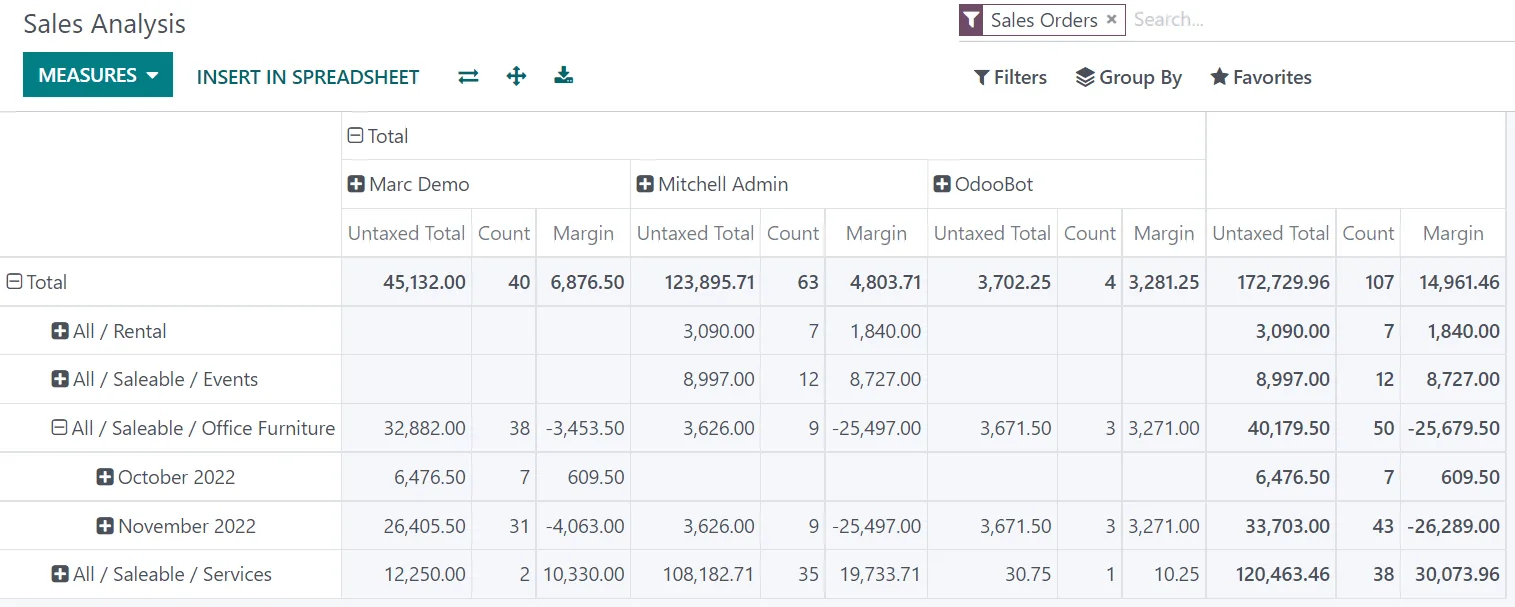
Channel managers need to see what each partner has earned, what is still conditional, and what the channel is costing overall.
Partner commission support varies more than salesperson commission. Confirm the detail for your edition.
| Zoho | Odoo | ERPNext | Dynamics 365 | |
|---|---|---|---|---|
| Partner on the sale | Custom field on CRM deals and Books invoices | Referring partner or reseller field where the relevant app is installed; confirm | Sales Partner field on orders and invoices | Custom field or extension in Business Central |
| Commission rate | Custom logic in Deluge or Zoho Creator | Commission plans for partners in recent Enterprise versions; confirm | Commission rate on Sales Partner with total commission on invoices | Typically an extension |
| Reports | Zoho Analytics | Standard and custom reports | Sales Partner commission summary report | Custom reports or Power BI |
| Rebates to distributors | Custom, settled by credit note | Custom module or partner app | Custom calculation, settled by credit note | Partner extensions are common |
| Partner portal | Zoho CRM or Creator portals | Odoo customer portal | ERPNext portal | Power Pages or a custom portal |
Where native support is limited we build the calculation as a small custom app on the same platform.
Partner commission draws on data from across the business and from partners themselves.
Partner commission involves VAT, corporate tax and contract law. This is general information, not tax or legal advice.
A VAT-registered agent in the UAE generally issues you a tax invoice for commission at 5%. If the agent is outside the UAE, the reverse charge may apply on your side. Recipient-created invoices are only possible under specific conditions; confirm with your advisor.
A rebate that reduces the price of goods you sold to a distributor is usually settled with a tax credit note, adjusting your output VAT. A payment for a service the distributor performs, such as marketing support, is treated differently.
If a distributor is a related party, commission and rebates must be at arm's length for corporate tax, and documentation requirements may apply depending on size.
Registered commercial agencies in the UAE have their own legal framework. Make sure the commission terms in the ERP match the signed agreement and take legal advice on agency rights.
Keep contracts, calculations, partner invoices and credit notes with your accounting records for at least the five-year period UAE tax law generally requires.
General information, not tax or legal advice. Rules change; confirm current FTA, MOHRE and Ministry of Finance guidance with your advisor.
These are the outcomes companies aim for; the effect depends on the size of the channel.
Statements and settlements are produced each period without a manual rebuild.
Agent invoices and distributor credit notes are issued and booked the right way.
The partner is recorded on the order at the time, not reconstructed months later.
Management sees what each partner costs against the revenue they bring.
Projects often take 5-10 weeks on an existing ERP, depending on the number of partner contracts.
Durations are typical ranges; your plan is agreed after discovery.
Collect all agent and distributor agreements and classify each by commission model.
Agree attribution rules, calculation periods, settlement documents and netting policy with finance.
Configure partner records, commission logic, statements, accruals and the partner portal if needed.
Recalculate a completed period and compare with what was paid.
Run the next period from the ERP and share statements with partners.
We configure the system for the rules UAE businesses report against, and test it before go-live.
General information, not tax or legal advice. Confirm current requirements with the FTA, MOHRE or your advisor. See all UAE compliance guides.
On-site workshops in Dubai, Abu Dhabi and Sharjah, and remote or on-site delivery across the Northern Emirates and free zones.
Official sources and references
Facts on this page were checked against these sources in October 2026. Rules change, so confirm current requirements before acting.
Still have a question? Our consultants are happy to help.
Ask an ExpertAn agent introduces customers and you invoice those customers yourself; the agent earns commission. A distributor buys from you and resells; they earn discounts, rebates or incentives on their own purchases. The ERP handles both but settles them differently.
Yes. Many agent contracts pay only on collected invoices. The ERP holds the commission as pending until the receipt is matched to the invoice.
Where the contract allows it, yes. We issue the credit note or book the partner's invoice and then allocate it against open invoices, so both statements agree. This also helps with credit management for that distributor.
Dealer networks for vehicles, equipment or appliances often have warranty and service incentives too. We cover those on the dealer management software page.
The partner is set up with their currency and country. Commission is calculated in your base currency and converted at the agreed rate, and VAT treatment follows the cross-border rules your advisor confirms.
Yes, through a portal or a scheduled statement by email. Seeing the order-level detail is usually what ends disputes, and it fits naturally with territory reporting when partners cover defined areas.
Related Solutions
Related Industries
Related ERP Platforms
Send us two or three partner contracts and we will outline how each would be calculated and settled.
Dubai, United Arab Emirates