
L
O
A
D
I
N
G


Zoho, Odoo, ERPNext, Dynamics 365 and custom ERP, delivered by one accountable team.

Connect every sales invoice to the real landed cost of the goods, keep foreign currency payables and post-dated cheques under control, and file VAT from the same ledger.
A UAE trading company needs accounting software that ties each sales invoice to the landed cost of the goods sold, handles supplier bills in USD, EUR or CNY with exchange differences, tracks post-dated cheques and customer credit limits, and builds the VAT return from the same ledger. An integrated ERP adds inventory, three-way matching and landed cost allocation that standalone accounting tools lack.
Trading company accounting software in the UAE has a harder job than a generic bookkeeping package. A general trading company in Deira, Al Quoz or Jebel Ali buys in USD, EUR or CNY, pays freight, customs duty and clearing charges in AED, sells to contractors and retailers on 60 to 120 day credit terms, and collects a large share of its receivables through post-dated cheques. If the books cannot tie each sales invoice to the true landed cost of the goods sold, the gross margin on the management report is an estimate, not a figure.
Most traders we meet run billing in one tool and the books in another, or keep the ledger in Tally, QuickBooks or Excel while the sales desk issues invoices from a separate system. The accountant re-enters supplier bills, allocates freight by hand at month-end and rebuilds the VAT return from exports. Month-end close drifts well into the following month, and the owner sees margins only after the quarter is over.
This page covers the finance side of a trading business: payables, receivables, foreign currency, landed cost, margin reporting, VAT and the coming e-invoicing mandate. For warehouses, batches and reorder levels see trading company inventory software, and for finance modules in general see accounting ERP software in the UAE.

These are the problems we see most often when we review the books of UAE trading and import businesses.
When freight, customs duty and clearing agent fees are booked as expenses instead of item cost, every invoice shows an inflated margin. The gap appears months later as an unexplained shortfall in the P&L.
A USD bill booked at one rate and paid weeks later at another creates an exchange difference that spreadsheets rarely record. Supplier balances in AED stop matching supplier statements.
PDCs received from customers and issued to suppliers live in a manual register. Nobody can see which cheques mature this week, which bounced, or how much of a customer's balance is actually secured.
Salesmen cannot see the ledger, so orders go out to customers who are over their limit or have invoices 90 days overdue. Finance finds out when the statement is sent.
Local standard-rated sales, zero-rated exports, designated zone movements and import VAT are tagged inconsistently. The accountant reconstructs the return in Excel and hopes it ties to the ledger.
Invoices are created in a billing tool and re-keyed into the ledger. Wrong TRNs, rounding differences and duplicate customer codes surface only at reconciliation.
In an integrated ERP each step posts to the ledger automatically, so finance reviews and approves instead of re-entering. The purchase side follows the same documents your buyers already use, described in more detail on our purchase order management page.
One shared database: every step updates stock, finance and reports in real time.
Implement these together; landed cost and credit control only work when purchasing, stock and sales post into the same ledger.
Chart of accounts designed for trading (stock, goods in transit, clearing accounts) with exchange rates and period-end revaluation.
Three-way match of PO, GRN and supplier bill, payment runs by due date and supplier statement reconciliation.
Allocate freight, duty, insurance and clearing charges to the items on a shipment by value, weight, volume or quantity.
Credit limits, payment terms, overdue blocks on new orders and customer statements by email.
Register of received and issued cheques by maturity date, deposit, clearance and bounce handling, plus bank reconciliation.
Tax codes for standard-rated, zero-rated, exempt and reverse charge transactions, mapped to the VAT return boxes.
Separate profit by branch, division or brand while keeping one legal entity and one VAT registration.
Gross margin by item, brand, customer and salesman, cash flow forecast and P&L by period.
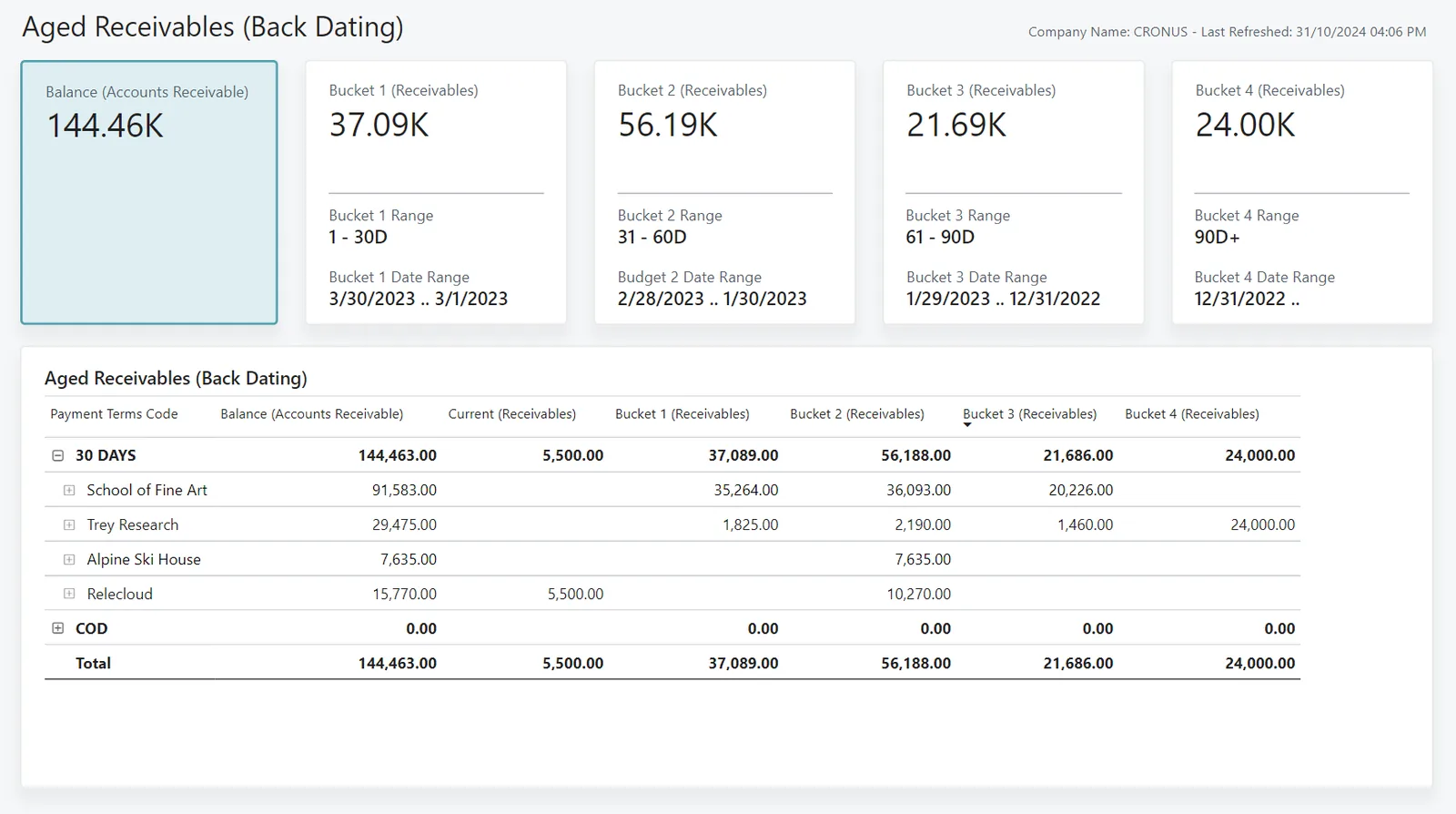
A finance dashboard built on posted transactions, not on exports pasted into Excel.
We implement all four platforms, so the choice depends on your size, complexity and team. Features change by edition and version; confirm the details for yours.
| Zoho | Odoo | ERPNext | Dynamics 365 | |
|---|---|---|---|---|
| Core setup for traders | Zoho Books with Zoho Inventory | Accounting with Sales, Purchase and Inventory apps | Accounts with Buying, Selling and Stock modules | Business Central finance with purchasing, sales and inventory |
| Landed cost | Landed cost allocation on bills in Zoho Inventory (check your plan) | Landed costs on receipts, split by quantity, value, weight or volume (edition-dependent) | Landed Cost Voucher spreads charges by quantity or amount | Item charges assigned to purchase receipts |
| Foreign currency | Multi-currency with exchange rate adjustments | Multi-currency with automatic exchange difference entries | Multi-currency accounts and Exchange Rate Revaluation | Currencies with the adjust exchange rates routine |
| Post-dated cheques | Usually tracked with custom fields or a Zoho Creator app | Often handled by a UAE localization or PDC app; confirm for your version | Cheque reference dates on payments; full PDC flow often customized | Typically a regional extension or customization |
| UAE VAT return | UAE VAT settings and VAT return report | UAE localization with tax report | UAE regional settings with a VAT 201 report | VAT posting setup mapped to the return, often with a partner localization app |
| Credit control | Credit limits on customers with warnings | Credit limit warnings and blocking on sales orders (recent versions) | Credit limit per customer and company, with bypass role | Credit limit and overdue checks on sales documents |
| Typical fit | Smaller traders wanting fast setup and low admin | Growing traders wanting sales, stock and books in one database | Cost-conscious traders comfortable with open source | Mid-size, multi-entity traders already on Microsoft 365 |
Not tax advice. Confirm VAT treatment of specific transactions with your tax advisor.
Accounting stays accurate when the systems around it post into it instead of being re-keyed.
Configure the ledger so compliance is a by-product of daily posting. Not tax advice; confirm with your tax advisor.
Standard-rated local sales at 5%, zero-rated exports with proof of export, and import VAT that VAT-registered importers generally account for through the reverse charge on the return when the customs code is linked to the TRN. Each needs its own tax code so the return builds itself. See VAT accounting software for the detail.
Taxable income is based on accounting profit, so correct stock valuation and landed cost directly affect the corporate tax figure. 0% applies up to AED 375,000 of taxable income and 9% above it.
Businesses with revenue of AED 50 million or more must be live from 1 January 2027, and smaller businesses from 1 July 2027, exchanging PINT AE invoices through an ASP. Check the latest Ministry of Finance and FTA guidance, because dates have been amended before.
Tax records must be kept for at least 5 years under Cabinet Decision 74 of 2023. An ERP with attached supplier bills, customs declarations and audit trail makes an FTA audit file far easier to produce.
General information, not tax or legal advice. Rules change; confirm current FTA, MOHRE and Ministry of Finance guidance with your advisor.
Benefits we aim for in every trading finance rollout.
Every invoice carries the landed cost of the stock it consumed, so margin reports reflect what you actually earned.
Bills, receipts and stock postings arrive in the ledger daily, leaving reconciliation and review for month-end.
Sales sees limits, overdue balances and PDC cover before releasing an order.
Tax codes on every line mean the return is a report, not a spreadsheet project.
A focused trading finance rollout often takes 8-14 weeks, depending on entities, data quality and integrations.
Durations are typical ranges; your plan is agreed after discovery.
Map current books, tax codes, branches, PDC practice and margin reporting needs.
Set up currencies, landed cost rules, credit control, approval limits and VAT mapping.
Load opening balances, open receivables and payables, outstanding PDCs and stock values.
Run one period alongside the old system and reconcile ledger, stock and VAT figures.
Support the first month-end, the first VAT return draft and margin report review.
We configure the system for the rules UAE businesses report against, and test it before go-live.
General information, not tax or legal advice. Confirm current requirements with the FTA, MOHRE or your advisor. See all UAE compliance guides.
On-site workshops in Dubai, Abu Dhabi and Sharjah, and remote or on-site delivery across the Northern Emirates and free zones.
Official sources and references
Facts on this page were checked against these sources in October 2026. Rules change, so confirm current requirements before acting.
Still have a question? Our consultants are happy to help.
Ask an ExpertA standalone package can keep the books, but it cannot see the cost of the stock behind each invoice or block orders for customers over their limit. Once you hold stock and buy in foreign currency, an integrated system usually pays off. Our guide on ERP vs accounting software explains where the line sits.
Freight, duty, insurance and clearing charges are allocated to the received items, which raises their unit cost before they are sold. Cost of goods sold then uses the updated cost. The landed cost software page covers allocation methods in detail.
Yes, with configuration. Received PDCs are recorded against the customer with a maturity date, held in a PDC account, deposited and cleared on the due date, and reversed with charges if they bounce. Depending on the platform this is native, a localization app or a small customization.
The customs declaration and the import VAT are recorded against the shipment, and the reverse charge entries are posted to the right return boxes when that treatment applies. Your tax advisor should confirm the treatment for your situation.
Smaller traders with simple stock often start well on Zoho Books with Zoho Inventory. Those expecting several warehouses, branches or complex pricing usually look at Odoo for trading companies or ERPNext. We recommend after reviewing your volumes and processes.
The ERP needs complete master data (TRNs, item codes, units, tax categories) and a connection to an Accredited Service Provider. Our page on e-invoicing for trading companies lists what to prepare.
Related Solutions
Related Industries
Related ERP Platforms
Share how you buy, stock and invoice today, and we will show how your accounts would run with landed cost, PDCs and VAT in one ERP.
Dubai, United Arab Emirates










