L
O
A
D
I
N
G


Zoho, Odoo, ERPNext, Dynamics 365 and custom ERP, delivered by one accountable team.

Material has left the store but nothing has reached the finished goods warehouse yet. An ERP tells you what is in between, where it is stuck and what it is worth.
An ERP tracks work in progress by moving issued material to a WIP location or account, recording operations stage by stage, and valuing each open order at month end from material issued, labor and machine time booked and overhead absorbed, minus output already posted. UAE manufacturers such as joinery, plastics and steel fabrication plants then see where orders are stuck and what WIP is worth.
An ERP for work in progress in the UAE tracks everything between material issue and finished output: cut panels waiting for edge banding in a joinery, molded parts waiting for printing in a plastics plant, a half-fabricated steel structure waiting for galvanizing, or a dough batch between mixing and baking. WIP has two faces. Operationally, it is a queue of semi-finished items at each stage. Financially, it is an asset on the balance sheet made of material, labor and overhead already spent.
In many UAE manufacturers, WIP is invisible on both counts. The store issues materials and treats them as consumed. The finished goods warehouse only records completed output. Everything in between is a number the accountant estimates at year end, often as a percentage of completion agreed in a meeting. Meanwhile, the production manager walks the floor to find which orders are stuck at which machine.
This page covers visibility and valuation of WIP. Releasing and running the order itself is covered in work order management, and real-time operator reporting in shop floor management software.
These issues distort both delivery dates and monthly profit.
Raw materials are charged to cost of sales as soon as they leave the store. In a month with heavy production but low dispatches, profit looks poor; the next month it looks unusually good.
The accountant and production manager agree a completion percentage for open jobs. The figure is hard to support, and auditors often adjust it.
Partially completed orders are never closed. Leftover material and cost sit in WIP indefinitely, inflating the asset and hiding losses.
Nobody can say how many units are waiting at painting, assembly or packing. Bottlenecks are discovered only when a customer chases a late order.
Components made for stock, such as sub-assemblies or printed sleeves, are not recorded. They are either forgotten or produced again.
Items sent out for galvanizing, powder coating or heat treatment leave the plant without a document, so WIP at the subcontractor is not visible.
WIP is controlled when material and time enter an order and leave it only through output, scrap or return.
One shared database: every step updates stock, finance and reports in real time.
WIP depends on production, inventory and accounting working on the same order record.
The container for WIP: planned quantity, issued material, reported operations and output to date.
A virtual or physical location where issued material sits until it becomes output.
Stages with status per order, so you can count units waiting or in process at each work center.
Multi-level BOMs where intermediate items are produced, stocked and consumed by the next order.
Labor and machine hours booked to the order, adding conversion cost to WIP.
Send-out and receive-back documents for outside processing; see subcontract manufacturing.
Postings to a WIP balance sheet account, cleared to finished goods and variances on order close.
Reports of open orders by age, last activity and value, to drive closure.
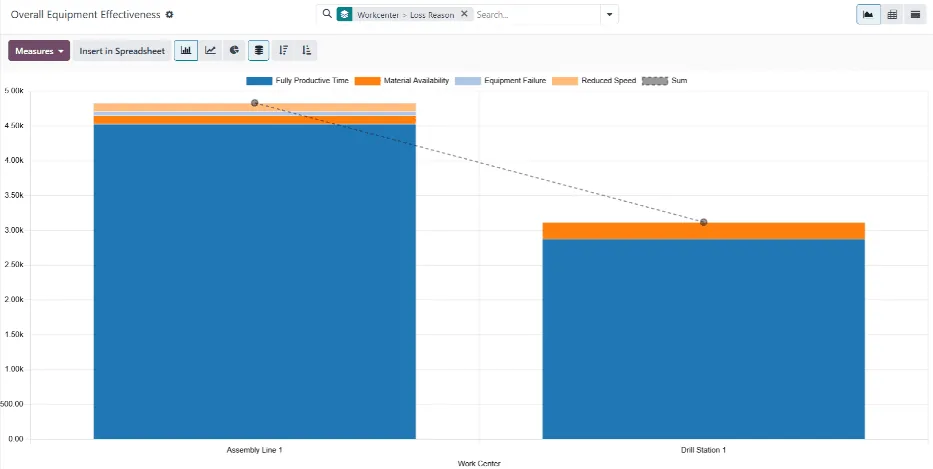
One view of open orders gives the plant a queue picture and gives finance a balance to support.
WIP accounting depth differs more between platforms than WIP visibility does. Confirm options for your edition and version.
| Zoho | Odoo | ERPNext | Dynamics 365 | |
|---|---|---|---|---|
| WIP stock location | No native WIP stage; usually modelled in a Zoho Creator production app | Pre-production and production locations with multi-step manufacturing | Work-in-Progress warehouse set on each Work Order | Production order components consumed to WIP |
| Stage tracking | Custom stages in a Creator app | Work orders per operation with status on the shop floor | Job Cards per operation with time logs | Routing operations with output and capacity journals |
| WIP accounting | Generally handled through manual journals | Recent versions offer WIP accounting entries for open orders; confirm for your version | Perpetual inventory posts the WIP warehouse value to its linked account | WIP account on production orders, cleared at finish with variances |
| Sub-assemblies | Nested composite items | Multi-level BoMs, with option to produce sub-assemblies as separate orders | Multi-level BOMs and sub-assembly Work Orders from a Production Plan | Multi-level production BOMs and planning |
| Subcontract tracking | Manual transfers to a vendor location | Subcontracting with resupply to the subcontractor | Subcontracting Order and supplier warehouse | Subcontracting through work centers or purchase in recent releases |
| Best fit | Simple, single-stage assembly | Multi-stage SMEs with shop floor reporting | SMEs needing transparent WIP warehouses | Larger plants with formal WIP accounting |
WIP data comes mostly from the floor, so capture has to be quick for operators.
WIP is part of inventory in your financial statements, so it affects tax and audit. Confirm with your auditor and tax advisor.
Taxable income under UAE corporate tax starts from accounting profit, and WIP is part of closing inventory. Transaction-based WIP is easier to support than an estimate made at year end.
Inventory, including WIP, is generally measured at the lower of cost and net realizable value. The ERP's order costs give you the cost side; review slow or stuck orders for write-downs.
Material sent to an outside processor remains your stock. Record the transfer with a delivery note so it stays in WIP and VAT treatment of the service charge is clear.
Keep manufacturing orders, job cards and WIP reports for at least five years under Cabinet Decision 74 of 2023.
General information, not tax or legal advice. Rules change; confirm current FTA, MOHRE and Ministry of Finance guidance with your advisor.
The benefits reach the production meeting and the monthly accounts.
Material sits in WIP until output, so monthly profit and loss reflects what was sold, not what was issued.
Queues by stage show where orders pile up before customers start chasing.
WIP value is built from transactions, so year-end discussions with auditors are shorter.
Old orders are closed with leftovers returned and variances explained, feeding production costing.
WIP control usually follows raw material and order discipline. Durations are typical ranges.
Durations are typical ranges; your plan is agreed after discovery.
Walk the floor, list stages and queues, and decide which semi-finished items need their own codes.
Agree WIP accounts, valuation and the month-end routine with finance.
Set up WIP locations, routings and reporting on one line first.
Count open jobs at cut-over and load them as open orders with issued material.
Compare system WIP with a physical walk and close or correct old orders.
We configure the system for the rules UAE businesses report against, and test it before go-live.
General information, not tax or legal advice. Confirm current requirements with the FTA, MOHRE or your advisor. See all UAE compliance guides.
On-site workshops in Dubai, Abu Dhabi and Sharjah, and remote or on-site delivery across the Northern Emirates and free zones.
Official sources and references
Facts on this page were checked against these sources in October 2026. Rules change, so confirm current requirements before acting.
Still have a question? Our consultants are happy to help.
Ask an ExpertIf production cycles are short (hours or a day) and month-end WIP is small, expensing material on issue may be acceptable. If orders span weeks or WIP is material to the balance sheet, track it properly; a short explanation of the mechanics is in how ERP works.
The ERP adds the cost of material issued, labor and machine time booked, and overhead absorbed for each open order, minus any output already posted. That total is the WIP balance.
Yes, when they are stored, counted, sold or used by more than one product. If a semi-finished item only exists for minutes between two machines, tracking the operation status is enough.
Return it to the store with a return document, or record it as scrap if unusable. The order then closes, and any difference between expected and actual cost becomes a variance.
Transfer them to a subcontractor location with a delivery note, and receive them back against the order. The ERP keeps them in WIP the whole time.
When output is reported on the last operation, the cost moves from WIP to finished goods automatically.
Related Solutions
Related Industries
Related ERP Platforms
Share a list of your open jobs and how you value them today, and we will show how an ERP would track and value your WIP.
Dubai, United Arab Emirates