L
O
A
D
I
N
G


Zoho, Odoo, ERPNext, Dynamics 365 and custom ERP, delivered by one accountable team.

Pull every order from your website and marketplaces into one ERP, ship it, collect the cash or payout, and see true margin per order after fees, delivery and returns.
An ecommerce ERP in the UAE pulls orders from the website, Amazon.ae and noon into one queue, ships them from the right location and pushes stock back to every channel to stop overselling. Courier COD remittances, payment gateway settlements and marketplace statements are matched to invoices, with fees posted as expenses, so sellers see true margin per order after returns.
Ecommerce ERP in the UAE is about what happens after the customer clicks Buy. Most online sellers start with a storefront and a spreadsheet. Then they add Amazon.ae and noon, a second warehouse or a 3PL in Dubai South, cash on delivery through a courier, and payment gateway payouts that arrive net of fees. At that point stock oversells, COD cash goes unreconciled for weeks and nobody knows the margin on a single order.
An ERP sitting behind the storefront becomes the single source for products, prices and stock. Orders from every channel arrive as sales orders, get picked and shipped from the right location, and generate invoices. Courier COD remittances, gateway settlements and marketplace statements are matched against those invoices, with fees and commissions posted as expenses. Returns come back into stock or a quarantine location with a credit note.
We connect storefronts and marketplaces to Odoo, Zoho, ERPNext, Microsoft Dynamics 365 or a custom ERP. This page is about the integration and the order-to-cash flow. For the broader picture of running an online business, see our ERP for ecommerce companies page.

The products we configure, integrate and support on projects like this one.

 Odoo eCommerce
Product names and logos are trademarks of their respective owners and are shown only to identify the software we implement.
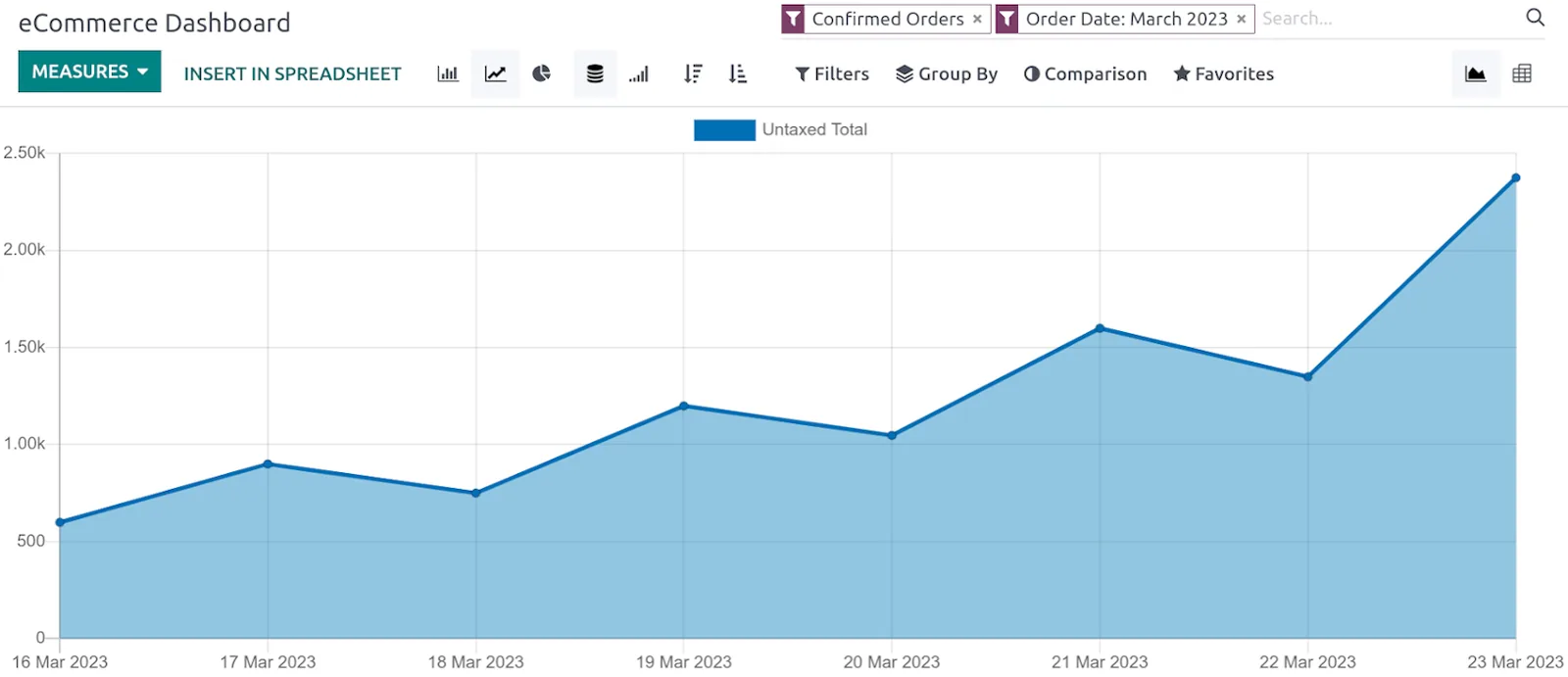
Operations sees what to ship today. Finance sees what money is still owed by couriers and marketplaces.
The steps are the same for every channel; only the payment and settlement source changes.
One shared database: every step updates stock, finance and reports in real time.
Each feature addresses a reconciliation or stock problem we see in nearly every online business.
Available stock is pushed to the website and marketplaces on a schedule or in near real time, with safety buffers per channel to avoid overselling.
Orders arrive with customer, shipping address, discounts, shipping charge and payment method mapped to the right ERP fields and tax codes.
Shipping labels and tracking numbers are created from the ERP or the courier portal, and delivery status flows back to the order.
Courier remittance files are imported and matched to delivered orders. Short payments, failed deliveries and courier fees are flagged for follow-up.
Gateway and marketplace settlements are broken down into sales, refunds, commissions and fees, then matched to invoices in one step.
Product cost, discounts, shipping, gateway fees and commissions are combined so you can see which channels and products actually make money.
Some platforms include their own storefront; others work best behind Shopify or WooCommerce.
| Zoho | Odoo | ERPNext | Dynamics 365 | |
|---|---|---|---|---|
| Native storefront | Zoho Commerce | Odoo Website and eCommerce apps | Webshop app for the Frappe stack | Dynamics 365 Commerce for larger retailers |
| Shopify link | Integrations and connectors available | Connectors from the app store or custom | Custom or community connectors | Business Central has a Shopify Connector |
| Marketplaces (Amazon.ae, noon) | Third-party connectors | Connectors or middleware | API integration, usually custom | Partner connectors or middleware |
| Stock across channels | Zoho Inventory multi-warehouse | Multi-warehouse with routes | Multi-warehouse stock ledger | Locations and availability by channel |
| Best fit | Small brands wanting an all-Zoho stack | Sellers wanting store and ERP in one | Sellers with developers and custom needs | Larger omnichannel retailers |
Connector quality varies. We test order, refund and stock scenarios with your real catalog before go-live.
The integration list for a typical UAE online seller.
These are configured in the ERP and should be confirmed with your tax advisor.
Sales to UAE customers carry 5% VAT. Shipping charges and discounts need the right tax treatment so the invoice and the VAT return agree.
Marketplace and gateway fees are services you buy, usually with their own tax invoice. Recording them separately, rather than netting them off sales, keeps both revenue and input VAT correct.
Orders shipped outside the UAE may qualify for zero-rating if export evidence is kept. The ERP can store shipping documents against the order; confirm the conditions with your advisor.
Under the UAE e-invoicing program, B2B invoices move through Accredited Service Providers using PINT AE, with mandatory dates from 1 January 2027 for larger businesses and 1 July 2027 for others. Check the latest Ministry of Finance and FTA guidance for how online B2B orders are covered.
General information, not tax or legal advice. Rules change; confirm current FTA, MOHRE and Ministry of Finance guidance with your advisor.
Platforms, industries and modules for online sellers.
We configure the system for the rules UAE businesses report against, and test it before go-live.
General information, not tax or legal advice. Confirm current requirements with the FTA, MOHRE or your advisor. See all UAE compliance guides.
On-site workshops in Dubai, Abu Dhabi and Sharjah, and remote or on-site delivery across the Northern Emirates and free zones.
Official sources and references
Facts on this page were checked against these sources in October 2026. Rules change, so confirm current requirements before acting.
No. Many sellers keep Shopify as the storefront and use the ERP for stock, fulfillment and accounting. Moving the store into the ERP only makes sense if you want one system and your storefront needs are simple.
The ERP holds the stock figure and pushes available quantity to each channel, often with a buffer for fast-moving items. Orders reserve stock the moment they sync, so two channels cannot sell the same last unit for long.
Yes. We import the courier remittance report and match it to delivered orders. Unpaid, short-paid and returned shipments appear on an exception list for your finance team.
The settlement statement is split into gross sales, refunds, commission, fulfillment fees and other charges. Each goes to its own account so margin and VAT are not distorted.
Returns are received against the original order, inspected and put back into sellable stock or a damaged location. The refund creates a credit note, and the marketplace or gateway refund is matched later.
Connecting one storefront and one courier to an ERP often takes 4-8 weeks. Each additional marketplace or 3PL adds time, depending on the connector and data quality.
Related Solutions
Related Industries
Related ERP Platforms
Related Guides
List your storefront, marketplaces and couriers, and we will sketch the integration and reconciliation flow.
Dubai, United Arab Emirates