L
O
A
D
I
N
G


Zoho, Odoo, ERPNext, Dynamics 365 and custom ERP, delivered by one accountable team.

A 3PL sells space, labor and service levels to many clients at once. We set up ERP so each client's contract drives billing automatically and each client's profitability is visible.
3PL companies in the UAE need an ERP that tracks client-owned stock off their own balance sheet and bills for activity rather than goods. Each client's rate card prices storage per pallet or CBM, inbound handling, pick fees, packaging and labelling automatically at month end. Odoo supports an owner on stock records, and other platforms can use separate warehouses or locations per client.
An ERP for 3PL companies UAE providers rely on has to do something most systems never consider: manage inventory you do not own and bill for activity rather than for goods. Your clients' stock sits in your racks, your staff receive, store, pick and pack it, and your revenue comes from rates written into each client contract. If those rates are applied by hand at month end, billing leaks.
The UAE 3PL market serves ecommerce brands fulfilling orders across the emirates, distributors that outsource storage near Jebel Ali or Dubai Investment Park, and overseas manufacturers holding regional stock in free zones. Each client type brings a different tariff: storage per pallet per day, per CBM per week, inbound handling per container, pick fees per line, packaging, labelling and returns processing.
This page focuses on the 3PL business model: contracts, billing, client-owned stock and client service. If your main concern is the physical warehouse, such as bins, putaway and cycle counts, see our page on ERP for warehousing companies. Most 3PLs need both, and we implement them on the same platform.

Most 3PLs we meet are operationally capable. The losses happen in contract administration and billing.
Finance pulls inbound, outbound and storage reports from the warehouse system and prices them in Excel. It takes days each month and small activities like relabelling are often forgotten.
One client pays per pallet, another per CBM, a third has a minimum monthly charge. Without rate cards in the system, each invoice is a custom calculation.
If client inventory is recorded like your own, it distorts your balance sheet and makes stock valuation unreliable. Ownership must be tracked separately.
Ecommerce clients expect orders to flow from their store automatically. Manual order entry creates delays, mispicks and disputes about who caused the error.
Contracts promise same-day dispatch or 48-hour receiving. When a client disputes performance, you need timestamps from the system, not memory.
From signing a client to issuing the monthly invoice, these are the steps we configure.
One shared database: every step updates stock, finance and reports in real time.
These are the areas we configure for third-party logistics. Exact module names differ by platform.
Each client contract stores rates for storage, handling, value-added services and minimum charges, with validity dates and price review terms.
Receipts, picks, packs and storage days are counted from warehouse transactions and priced from the rate card into a draft invoice for review.
Stock is held under the client as owner, so quantities are tracked precisely while value stays off your own books.
Connectors to client storefronts and marketplaces pull orders in and push tracking numbers and stock levels back.
Clients see their stock, open orders, receipts and invoices without emailing your customer service team.
Track tenders, space enquiries and contract renewals, including the volumes and rates each prospect was quoted.
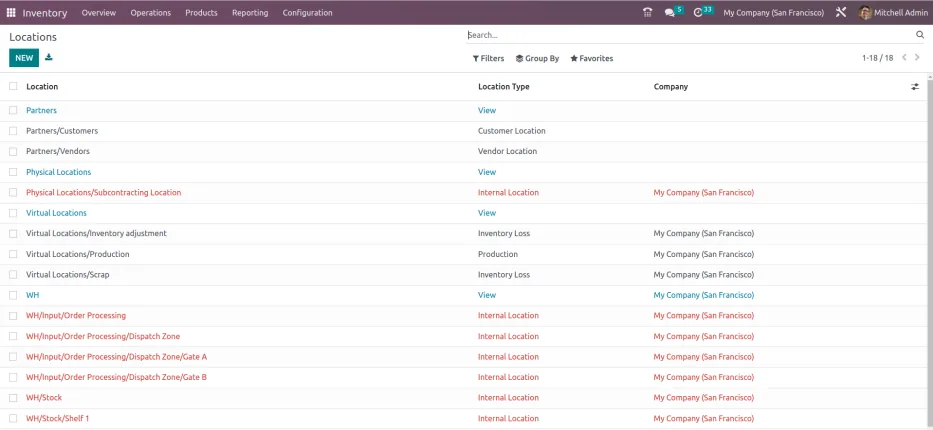
A 3PL dashboard is organized by client, not by warehouse. This is a typical layout.
We implement all four platforms below. The fit depends on order volume, the number of clients and how complex your tariffs are.
| 3PL profile | Usual fit | Reason |
|---|---|---|
| Ecommerce fulfilment for a handful of brands | Zoho Inventory with Zoho Books | Marketplace and store connectors, simple billing; activity billing usually needs a Zoho Creator layer. |
| Multi-client contract logistics with varied tariffs | Odoo | Inventory supports stock owners and multi-step routes; billing rules can be added as a custom module on the same database. |
| 3PL that wants to own its billing logic | ERPNext | Open-source; custom doctypes for contracts and rate cards sit next to standard stock and accounting. |
| Large 3PL with several sites and entities | Dynamics 365 Business Central or Supply Chain Management | Advanced warehousing and multi-company finance; billing extensions or partner apps cover 3PL charges. |
| 3PL with an existing WMS it wants to keep | Any of the above, integrated | The WMS keeps running the floor; the ERP receives activity data and handles billing and finance. |
We configure the system to support these requirements. Your tax advisor should confirm how they apply to your contracts.
Storage and handling services are generally standard-rated at 5%, but some services linked to imports, exports or clients outside the UAE may qualify for different treatment. Tax codes are set per service line as your advisor directs.
Holding goods in a VAT designated zone can change the VAT position of movements in and out of the zone. The ERP can track stock by zone location so your advisor has the data needed.
Bonded and free zone storage requires accurate records of goods in and out. Linking receipts and dispatches to declaration references helps when customs or the free zone authority asks.
Monthly client invoices must carry your TRN and required fields. E-invoicing through an Accredited Service Provider becomes mandatory from 2027 depending on revenue; check the latest MoF and FTA guidance.
General information, not tax or legal advice. Rules change; confirm current FTA, MOHRE and Ministry of Finance guidance with your advisor.
These are the improvements clients look for. We help you set the baseline so you can measure them honestly.
Draft invoices are generated from captured activity, so finance reviews rather than builds them.
Every value-added service is recorded as a transaction with a price, so relabelling or kitting is not forgotten.
Revenue and the space and labor each client uses sit side by side, which helps at renewal time.
System timestamps on receipts and dispatches give both sides the same facts.
Ranges assume one or two sites; we confirm a plan after discovery.
Durations are typical ranges; your plan is agreed after discovery.
Collect every client contract and list each billable activity, unit of measure and minimum charge.
Decide how activity is captured, how rate cards are stored and which clients need integrations first.
Configure inventory and accounting, build the billing engine and connect priority client stores.
Run one billing cycle in both the old method and the ERP and compare invoices client by client.
Switch billing over and open the client portal to clients in groups.
Go deeper on warehousing, integrations and platforms used by 3PLs.
We configure the system for the rules UAE businesses report against, and test it before go-live.
General information, not tax or legal advice. Confirm current requirements with the FTA, MOHRE or your advisor. See all UAE compliance guides.
On-site workshops in Dubai, Abu Dhabi and Sharjah, and remote or on-site delivery across the Northern Emirates and free zones.
Official sources and references
Facts on this page were checked against these sources in October 2026. Rules change, so confirm current requirements before acting.
Yes. Odoo supports an owner on stock records, and the other platforms can be configured to do the same, often with separate warehouses or locations per client. Quantities are tracked precisely while the value stays off your balance sheet.
Every receipt, pick, pack, storage day and service is captured as a transaction. At month end the system prices each activity from the client's rate card, applies minimums, and creates a draft invoice that finance reviews before posting.
Yes, through standard connectors where they exist or through APIs. Orders flow into the ERP and tracking numbers and stock levels flow back. See our ERP API integration page for how we approach this.
Not necessarily. If your WMS runs the floor well, we can integrate it so activity data reaches the ERP for billing and accounting. We only recommend replacing it when it is the source of the problem.
Many 3PLs run their first parallel billing cycle about 8 to 12 weeks after kickoff, depending on how many tariff structures and integrations are involved.
Related Solutions
Related Industries
Related ERP Platforms
Share two or three client contracts and we will show how the ERP would turn your warehouse activity into accurate invoices.
Dubai, United Arab Emirates