
L
O
A
D
I
N
G


Zoho, Odoo, ERPNext, Dynamics 365 and custom ERP, delivered by one accountable team.

Stop quotations with thin margins, open-ended payment terms or unvetted customers from reaching the customer, without slowing down the deals that follow the rules.
An ERP controls sales approvals by checking every quotation and sales order against rules such as a gross margin floor, non-standard payment terms, order value limits and missing customer documents like the trade license and TRN. Only orders that break a rule are routed to an approver, while standard deals go straight through. Approved quotations are locked, and any revision returns for re-approval.
An ERP for sales approval in the UAE governs the commitments your sales team makes on the company's behalf. A salesperson in a Deira trading company can promise 120-day credit, free delivery to Ras Al Khaimah, a price below landed cost, or a delivery date the warehouse cannot meet. Once the customer has a signed quotation, those promises are hard to take back.
Sales approval puts a checkpoint between the draft and the customer. The ERP checks each quotation or sales order against rules: gross margin below a floor, payment terms longer than standard, a new customer without a trade license and TRN on file, an order value above the salesperson's authority, or a product that needs technical sign-off. Only orders that break a rule are routed for approval; the rest go straight through.
This page covers approval of the quotation and order as a whole. Price reductions on individual lines have their own rules, covered in ERP for discount approval, and blocking orders for customers over their limit is covered in ERP for credit limit control.

Most UAE sales teams have approval rules on paper. The problems appear when the rules depend on someone remembering them.
The salesperson sees the selling price but not the landed cost, including freight, customs duty and clearing. Low-margin quotes are only discovered when the monthly profit report is run.
Extended credit, free installation or consignment stock is agreed on a call and written into the quotation without anyone in finance seeing it.
The sales manager replies "ok" in a group chat. There is no link between that message and the document the customer receives, so disputes cannot be resolved.
An approved quotation is copied and changed for the next revision, and the new terms never go back for sign-off.
Orders are released to customers whose trade license, TRN and credit application are still pending, which creates VAT and collection problems later.
Rules are checked automatically. Only exceptions wait for a person.
One shared database: every step updates stock, finance and reports in real time.
Sales approval relies on accurate cost, customer and stock data, so these modules need to work together.
Versioned quotes with validity dates, terms and conditions and approval status. See quotation management.
Confirmed orders that drive delivery, invoicing and stock reservation.
Landed cost or standard cost per item so the system can calculate margin on each line.
Trade license, TRN, payment terms, credit limit and approved price list per customer.
Conditions on margin, value, terms, customer status and product group, with approver chains.
Opportunities that carry the deal history and the approval decision forward.
Stock and incoming POs so delivery promises can be checked before approval.
Value limits per salesperson, team leader and branch manager.
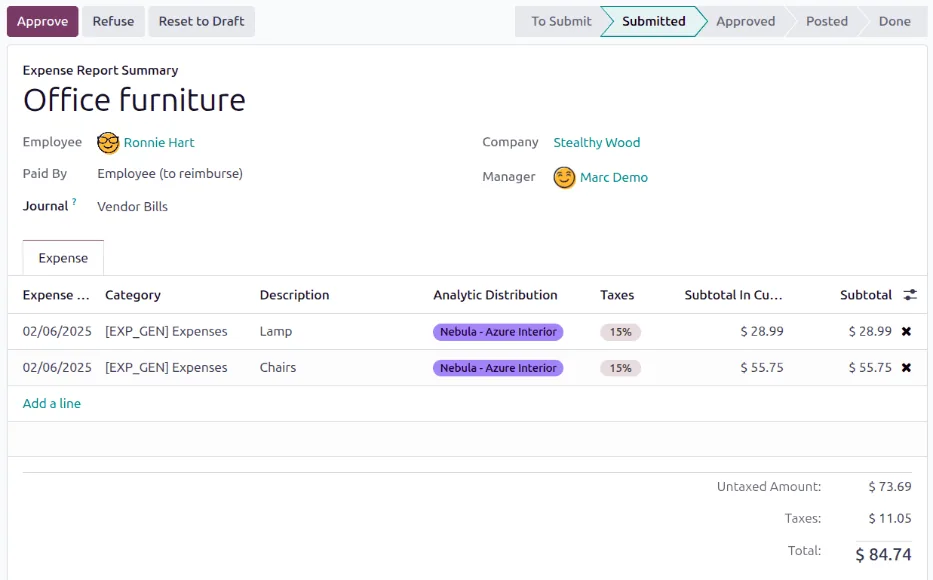
Sales managers need to see what is blocked, why it is blocked and how long the customer has been waiting.
A hedged summary of how each platform handles approval of quotations and orders. Confirm details for your edition.
| Zoho | Odoo | ERPNext | Dynamics 365 | |
|---|---|---|---|---|
| Quote approval | Approval processes in Zoho CRM; transaction approval in Zoho Books | Studio approval rules on buttons (Enterprise) or custom module | Workflow on Quotation with states and roles | Approval workflows in Business Central; Power Automate for Dynamics 365 Sales |
| Sales order approval | Zoho Books sales order approval in supported plans | Order lock and approval via Studio or customization | Workflow on Sales Order with conditions | Sales order approval workflow template in Business Central |
| Margin rules | Usually custom functions using cost fields | Margin shown on order lines; approval on margin needs configuration | Conditions on margin fields in Workflow or custom script | Profit shown on order statistics; rules via workflow conditions or extension |
| Terms and customer checks | Validation rules and blueprints in Zoho CRM | Payment terms on customer; checks via automation | Customer fields and validations | Customer card fields, blocked status and workflow conditions |
| Mobile approval | Zoho CRM and Books mobile apps | Odoo mobile and email | Frappe mobile and email | Business Central app, Outlook and Teams |
Approval features vary by plan and version. We prototype the rules before committing to a design.
Approval decisions are only as good as the data behind them.
These items affect what must be captured before an order is approved. Confirm tax treatment with your advisor.
Capturing the customer TRN and emirate, and free zone or export status, before approval makes sure the tax invoice carries the right VAT treatment.
Under the phased UAE e-invoicing rollout from 2027, invoices will need structured buyer data. Approving only customers with complete master data avoids rejected invoices later. See UAE e-invoicing and check the latest Ministry of Finance / FTA guidance.
Approved quotations, terms and approval logs support revenue records and should be kept for at least 5 years.
General information, not tax or legal advice. Rules change; confirm current FTA, MOHRE and Ministry of Finance guidance with your advisor.
Typical improvements, which depend on clean cost data and sales team adoption.
Low-margin deals are seen by a manager before the customer receives them.
Quotes within the rules are released without waiting for anyone.
Every exception has a named approver and a reason on record.
Non-standard terms are agreed knowingly, so collection surprises reduce.
Typical ranges; cost data quality is usually the deciding factor.
Durations are typical ranges; your plan is agreed after discovery.
List the exceptions that should need approval and who can approve each one.
Clean landed costs, customer terms and documents so rules have reliable inputs.
Build approval rules and test with last quarter's real quotations.
Train the sales team and managers, then monitor the queue for bottlenecks.
We configure the system for the rules UAE businesses report against, and test it before go-live.
General information, not tax or legal advice. Confirm current requirements with the FTA, MOHRE or your advisor. See all UAE compliance guides.
On-site workshops in Dubai, Abu Dhabi and Sharjah, and remote or on-site delivery across the Northern Emirates and free zones.
Official sources and references
Facts on this page were checked against these sources in October 2026. Rules change, so confirm current requirements before acting.
Still have a question? Our consultants are happy to help.
Ask an ExpertNot if the rules are designed well. Only exceptions are routed, and approvers get mobile notifications. Most quotations within standard terms are released immediately.
Yes, if the system has reliable item costs. In trading companies, landed cost including freight and duty is usually the right basis. Without accurate costs, margin rules produce false alarms.
Field and counter sales usually use fixed price lists with limited discretion, so approvals are rare. See van sales software for that model.
Commonly the sales manager for terms and margin, finance for credit and payment terms, and the GM above a value limit. The sales manager's ERP view shows how this looks day to day.
It is a control inside the order process. The full process from order to delivery and invoice is covered in sales order management.
Usually yes, the same workflow engine handles both, with separate rules. See ERP for purchase approval for the buying side.
Related Solutions
Related Industries
Related ERP Platforms
We will review your quotation process and propose rules that catch risky deals without blocking standard ones.
Dubai, United Arab Emirates