L
O
A
D
I
N
G


Zoho, Odoo, ERPNext, Dynamics 365 and custom ERP, delivered by one accountable team.

See where purchase requests are stuck, what you have committed to suppliers, and which vendors deliver late or invoice above the PO price, all from transactions already in your ERP.
A procurement dashboard for a UAE company should show which purchase requisitions await approval and for how long, overdue purchase orders, goods received but not invoiced, committed spend by supplier, late-delivering vendors and supplier invoices priced above the PO. It is built from transactions already in the ERP, covering the PR, RFQ, PO, GRN and three-way match cycle.
A procurement dashboard UAE buyers and finance teams actually use is not a chart of total purchases. It answers operational questions every morning: which purchase requisitions are waiting for approval and for how long, which POs are overdue for delivery, which goods have been received but not yet invoiced, and where the price on a supplier invoice differs from the agreed PO price.
In many UAE trading, contracting and manufacturing companies the purchase cycle still runs on email, a shared Excel tracker and a WhatsApp group with suppliers. The procurement manager learns about a late delivery when the site engineer or storekeeper calls. Spend by supplier is rebuilt once a quarter from accounting exports, after the money is gone. A dashboard built on your procurement software replaces that with a live view of the PR, RFQ, PO, GRN and supplier invoice records.
This page covers the KPIs, the data flow and the tools. It focuses on the purchasing function; stock levels and reorder points belong on an inventory dashboard, and payables ageing and cash belong on the finance dashboard.

How a UAE building-materials trader with a Jebel Ali warehouse and two project sites might see its purchasing position on a Sunday morning.
Spend by category (last 90 days)
Approval wait by approver (avg days)
Top suppliers by spend share
Overdue PO lines
| PO | Supplier | Item | Days late |
|---|---|---|---|
| PO-2026-0841 | Supplier B | Rebar 16mm | 6 |
| PO-2026-0857 | Supplier D | Cable tray 300mm | 4 |
| PO-2026-0862 | Supplier A | OPC cement | 3 |
| PO-2026-0870 | Supplier C | Fire-rated doors | 2 |
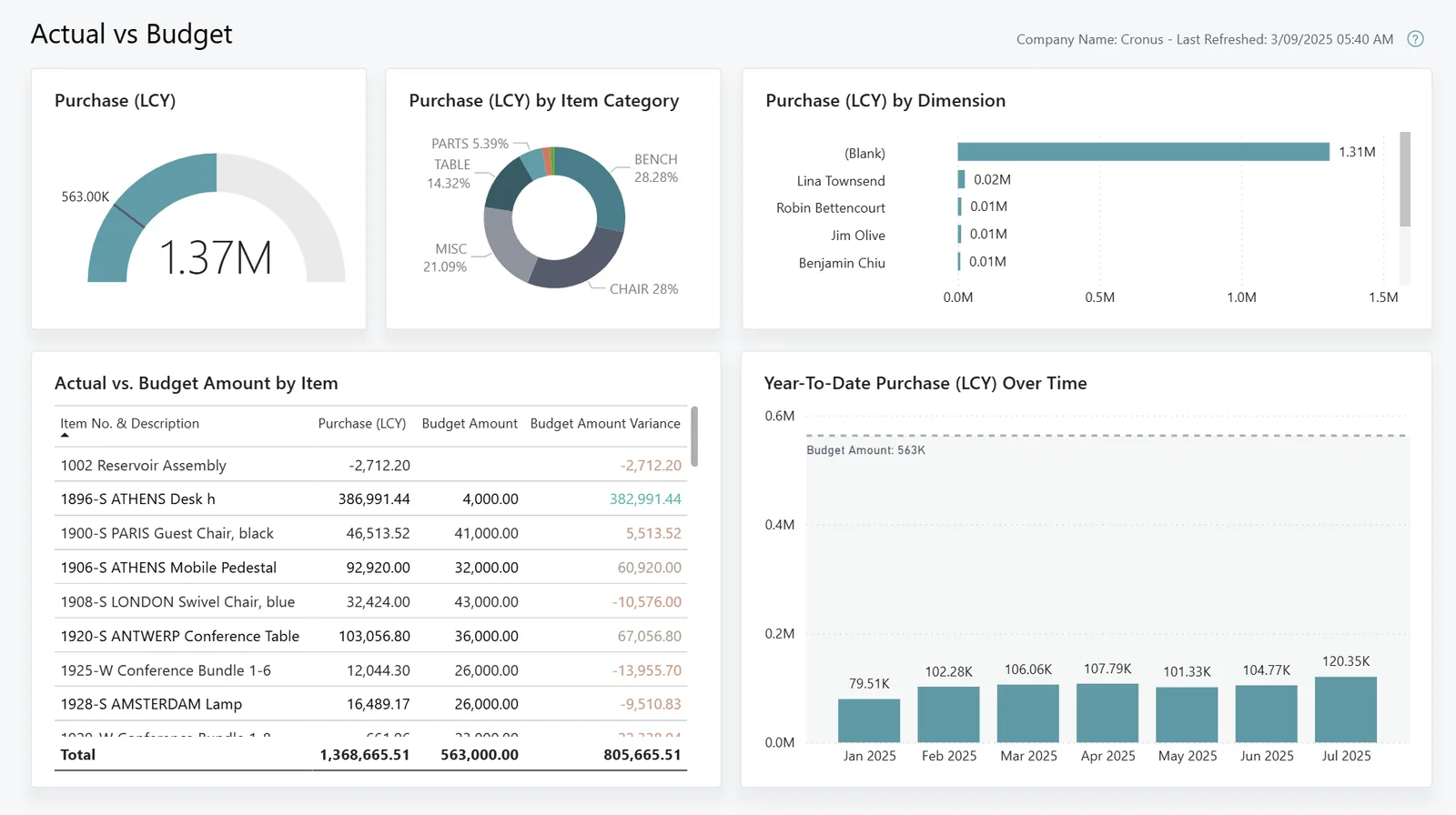
Most of these figures come straight from standard purchase reports once POs and receipts are recorded in the system. The work is in agreeing definitions and making sure every purchase goes through a PO.
Agree these definitions with procurement and finance before building anything. Most arguments about dashboards are really arguments about definitions.
| KPI | What it shows | Source data | Review frequency |
|---|---|---|---|
| PR to PO cycle time | Days from approved requisition to issued PO; shows buyer workload and RFQ delays | PR approval date, PO date | Weekly |
| Approval wait time | How long PRs and POs sit with each approver | Approval log with timestamps | Daily |
| Open PO value | Committed spend not yet received | Open PO lines x unit price | Daily |
| Supplier on-time delivery | Share of PO lines received on or before the promised date | PO promised date, GRN date | Monthly |
| Supplier fill rate | Quantity received versus quantity ordered | PO lines, GRN lines | Monthly |
| Received not invoiced (GRNI) | Goods received with no supplier bill yet; an accrual and a VAT recovery risk | GRN, supplier invoice | Weekly, and at month end |
| Invoice price variance | Supplier invoice price above PO or price list | Three-way match results | Weekly |
| Spend under contract | Share of spend placed against agreed price lists or framework agreements | PO lines flagged to a contract or price list | Monthly |
| Emergency or after-the-fact POs | POs dated after the supplier invoice or flagged urgent; signals bypassed process | PO date versus invoice date, urgency flag | Monthly |
| Spend by supplier and category | Concentration and negotiation opportunities | Posted purchase invoices | Quarterly |
Every tile traces back to a document in the purchase cycle. If a step is done outside the ERP, the dashboard will be blind to it.
One shared database: every step updates stock, finance and reports in real time.
These are the data hygiene points we check first in UAE procurement teams.
The purchase module is the core source, but a useful procurement view usually pulls from a few more places. Our ERP dashboard solutions team connects these and keeps the definitions consistent.
We configure the system for the rules UAE businesses report against, and test it before go-live.
General information, not tax or legal advice. Confirm current requirements with the FTA, MOHRE or your advisor. See all UAE compliance guides.
On-site workshops in Dubai, Abu Dhabi and Sharjah, and remote or on-site delivery across the Northern Emirates and free zones.
Official sources and references
Facts on this page were checked against these sources in October 2026. Rules change, so confirm current requirements before acting.
Still have a question? Our consultants are happy to help.
Ask an ExpertZoho, Odoo, ERPNext and Dynamics 365 all record PRs or POs, receipts and supplier bills, so the raw data exists in each. Standard reports cover most of it; KPIs such as approval wait time or spend under contract usually need a custom report or a BI layer such as Power BI or Zoho Analytics.
This page is about the dashboard itself: KPIs, definitions and data flow. If you want to see how the whole system supports the person running purchasing day to day, see ERP for procurement managers.
Yes, if every PR and PO carries the project and cost code. Contractors usually add committed cost versus budget per project, which links to project procurement controls and the project cost reports.
Input VAT is generally recovered on a valid tax invoice from the supplier, so goods received without a bill are both an accrual for month end and a recovery you cannot yet claim. Tracking it helps AP chase missing invoices before the return period closes. Confirm the recovery rules for your situation with your tax advisor.
If the purchase cycle already runs in the ERP, a first version is often ready in two to four weeks. If POs are still raised in Excel, the real project is moving purchasing into the system first; the dashboard follows.
Some teams share a monthly scorecard of on-time delivery and fill rate with key suppliers. This can be exported from the dashboard or published through a supplier portal where your platform supports one.
Related Solutions
Related Industries
Related ERP Platforms
Share how your PRs, POs and receipts flow today and we will show you a procurement dashboard built on your own process.
Dubai, United Arab Emirates