L
O
A
D
I
N
G


Zoho, Odoo, ERPNext, Dynamics 365 and custom ERP, delivered by one accountable team.

Move QC from paper checksheets in a lab drawer into the ERP, where a failed test can stop a batch from being used or shipped.
An ERP manages manufacturing quality control by building inspections into incoming receipts, manufacturing operations and finished batches. Each inspection plan defines tests, samples and limits; results are recorded as values; and stock is blocked until QC accepts, rejects, reworks or grants a concession. Non-conformances link to batch, supplier, machine and order, so complaints can be traced quickly.
An ERP for manufacturing quality control in the UAE builds inspections into the transactions that move material: the goods receipt for incoming raw materials, the operations of a manufacturing order, and the output of finished batches. Each inspection has a plan (what to test, how many samples, which limits), a result, and a decision: accept, reject, rework or accept with concession. The ERP then enforces that decision on stock, so a rejected lot cannot be issued and an unreleased batch cannot be shipped.
Quality pressure in the UAE is real. Food plants answer to municipality food safety inspections and retailer audits. Building material and steel producers face product conformity requirements and main contractors asking for test certificates. Exporters to Saudi Arabia and the wider GCC need consistent documentation. Yet many plants still keep QC results on paper or in a lab spreadsheet that has no link to the batch in the ERP, so a recall or audit means searching through files.
This page focuses on operational QC on the factory floor. Document control, internal audits, CAPA programs and ISO certification support are covered in quality management software. For the wider set of plant processes, see manufacturing ERP processes.

These gaps usually surface during a customer complaint, a retailer audit or a failed shipment.
Lab results sit in a binder or spreadsheet. When a customer questions a batch, finding the test values takes hours and sometimes the sheet is missing.
A failed incoming test is noted, but the material is already in the store and gets issued to production. The defect then appears in finished goods.
Hourly weight, dimension or temperature checks are skipped when the line is behind. Nobody notices until the end-of-line inspection rejects a full pallet.
Rejected deliveries are returned informally, without a record per supplier. Buyers keep ordering from vendors with the worst rejection history.
Certificates of analysis or test certificates for customers are typed in Word for each shipment, with a risk of wrong batch numbers or values.
Defects are fixed on the spot but never analyzed. The same root cause, such as a worn mold or a wrong setting, comes back month after month.
Inspections are triggered by stock movements, and stock stays on hold until a decision is recorded.
One shared database: every step updates stock, finance and reports in real time.
QC data is only useful when it lives on the same item, batch and order records used by stores and production.
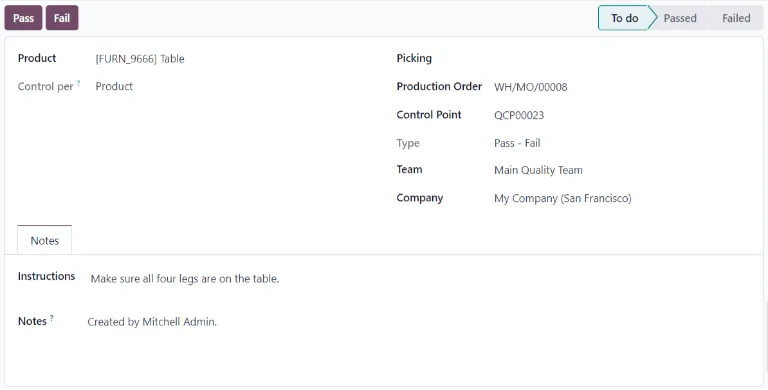
Parameters, methods, sample sizes and limits by item, supplier or operation.
Triggered by the goods receipt; results decide whether supplier lots move to approved stock.
Checks at defined operations or intervals, recorded by operators or QC inspectors on tablets.
End-of-line tests that release a batch for sale or hold it.
Results stored against batches, linked to supplier lots; see batch tracking.
Records of defects with disposition, root cause and corrective action owner.
Rejection rates per supplier feeding vendor evaluation and procurement control.
Certificates of analysis printed from recorded results for each shipped batch.
A quality dashboard shows the QC manager where defects come from and the plant manager what is on hold.
Quality depth varies widely between platforms and editions. Confirm the features for your edition before deciding.
| Zoho | Odoo | ERPNext | Dynamics 365 | |
|---|---|---|---|---|
| Inspection plans | Not native in Zoho Inventory; built as a Zoho Creator QC app | Quality control points by product, operation or picking type (Quality app, Enterprise) | Quality Inspection Templates with parameters and acceptance criteria | Test groups and quality associations in Finance and SCM; Business Central typically via an app |
| Incoming QC | Creator form linked to receipts | Checks triggered on receipts | Quality Inspection required before Purchase Receipt submission when configured | Quality orders generated on receipt |
| In-process QC | Creator checklists on tablets | Checks on work orders in the shop floor interface | Quality Inspection on Job Cards or manufacture entries | Quality orders on production operations |
| Hold and block | Hold warehouse with manual transfer | Quality alerts and blocked moves depending on setup | Rejected warehouse and inspection status on stock entries | Inventory blocking and quarantine orders |
| Non-conformance | Custom module in Creator | Quality alerts with root cause and corrective actions | Non Conformance doctype in the Quality module; see ERPNext quality management | Non-conformances and corrections in Finance and SCM |
| Best fit | Simple checks around light assembly | SMEs wanting QC on the shop floor tablet; see Odoo manufacturing | Process plants needing parameter-based tests | Larger plants with formal quality orders |
The fewer values typed by hand, the more reliable the record.
QC records are evidence for regulators, customers and auditors. Requirements depend on your product and emirate, so confirm them with the relevant authority.
Food manufacturers are inspected by municipal food safety authorities and expected to trace batches and act on recalls. Linking QC results to batches supports this; see ERP for food manufacturing.
Some regulated products need conformity certification before sale in the UAE. Keep certificates and test reports attached to the item and batch in the ERP.
Keep inspection results with the related receipts, orders and invoices for at least five years under Cabinet Decision 74 of 2023, and longer where your industry rules require.
Record who entered or changed a result and when. Restrict edits after release so results cannot be altered without a logged reason.
General information, not tax or legal advice. Rules change; confirm current FTA, MOHRE and Ministry of Finance guidance with your advisor.
The benefits show up in fewer escaped defects and faster answers to customers and auditors.
Stock blocks stop failed materials and unreleased batches from moving forward.
Batch results and supplier lots are available in minutes when a customer raises an issue.
Rejection rates per supplier are measured, not remembered, including for subcontracted operations.
Early in-process checks catch drift before a whole batch fails, which reduces scrap.
QC is often rolled out stage by stage, starting with final release. Durations are typical ranges.
Durations are typical ranges; your plan is agreed after discovery.
Collect current checksheets, specifications and test methods; agree parameters and limits.
Configure output holds and release so no batch ships without a result.
Link inspections to receipts for critical materials and set up quarantine.
Deploy tablet checklists at key operations and train operators.
Start monthly defect reviews using the ERP data and track corrective actions.
We configure the system for the rules UAE businesses report against, and test it before go-live.
General information, not tax or legal advice. Confirm current requirements with the FTA, MOHRE or your advisor. See all UAE compliance guides.
On-site workshops in Dubai, Abu Dhabi and Sharjah, and remote or on-site delivery across the Northern Emirates and free zones.
Official sources and references
Facts on this page were checked against these sources in October 2026. Rules change, so confirm current requirements before acting.
Still have a question? Our consultants are happy to help.
Ask an ExpertMany SMEs can run operational QC inside the ERP. A dedicated LIMS makes sense for labs with heavy instrument workflows, and a QMS for document control and audit programs. The ERP should still hold the release decision and key results per batch.
Yes, with tablet checklists showing only the parameters for that operation, numeric fields with limits highlighted, and gauges or scales sending values directly where possible.
The batch sits in a hold location or status until a release is recorded. Pick lists and deliveries only consider released stock, so a failed or untested batch cannot be picked.
Yes. A certificate template pulls the recorded results for the batch and prints or emails it with the delivery note or invoice.
Dynamics 365 Finance and SCM and Odoo Enterprise have the most built-in QC features; ERPNext has solid parameter-based inspections; Zoho usually needs a Creator app. We implement all four and recommend by fit.
Related Solutions
Related Industries
Related ERP Platforms
Share your current checksheets and specifications, and we will show how they would run as ERP inspections with holds and release.
Dubai, United Arab Emirates