L
O
A
D
I
N
G


Zoho, Odoo, ERPNext, Dynamics 365 and custom ERP, delivered by one accountable team.

What enterprise resource planning really means, how it evolved, what it contains and what can go wrong, written for UAE owners and managers rather than software specialists.
Enterprise resource planning (ERP) is a way of running a business on one shared system and database, where finance, sales, purchasing, inventory and HR work in modules of the same application. A transaction is recorded once and used everywhere. For UAE companies, ERP also provides the controls, audit trail and structured data needed for VAT, corporate tax, e-invoicing and WPS payroll.
Enterprise resource planning (ERP) is a way of running a business on one shared system and one shared set of data. Instead of finance, sales, purchasing, warehouse and HR each keeping their own records, every department works in modules of the same application. When a salesperson confirms an order, the warehouse sees what to pick, purchasing sees what to reorder and finance sees the receivable, without anyone retyping it. That is the core idea of enterprise resource planning in the UAE or anywhere else: record a business event once and let every function use it.
The "resources" in the name are money, materials, people, equipment and time. The "planning" refers to the system's original purpose of calculating what a manufacturer needed to buy and make. Today ERP covers far more than planning, but the principle of one integrated record remains.
For UAE companies, ERP has an extra role: it is where VAT, corporate tax and soon e-invoicing data originates. This guide covers the history, key concepts, typical modules, benefits, risks and a glossary. For help choosing a system, see ERP Software UAE or Best ERP Software UAE.

ERP is powerful, but projects fail in predictable ways. Knowing the risks is the best protection against them.
Putting a confusing approval chain into software makes it faster to be confused. Processes should be simplified before they are configured.
Duplicate customers, inconsistent item codes and unreconciled balances carried into a new ERP undermine trust in every report from day one.
Changing the software to match every habit makes upgrades expensive and ties you to the developer who wrote the changes.
When ERP is treated as an IT project, departments do not commit to decisions, and the system goes live without agreed ways of working.
Users who learn only in a single session before go-live revert to spreadsheets within weeks. Training should be role-based and repeated.
The partner's understanding of your industry and UAE requirements often matters more than any single feature on a vendor's list.
Whatever the brand, a true enterprise resource planning system is built on these ideas. If a product lacks them, it is a departmental tool, not an ERP.
One customer master, one item master and one ledger, used by every module, so figures agree across departments.
Each document links to the one before it: quotation to order, order to delivery, delivery to invoice, invoice to payment.
Operational events post to the general ledger automatically, so stock movements and sales update the books in real time.
Roles limit who can do what, approvals enforce policy, and every change is logged for auditors.
Several companies, branches and currencies in one system, with intercompany transactions and consolidation.
Management reports and dashboards read directly from transactions instead of manually compiled spreadsheets.
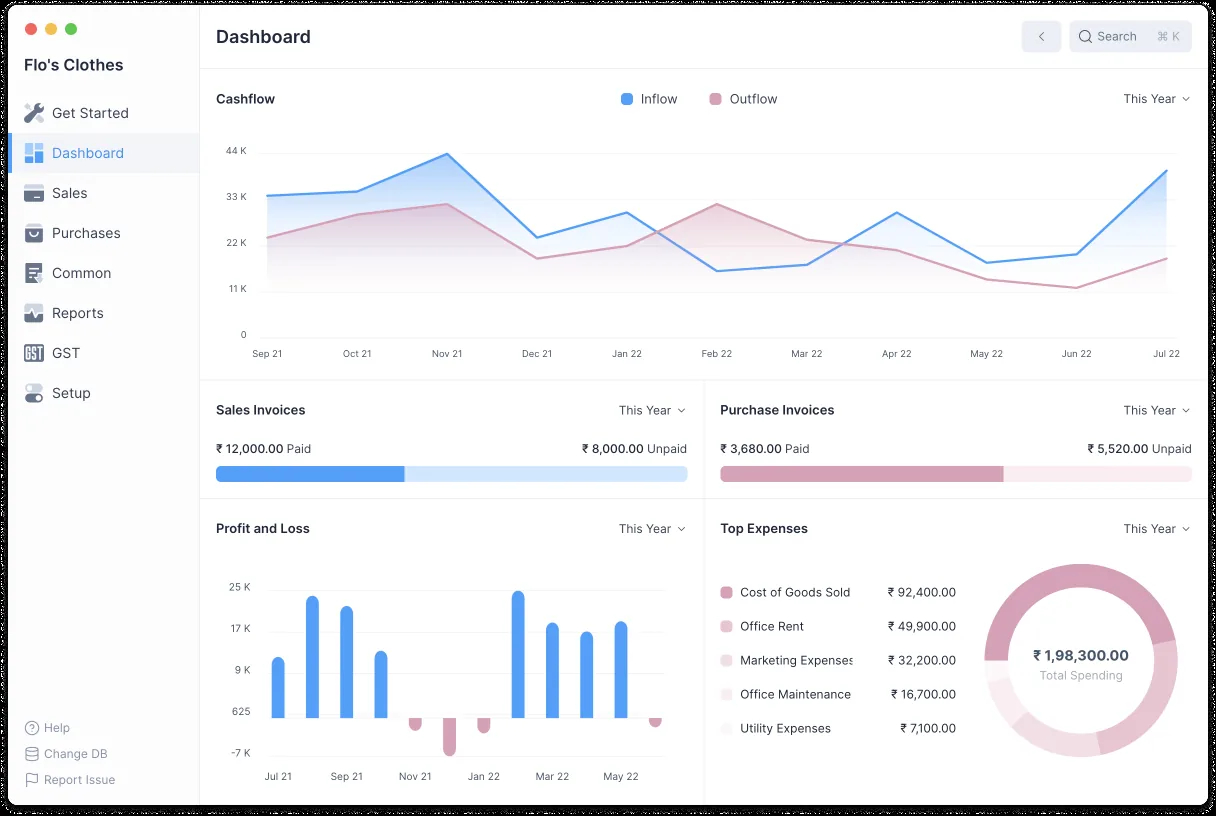
Because every module writes to the same database, one finance view can show results driven by sales, purchasing and inventory at the same moment.
A short glossary of common enterprise resource planning terms, with notes on why each matters to UAE businesses.
| Term | Meaning | Why it matters in the UAE |
|---|---|---|
| Chart of accounts | The list of ledger accounts used to classify transactions | Should separate VAT, non-deductible items and free zone income streams for tax reporting |
| Master data | Core records such as customers, suppliers, items and employees | Customer and supplier TRNs must be held here for compliant invoices |
| Module | A functional area of the ERP, such as sales or payroll | Lets you phase a rollout, starting with finance and adding others |
| Workflow | A defined sequence of steps and approvals | Enforces spending limits and segregation of duties |
| Costing method | How inventory value is calculated (for example FIFO or weighted average) | Affects gross margin and taxable income |
| Consolidation | Combining results of several entities into group reports | Common for groups with mainland and free zone companies |
| Go-live | The date the business starts working in the new system | Often aligned to the start of a VAT quarter or financial year |
| Customization vs configuration | Changing code vs changing settings | Configuration is cheaper to maintain through upgrades |
| Peppol / PINT AE | The network and data specification for UAE e-invoicing | ERP must produce structured invoices for an Accredited Service Provider |
ERP did not appear fully formed. It grew in stages over several decades.
Durations are typical ranges; your plan is agreed after discovery.
Early computer systems calculated which materials manufacturers needed and when, based on production plans and bills of materials.
Planning expanded to include capacity, shop floor control and links to costing and finance.
Analysts began using enterprise resource planning for systems that integrated finance, HR, sales and supply chain across the whole company.
Browser access and subscription models brought ERP within reach of mid-sized and small businesses, including open-source options.
VAT from 2018, corporate tax from 2023 and e-invoicing from 2027 turned ERP into the core of tax compliance for UAE businesses.
Tax authorities increasingly expect data to come straight from business systems. Confirm specific treatments with your tax advisor.
The 5% VAT administered by the FTA since 2018 depends on correct tax codes on every sales and purchase transaction, which the ERP applies and reports for EmaraTax returns.
Federal Decree-Law No. 47 of 2022 applies 9% above AED 375,000 of taxable income. ERP ledgers and adjustments form the basis of the calculation.
Under Ministerial Decisions No. 243 and 244 of 2025, invoices will flow in PINT AE format through Accredited Service Providers, starting 1 January 2027 for larger businesses and 1 July 2027 for others. Check the latest Ministry of Finance / FTA guidance.
ERP payroll modules produce the Salary Information File for MOHRE's Wage Protection System and calculate end-of-service gratuity under Federal Decree-Law No. 33 of 2021.
General information, not tax or legal advice. Rules change; confirm current FTA, MOHRE and Ministry of Finance guidance with your advisor.
Benefits depend on how well the system is implemented and adopted, but these are the most consistent.
Sub-ledgers post automatically, so closing is about review rather than collecting data.
Live quantities and reorder rules reduce both stock-outs and excess inventory.
Approvals and audit trails reduce errors and make external audits smoother.
Managers see margins, cash and orders as they are today, not as they were last month.
Go deeper into modules, platforms, costs and implementation.
We configure the system for the rules UAE businesses report against, and test it before go-live.
General information, not tax or legal advice. Confirm current requirements with the FTA, MOHRE or your advisor. See all UAE compliance guides.
On-site workshops in Dubai, Abu Dhabi and Sharjah, and remote or on-site delivery across the Northern Emirates and free zones.
Official sources and references
Facts on this page were checked against these sources in October 2026. Rules change, so confirm current requirements before acting.
Still have a question? Our consultants are happy to help.
Ask an ExpertAccounting software records financial transactions. Enterprise resource planning covers the operations that create those transactions too, such as sales orders, purchasing, inventory, production, projects and payroll, all sharing one database.
Most start with accounting, sales, purchasing and inventory. Manufacturers add production and quality, contractors add projects and job costing, and service firms add timesheets and billing. HR and payroll with WPS support often follow. See our ERP modules overview.
No. Cloud subscriptions and open-source platforms have made ERP practical for small and mid-sized UAE companies, often starting with a handful of users and a limited scope.
It varies widely. A focused rollout for a small company may take around 6-10 weeks, while multi-company projects with manufacturing or heavy integration can run for several months.
We implement Zoho, Odoo, ERPNext, Microsoft Dynamics 365 and custom ERP. We do not implement SAP, NetSuite, QuickBooks, Tally or Sage, but we migrate data from them and can compare them honestly.
ERP stands for enterprise resource planning. The name comes from its roots in manufacturing planning, even though modern systems cover finance, sales, HR and much more.
Related Solutions
Related Industries
Related ERP Platforms
Speak with our Dubai consultants for a plain-English assessment of what enterprise resource planning could change in your company.
Dubai, United Arab Emirates