L
O
A
D
I
N
G


Zoho, Odoo, ERPNext, Dynamics 365 and custom ERP, delivered by one accountable team.

The material request is the first document in the site supply chain. Get it right and the store, the buyer and the QS all work from the same number.
Construction material request software replaces WhatsApp messages, indent books and Excel sheets with one material request per need, tied to the project, BOQ line and activity. The system checks the remaining BOQ quantity and site and yard stock before any purchase, applies approval rules by value and item type, and converts only the shortfall into a purchase requisition.
On most UAE construction projects, the day starts with a foreman telling the site engineer what the crew will need tomorrow: 40 bags of OPC cement, two bundles of 12mm rebar, 200 blocks, binding wire. That need becomes a material request (MR), sometimes called a site indent. Construction material request software replaces the WhatsApp message, the handwritten indent book and the Excel sheet emailed to the store with one controlled document that carries the project, the BOQ item, the activity, the required date and the delivery location.
The MR is not a purchase document. It is a demand. Its job is to tell the organization what the site needs and when, so the storekeeper can decide whether to issue from the site store, transfer from the central yard in Al Quoz or Mussafah, or pass the shortfall to procurement as a purchase requisition. Mixing those steps up is where most contractors lose control: sites order directly from suppliers, the yard holds the same item, and the project pays twice.
This page covers the request stage only: how an MR is raised, validated against the BOQ and budget, approved, fulfilled and closed. The wider picture of stock, wastage and reconciliation sits on our construction material management page, and buying from suppliers is covered under construction procurement software.

These are the patterns we see when a contractor still runs site requests on paper, chat groups or spreadsheets.
The storekeeper gets the same request from the foreman, the site engineer and the project manager, each with a slightly different quantity. Nobody knows which one is final, so either nothing ships or it ships three times.
Sites can request 30% more tiles than the BOQ allows and nobody notices until the QS reconciles at the end of the package. By then the overrun is spent and cannot be recovered from the client.
The site raises a request, the buyer issues a PO, and two weeks later someone finds the same item in the central store from a finished project. Without a stock check at MR stage, purchasing has no reason to look.
When a pour is scheduled for tomorrow morning, the site buys from a local trader with petty cash. The cost lands on the wrong project or in general overheads, and the VAT invoice is often missing.
Material issued to a subcontractor for their scope is rarely recorded against their account. When their final bill comes, there is no basis to recover excess consumption.
Partially delivered MRs stay open for months, so the open-demand report is useless and the planner cannot tell what is still outstanding for the next activity.
This is the flow we configure for contractors and fit-out companies. The stock check and BOQ check happen before procurement ever sees the request.
One shared database: every step updates stock, finance and reports in real time.
A material request touches several parts of the ERP. These are the pieces that need to be set up together.
Header with project, site, required date and delivery point; lines with item, unit, quantity, BOQ reference and activity or cost code.
Each line checks the remaining BOQ or budgeted quantity for that item, so over-requests are flagged before approval.
Rules by value, item category (for example steel, MEP equipment) and over-BOQ quantity, with escalation if the approver does not act in time.
Central yard, site stores and in-transit locations, so the storekeeper sees what can be transferred before anything is bought.
Transfer notes from yard to site and material issue notes from site store to activity or subcontractor, each referencing the MR.
Unfulfilled quantities convert into a requisition for procurement with the MR number carried through to the PO and GRN.
Site engineers raise and track requests from a phone, attach photos or drawings and see delivery status without calling the store.
Issued material is charged to the project and cost code at valuation, so the cost report updates as soon as material leaves the store.
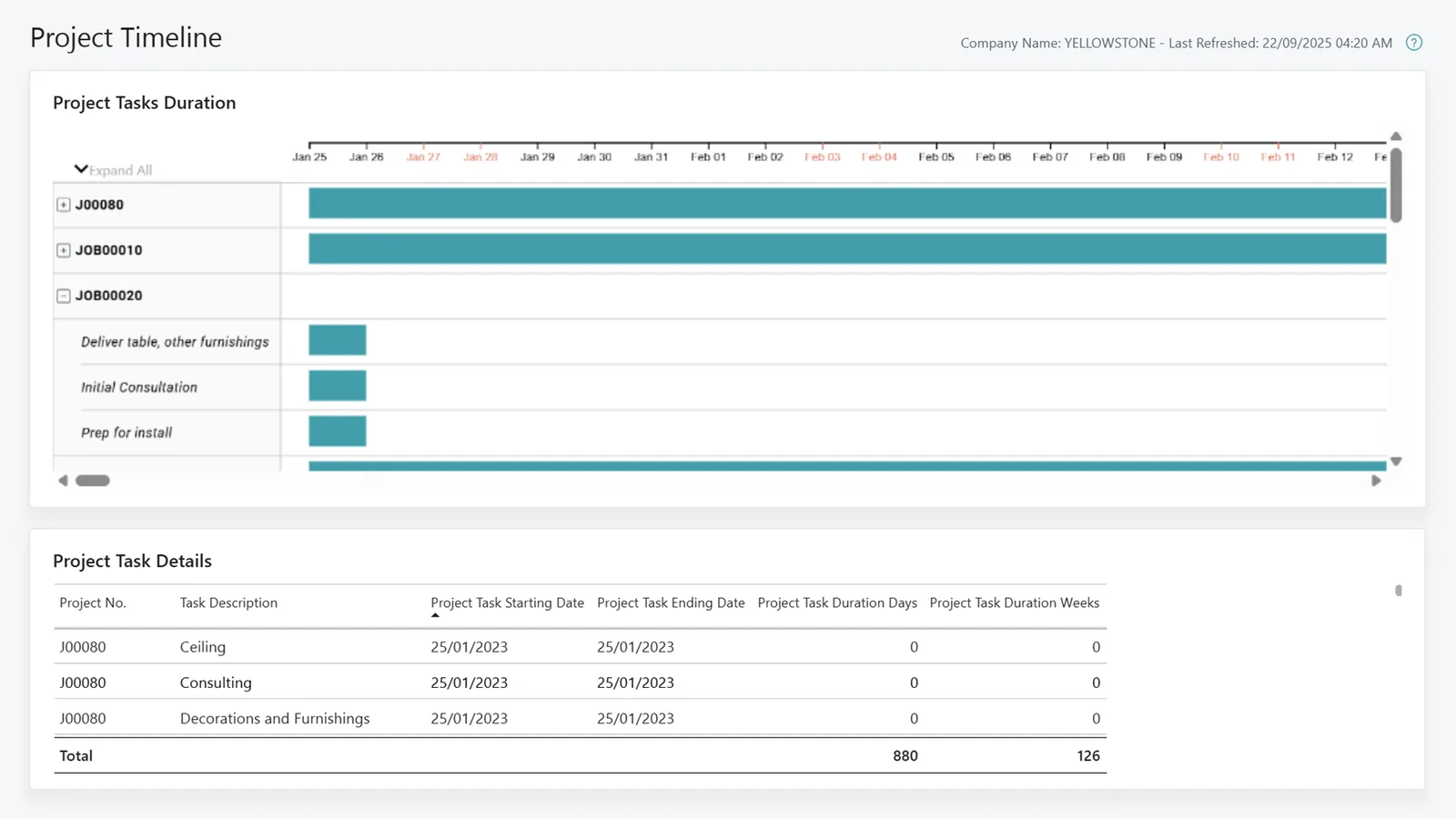
These views are for the store manager, the procurement lead and the project manager. Run them daily on active projects.
All four can run a controlled MR process. The difference is how much is native and how much needs configuration or a small custom app. Confirm details for your edition.
| Zoho | Odoo | ERPNext | Dynamics 365 | |
|---|---|---|---|---|
| Material request document | Usually built as a Zoho Creator app or custom module linked to Zoho Inventory and Projects | Typically added through a community purchase request app or a custom module | Native Material Request doctype with Purchase, Material Transfer and Material Issue types | Business Central uses job planning lines and requisition worksheets; Finance and Operations has purchase requisitions and item requirements |
| Link to project and BOQ | Project reference via custom fields; BOQ check needs custom logic | Analytic account per project; BOQ quantity check usually customized | Project and cost center on each line; BOQ check via budget or custom validation | Job task and planning lines can hold budgeted quantities per job |
| Approval rules | Approval workflows in Creator or Books, by value or field conditions | Approval steps configurable; complex rules often via Studio or code | Workflow with states and roles, conditions per field | Approval workflows with conditions; Power Automate for complex routing |
| Stock check across locations | Multiple warehouses in Zoho Inventory | Multi-warehouse with routes and transfers | Warehouse tree with projected quantity per location | Locations and transfer orders |
| Convert shortfall to purchase | Manual or scripted conversion to a purchase order | Can generate RFQs from requests | Make Purchase Order or Request for Quotation from the MR | Requisition worksheet creates purchase orders |
| Mobile entry for site staff | Zoho Creator mobile apps | Odoo mobile web and app | Responsive web and Frappe mobile app | Business Central mobile app or a Power Apps form |
Platform capabilities change with releases. We confirm the current edition during discovery.
Requests sit between planning, stores and suppliers, so they connect to more systems than people expect.
The MR itself has no tax impact, but the documents it triggers do. Confirm specific treatments with your tax advisor.
When urgent requests are bought locally, the system should insist on a valid tax invoice with the supplier TRN so input VAT at 5% can be claimed. Routing every purchase back to an approved MR makes that check routine.
Under the Peppol-based PINT AE model, larger businesses move to mandatory e-invoicing from 1 January 2027 and others from 1 July 2027 (check the latest Ministry of Finance / FTA guidance). An MR-to-PO-to-GRN chain makes matching structured supplier invoices much easier. See e-invoicing for construction companies.
Tax records must generally be kept for at least five years. MRs, transfer notes and issue notes are part of the audit trail that supports project cost claims.
Transfers between a free zone yard and a mainland site can have customs and VAT implications. Configure separate locations so these movements are visible and reviewed.
General information, not tax or legal advice. Rules change; confirm current FTA, MOHRE and Ministry of Finance guidance with your advisor.
We do not quote percentages. These are the outcomes site and office teams usually notice first.
The yard is checked before procurement sees a request, so idle stock gets used instead of reordered.
Over-BOQ requests surface at approval, while there is still time to query the cause or raise a variation.
Engineers see status on their phone, so the storekeeper spends less time answering the same question.
Material is charged to the right project and cost code when issued, not reallocated at month end.
Ranges are typical for a contractor with a few active sites; scope and data quality move them.
Durations are typical ranges; your plan is agreed after discovery.
Walk through the current indent process with site engineers, storekeepers and buyers, and agree approval rules.
Clean the item master, units of measure and BOQ references so requests can be checked against them.
Build the MR form, approvals, locations, transfer and issue flows, and the hand-off to purchasing.
Run one live project on the new process, adjust rules, then train the remaining sites.
Add sites in waves and review the open-MR and overrun reports monthly.
We configure the system for the rules UAE businesses report against, and test it before go-live.
General information, not tax or legal advice. Confirm current requirements with the FTA, MOHRE or your advisor. See all UAE compliance guides.
On-site workshops in Dubai, Abu Dhabi and Sharjah, and remote or on-site delivery across the Northern Emirates and free zones.
Official sources and references
Facts on this page were checked against these sources in October 2026. Rules change, so confirm current requirements before acting.
Still have a question? Our consultants are happy to help.
Ask an ExpertA material request is the site's demand for material, whatever the source. A purchase requisition is the internal request to buy, raised only for the quantity that cannot be supplied from stock. Keeping them separate is what stops sites from buying items that are already in the yard.
Both can, with different rights. Many contractors let foremen draft requests on a phone and require the site engineer to submit them, so there is one accountable person per request.
Add an urgent flag with a short approval path, for example project manager only, and a separate report of urgent requests per site. If one site raises far more urgent MRs than others, that is a planning issue worth discussing.
Ideally both. The BOQ check catches quantity overruns on specific items; the budget control check catches value overruns on cost codes. Most contractors start with the BOQ quantity and add value checks later.
Issue it against the subcontractor as well as the project, with an allowance from their contract. The issue history then supports deductions in their payment certificate; see subcontractor management.
ERPNext has the most complete native document for this, while Odoo, Zoho and Dynamics 365 handle it well with configuration. The right choice depends on the rest of your stack; our construction ERP overview compares them for contractors.
Related Solutions
Related Industries
Related ERP Platforms
We map your current indent process and show how material requests would flow from site to store to supplier in your ERP.
Dubai, United Arab Emirates