
L
O
A
D
I
N
G


Zoho, Odoo, ERPNext, Dynamics 365 and custom ERP, delivered by one accountable team.

Give site engineers, buyers and the QS one procurement flow where every LPO carries a project, a cost code and a budget check.
Construction procurement software for UAE contractors links every purchase to a project and cost code: site material requests, requisitions checked against budget, RFQs to approved suppliers, a comparison statement, LPO approval by value, site GRN and a three-way match before supplier payment. This replaces WhatsApp and Excel workflows and lets the QS see commitments before invoices arrive.
A trading company buys stock for a warehouse. A contractor buys specific quantities for a specific site, often to an approved material submittal, with a delivery window set by the program and a consultant who may reject what arrives. Construction procurement software has to handle all of that: project-coded requests, competitive quotes, comparison statements, approval by value, delivery to site and payment only for what was received and accepted.
In many UAE contractors the flow still runs on WhatsApp and email. A site engineer messages the procurement office, a buyer collects three quotes, a comparison is made in Excel, and an LPO is typed in the accounting system with a project name in the description. The QS discovers the commitment when the invoice arrives. General procurement software covers the basics, but contractors need the project and budget link at every step.
This page covers buying. The upstream request from site is detailed on construction material request software, and what happens to stock after delivery is on construction inventory software.
Most procurement losses are not fraud. They are missing controls and missing information.
Buyers place LPOs without seeing how much of the cost code is already committed. Overruns surface only at invoice stage.
Quotes compare on unit price only, ignoring delivery terms, payment terms and whether the product matches the approved submittal. The comparison is not saved with the order.
Site pressure leads to verbal orders that are regularized later. Duplicate deliveries and disputes over price follow.
Delivery notes stay in the site office drawer, so accounts pays the supplier on invoice without proof of quantity received or rejected.
Chillers, switchgear, lifts and facade systems have long lead times. Without dates in the system, a late shipment is discovered when the activity is due to start.
Each step is a document in the ERP, linked to the one before, so the audit trail is complete.
One shared database: every step updates stock, finance and reports in real time.
These modules work together so a buyer sees budget, stock and supplier history while ordering.
Site requests coded to project, activity and cost code, with required-on-site date.
Requisition amount checked against remaining budget for the cost code; warn or block per policy.
RFQs to multiple suppliers, bids recorded, comparison statement with selected supplier and reason.
LPOs with project, delivery address of the site, payment terms and approval history.
Prequalified supplier list by category, trade license and TRN, with performance notes.
GRN on site against the LPO, including partial deliveries and rejections.
Invoice matched to LPO and GRN; differences routed to the buyer before posting.
Promised dates, shipment status and long-lead tracking per order line.
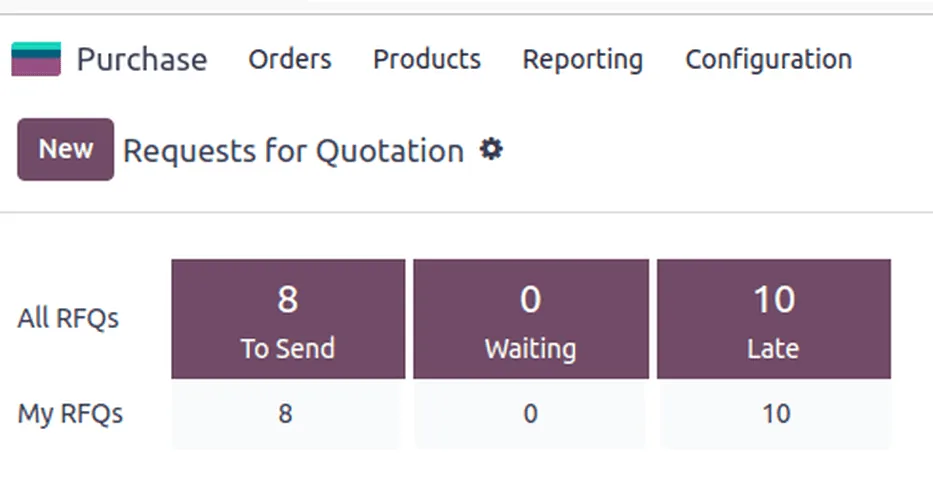
A buyer's daily list and a manager's control view come from the same data. See also the procurement dashboard page.
All four have mature purchasing. The construction-specific parts are project coding, budget checks and site receipts. Confirm for your edition.
| Zoho | Odoo | ERPNext | Dynamics 365 | |
|---|---|---|---|---|
| Material request | Custom form in Zoho Creator or purchase request flow | Purchase requisition or custom request linked to project | Standard Material Request doctype with project | Requisition worksheets or purchase requisitions |
| RFQ and comparison | Basic quote capture; comparison often custom | RFQ and call for tenders/purchase agreements; compare bids | Request for Quotation and Supplier Quotation comparison report | Purchase quotes; RFQ management stronger in Finance and Supply Chain |
| Budget check on order | Custom validation | Budget reports with analytic accounts; blocking usually custom | Budget with actions on Material Request and Purchase Order | Project budget comparison; blocking via approvals or extension |
| Approval matrix | Zoho Books approvals and Zoho Flow | Purchase approval rules by amount; finer rules via Studio | Workflow by role and value | Approval workflows in Business Central |
| Site GRN and 3-way match | Purchase receives in Zoho Inventory | Receipts with bill control on received quantities | Purchase Receipt and billing against receipt | Receipts and invoice matching |
| Fit | Small contractors with simple buying | Mid-size contractors needing all-in-one | Contractors wanting strong standard material request | Larger groups with complex approvals |
Common connections for contractors with multiple sites and suppliers.
Procurement creates the documents that VAT and audit rely on. Confirm tax points with your advisor.
Record each supplier's TRN and require valid tax invoices before recovering input VAT. Store them against the LPO and GRN.
Imported materials carry import VAT and customs paperwork; services from abroad usually fall under reverse charge. Separate tax codes keep the VAT return mapping correct.
From the mandatory phases (1 January 2027 for revenue of AED 50 million or more, 1 July 2027 for others), supplier invoices will arrive as PINT AE data through Accredited Service Providers. Matching them to LPOs automatically depends on suppliers quoting your PO number. Check the latest MoF and FTA guidance.
Keep RFQs, comparisons and approvals for at least five years. They are also what internal audit asks for when a project overruns.
General information, not tax or legal advice. Rules change; confirm current FTA, MOHRE and Ministry of Finance guidance with your advisor.
Benefits contractors usually target, without promised percentages.
Every approved LPO shows in the cost report immediately.
Comparison statements and reasons are stored with the order.
Payment follows site-confirmed quantities and agreed prices.
Promised dates against program dates flag risk weeks ahead.
Typical ranges for a contractor with several live sites.
Durations are typical ranges; your plan is agreed after discovery.
Map request-to-pay steps, approval limits and supplier categories.
Set up requests, RFQs, budget checks, approvals and GRN on mobile.
Import supplier master with TRNs and open LPOs per project.
Train storekeepers and engineers site by site, then switch off email ordering.
We configure the system for the rules UAE businesses report against, and test it before go-live.
General information, not tax or legal advice. Confirm current requirements with the FTA, MOHRE or your advisor. See all UAE compliance guides.
On-site workshops in Dubai, Abu Dhabi and Sharjah, and remote or on-site delivery across the Northern Emirates and free zones.
Official sources and references
Facts on this page were checked against these sources in October 2026. Rules change, so confirm current requirements before acting.
Still have a question? Our consultants are happy to help.
Ask an ExpertThe tender and award steps are similar, but subcontracts need certificates, retention and back-charges. We handle them in a separate flow described on construction subcontractor management.
Yes. All four platforms support mobile or browser-based requests and GRNs, so requests come with project and cost code from the start.
We set an emergency route with a lower limit and post-approval within a set time, so urgent buying stays visible instead of bypassing the system.
It can require a minimum number of supplier quotations above a value threshold before an LPO is approved, with an override reason recorded.
Yes. Each legal entity keeps its own suppliers, TRN and ledgers, while group procurement can view combined spend. Our procurement control page covers policy design.
Related Solutions
Related Industries
Related ERP Platforms
We will map your request-to-pay flow and show where budget checks and site receipts fit in your chosen ERP.
Dubai, United Arab Emirates










